


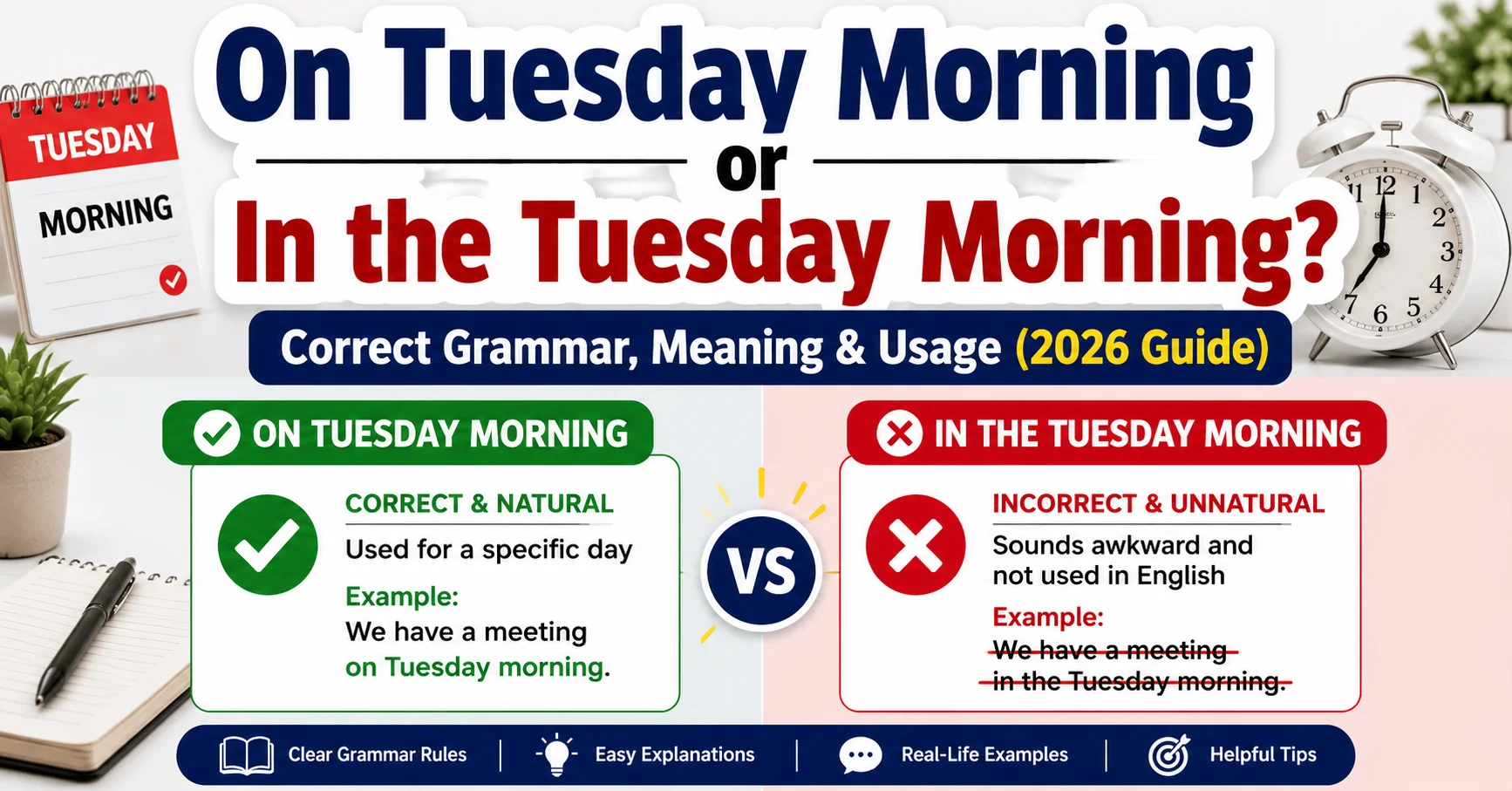
Have you ever stopped while writing and wondered whether to say “on Tuesday morning or in the Tuesday morning”? You are not alone. Many English learners and even native speakers get confused by these small grammar details.
The good news is that the answer is simple once you understand the rule. In most situations, “on Tuesday morning” is correct, while “in the Tuesday morning” usually sounds unnatural or wrong.
Still, there are a few special cases that can make the topic confusing. That is why this guide explains everything in clear and simple language. You will learn grammar rules, real examples, common mistakes, and easy tips you can remember forever.
By the end of this article, you will confidently know when to use “on Tuesday morning or in the Tuesday morning” correctly in everyday English.
Why People Get Confused About “On Tuesday Morning or In the Tuesday Morning”
English prepositions can feel tricky because small words often change the meaning of a sentence. Words like “on,” “in,” and “at” seem tiny, but they follow specific grammar patterns.
Many learners know that we say:
- “in the morning”
- “on Tuesday”
So when both ideas combine, people naturally wonder whether they should say:
- “on Tuesday morning”
or - “in the Tuesday morning”
The confusion happens because both “on” and “in” are commonly used with time expressions. But English follows a clear rule here. When a specific day is mentioned, we normally use “on.”
That is why native speakers almost always say:
- “I will call you on Tuesday morning.”
Instead of:
- “I will call you in the Tuesday morning.”
The second version sounds unnatural because “Tuesday morning” already acts as a specific time period connected to a day.
The Correct Phrase: “On Tuesday Morning”
The grammatically correct and natural phrase is usually “on Tuesday morning.”
English uses “on” for specific days and dates. Since “Tuesday morning” includes a specific day, the correct preposition becomes “on.”
Examples
| Correct Sentence | Why It Works |
|---|---|
| We met on Tuesday morning. | Specific day |
| The package arrived on Tuesday morning. | Refers to one morning |
| She called me on Tuesday morning. | Natural English usage |
This structure is widely accepted in both spoken and written English. You will hear it in schools, offices, movies, emails, and news reports.
If you want your English to sound natural, this is the phrase you should remember.
Is “In the Tuesday Morning” Ever Correct?
In modern English, “in the Tuesday morning” is rarely used. Most native speakers avoid it because it sounds awkward and unnatural.
However, there are a few rare literary or old-fashioned situations where similar structures may appear. For example, a writer may use it for poetic style or emphasis.
Still, in daily conversation and professional writing, it is better to avoid it.
Compare These Sentences
| Sentence | Natural or Unnatural |
|---|---|
| I saw him on Tuesday morning. | Natural |
| I saw him in the Tuesday morning. | Unnatural |
| I exercise in the morning. | Natural |
Notice something important here:
- We use “in the morning” when speaking generally.
- We use “on Tuesday morning” when speaking about a specific day.
That simple difference helps you choose the right phrase every time.
Understanding the Grammar Rule Behind It
To fully understand “on Tuesday morning or in the Tuesday morning,” you need to know how English prepositions work with time.
Use “On” For:
- Days
- Dates
- Specific days with parts of the day
Use “In” For:
- Months
- Years
- General parts of the day
Here is an easy table to remember:
| Preposition | Used For | Example |
|---|---|---|
| On | Specific days | on Tuesday |
| On | Specific mornings | on Tuesday morning |
| In | General periods | in the morning |
| In | Months or years | in May, in 2026 |
Once you learn this pattern, choosing the correct phrase becomes much easier.
Why “On Tuesday Morning” Sounds More Natural
Native English speakers rely heavily on rhythm and common patterns. The phrase “on Tuesday morning” flows naturally because it matches standard English structure.
When someone says:
- “Let’s meet on Tuesday morning.”
Your brain instantly recognizes it as correct because you have probably heard it many times before.
But if someone says:
- “Let’s meet in the Tuesday morning.”
It feels strange because English speakers almost never use that pattern.
Language is not only about grammar rules. It is also about what sounds natural to native speakers. That is why exposure and practice matter so much.
Common Examples in Daily English
You will hear “on Tuesday morning” in many real-life situations. Here are some common examples.
School and Education
- The exam starts on Tuesday morning.
- Parents will meet teachers on Tuesday morning.
Workplace Conversations
- We have a meeting on Tuesday morning.
- The manager arrives on Tuesday morning.
Family and Friends
- My cousin visited on Tuesday morning.
- We left for the trip on Tuesday morning.
Travel Situations
- The flight departs on Tuesday morning.
- The train was delayed on Tuesday morning.
These examples show how naturally the phrase fits into everyday communication.
Common Mistakes People Make
Many English learners accidentally mix prepositions because they translate directly from their native language.
Here are the most common mistakes connected to “on Tuesday morning or in the Tuesday morning.”
| Incorrect | Correct |
|---|---|
| in Tuesday morning | on Tuesday morning |
| in the Tuesday morning | on Tuesday morning |
| at Tuesday morning | on Tuesday morning |
A helpful trick is this:
If the sentence includes a specific day, use “on.”
That simple rule fixes most mistakes instantly.
Difference Between “In the Morning” and “On Tuesday Morning”
This is where many learners finally understand the topic clearly.
“In the Morning”
This is general. It does not mention a specific day.
Example:
- I like jogging in the morning.
“On Tuesday Morning”
This is specific because it includes a day.
Example:
- I like jogging on Tuesday morning.
Here is a comparison table:
| Phrase | Meaning |
|---|---|
| in the morning | Any morning in general |
| on Tuesday morning | One specific morning |
Think of it this way:
- General time = in
- Specific day = on
That is the easiest rule to remember.
Can You Say “Tuesday Morning” Without a Preposition?
Yes, sometimes native speakers remove the preposition completely in casual speech.
For example:
- Tuesday morning works best for me.
- We are leaving Tuesday morning.
This is very common in spoken American English. The meaning remains clear even without “on.”
However, in formal writing, adding “on” is usually safer and more grammatically complete.
Casual vs Formal Usage
| Casual English | Formal English |
|---|---|
| We met Tuesday morning. | We met on Tuesday morning. |
| I’ll call you Tuesday morning. | I’ll call you on Tuesday morning. |
Both are correct, but the formal version sounds more polished.
Real-Life Conversation Examples
Learning grammar becomes easier when you see real conversations.
Example 1
Sarah: When is the interview?
Ali: It is on Tuesday morning.
Example 2
Teacher: When will you submit the project?
Student: I will submit it on Tuesday morning.
Example 3
Friend: Are you free tomorrow?
You: No, I am busy on Tuesday morning.
These examples sound natural because they follow standard English patterns.
Easy Memory Tricks for Beginners
If you keep forgetting whether to use “on Tuesday morning or in the Tuesday morning,” these tricks can help.
Trick #1: Specific Day = On
If the sentence mentions Monday, Tuesday, Wednesday, or another day, use “on.”
Example:
- on Friday evening
- on Monday afternoon
- on Tuesday morning
Trick #2: General Time = In
If no specific day appears, use “in.”
Example:
- in the morning
- in the afternoon
- in the evening
Trick #3: Read It Out Loud
Sometimes your ears notice mistakes faster than your eyes. Say the sentence aloud.
- “On Tuesday morning” sounds smooth.
- “In the Tuesday morning” sounds awkward.
That difference helps many learners remember the correct structure.
How Native Speakers Actually Use These Phrases
If you watch English movies, TV shows, YouTube videos, or interviews, you will notice something important:
Native speakers almost always say:
- on Tuesday morning
They rarely say:
- in the Tuesday morning
This matters because real English depends heavily on natural usage patterns. Even if something seems technically possible, people may never actually say it.
Learning natural English helps your speech sound fluent and confident.
Similar Expressions You Should Know
The same grammar rule works with other days too.
| Correct Expression | Example |
|---|---|
| on Monday morning | We met on Monday morning. |
| on Wednesday evening | The party starts on Wednesday evening. |
| on Friday night | They arrived on Friday night. |
| in the morning | I study in the morning. |
Once you learn one structure, you can use it with many other time expressions.
Why Prepositions Are Hard in English
Prepositions are difficult because English does not always follow strict logic. Many rules depend on common usage and patterns.
For example:
- We say “on the bus.”
- But we say “in the car.”
Similarly:
- We say “in the morning.”
- But “on Tuesday morning.”
This is why practice matters more than memorizing long grammar rules.
Reading English daily helps these patterns become natural over time.
Simple Practice Sentences
Try completing these sentences yourself.
| Sentence | Correct Answer |
|---|---|
| The meeting starts ___ Tuesday morning. | on |
| I usually exercise ___ the morning. | in |
| We arrived ___ Friday evening. | on |
| She studies best ___ the afternoon. | in |
These exercises help train your brain to recognize the correct preposition automatically.
How to Avoid This Mistake in Writing
If you write blogs, emails, essays, or social media posts, using the correct preposition improves your grammar instantly.
Here are some quick editing tips:
Check for Specific Days
If the sentence mentions a weekday, use “on.”
Keep Sentences Simple
Avoid overthinking grammar. Native English usually prefers shorter, cleaner structures.
Read Your Sentence Naturally
Ask yourself:
“Would I hear this in a movie or conversation?”
If the answer is no, the sentence may sound unnatural.
Formal vs Informal English Usage
Both formal and informal English prefer “on Tuesday morning.”
Still, the style can slightly change.
Formal Style
- The conference will begin on Tuesday morning.
Informal Style
- The conference starts Tuesday morning.
Both versions work well. The first sounds more professional, while the second feels more conversational.
Quick Summary Table
| Phrase | Correct? | Usage |
|---|---|---|
| on Tuesday morning | Yes | Standard English |
| in the Tuesday morning | No | Usually incorrect |
| in the morning | Yes | General time |
| Tuesday morning | Yes | Informal English |
This table gives you the full answer in seconds.
FAQs About “On Tuesday Morning or In the Tuesday Morning”
Is “on Tuesday morning” grammatically correct?
Yes, it is completely correct. English uses “on” for specific days and times connected to those days.
Why is “in the Tuesday morning” incorrect?
It sounds unnatural because “Tuesday morning” is a specific time expression. English normally uses “on” for specific days.
Can I say “Tuesday morning” without “on”?
Yes. In casual English, many people drop the preposition completely.
Example:
- I’ll see you Tuesday morning.
Do British and American English use the same rule?
Yes. Both British and American English generally prefer “on Tuesday morning.”
Should I use “in the morning” or “on Tuesday morning”?
Use “in the morning” for general situations and “on Tuesday morning” for a specific day.
Conclusion
Now you finally know the answer to the common grammar question: “on Tuesday morning or in the Tuesday morning.”
The correct and natural phrase is almost always “on Tuesday morning.” English uses “on” with specific days, while “in” is used for general periods like “in the morning.”
Although “in the Tuesday morning” may appear in rare literary situations, it sounds unnatural in modern everyday English. If you want your writing and speaking to sound fluent, stick with “on Tuesday morning.”
The easiest way to remember the rule is simple:
- Specific day = on
- General time = in
With enough practice, these patterns become automatic. Keep reading, listening, and speaking English regularly, and soon these grammar choices will feel easy and natural.
