


Have you ever typed “glueing” and seen a red spelling line appear under it? Many English learners and even native speakers get confused about Gluing vs Glueing because both words look possible. After all, the base word is “glue,” so adding “-ing” should logically create “glueing,” right?
English spelling rules can feel strange sometimes. Some words keep the silent “e,” while others drop it before adding “-ing.” That is why this topic creates confusion for students, writers, bloggers, and even professionals.
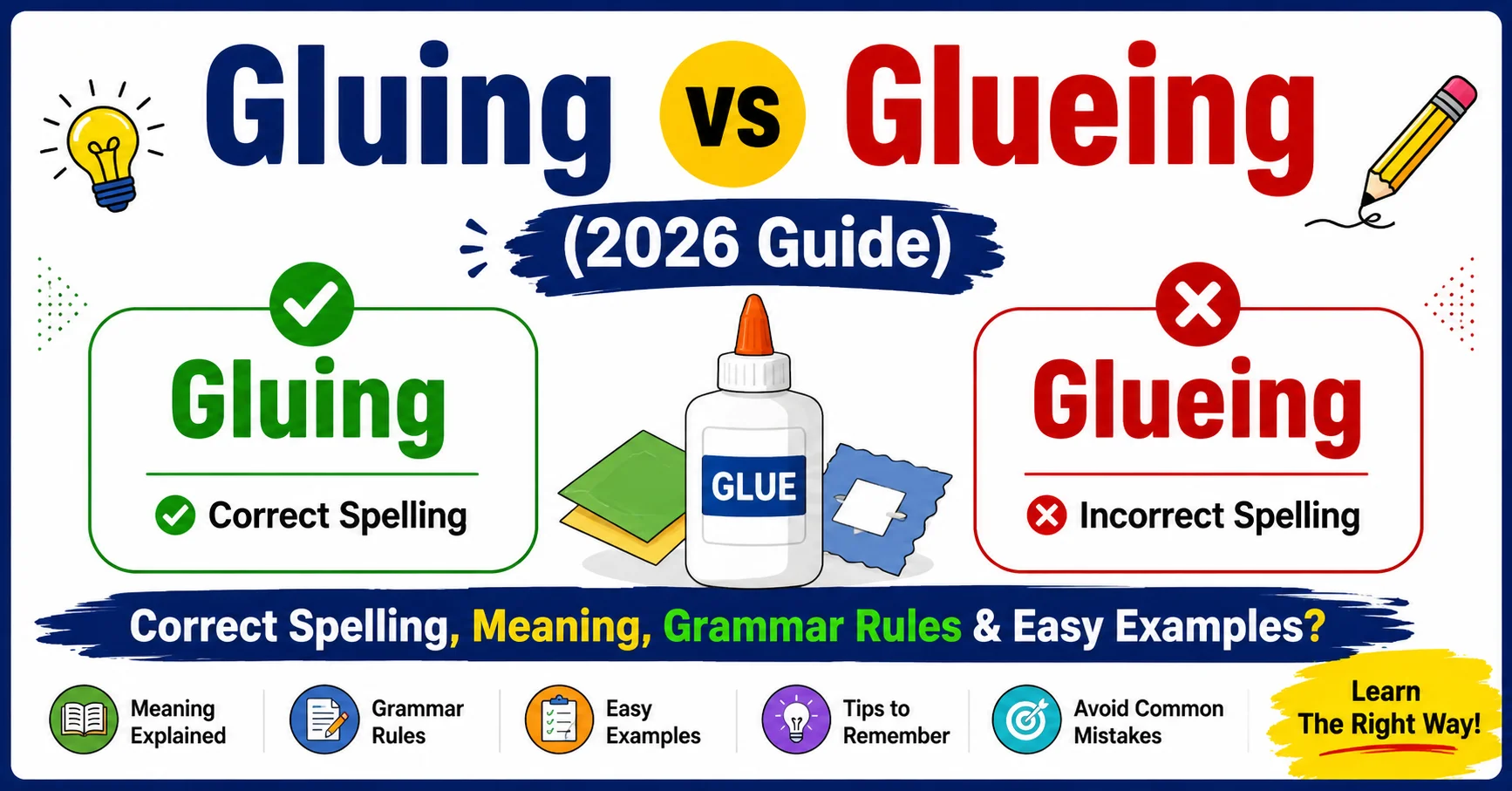
The short answer is simple: “gluing” is the correct spelling in modern English. “Glueing” is considered incorrect or outdated in most dictionaries and style guides.
Still, there is more to understand. Why is “gluing” correct? Why do some people still write “glueing”? Are both accepted anywhere? How can you remember the correct version easily?
In this complete Gluing vs Glueing guide for 2026, you will learn the meaning, spelling rules, grammar explanations, examples, common mistakes, and simple memory tricks. You will also see comparison tables and real-life examples to make everything easier.
What Does “Gluing” Mean?
The word “gluing” comes from the verb “glue.” It means joining or sticking things together using glue or adhesive.
People use the word in schools, crafts, construction, woodworking, art projects, and daily life. Whenever someone attaches two objects with glue, they are “gluing.”
Here are some simple examples:
- She is gluing paper onto the poster.
- The child spent an hour gluing pictures into a scrapbook.
- He is gluing broken parts together.
The word is often used as a present participle or gerund. That means it can act like a verb or noun depending on the sentence.
For example:
| Sentence | Usage Type |
|---|---|
| I am gluing the box. | Verb |
| Gluing takes patience. | Noun/Gerund |
| They were gluing decorations yesterday. | Continuous verb |
In modern English, “gluing” is the standard spelling accepted by dictionaries, schools, publishers, and grammar experts.
Is “Glueing” Ever Correct?
This is where many people become unsure in the Gluing vs Glueing debate.
Technically, “glueing” appeared in older texts many years ago. Some writers believed the full root word “glue” should stay unchanged before adding “-ing.” Because of that, they wrote “glueing.”
Today, however, most dictionaries list “glueing” as incorrect, rare, or outdated.
Modern English prefers simpler spellings. The extra “e” is usually removed before adding “-ing.” That is why “gluing” became the accepted standard.
Here is a quick comparison:
| Word | Status in Modern English |
|---|---|
| Gluing | Correct |
| Glueing | Incorrect or outdated |
If you are writing essays, blog posts, emails, books, or business documents, you should always use “gluing.”
Using “glueing” may make your writing look unprofessional or grammatically weak.
Why Do People Get Confused About Gluing vs Glueing?
The confusion happens because English spelling rules are not always consistent.
Many learners notice that the base word ends in “e”:
- glue
So they naturally think the “e” should remain:
- glue + ing = glueing
That logic seems reasonable. But English often drops the silent “e” before adding “-ing.”
For example:
| Base Word | Correct “-ing” Form |
|---|---|
| make | making |
| bake | baking |
| write | writing |
| use | using |
| glue | gluing |
This spelling rule helps words look cleaner and easier to read.
Still, some words keep the “e” because pronunciation could change without it. English is full of exceptions, which makes learning difficult sometimes.
I remember seeing “glueing” in an online forum years ago and thinking it looked more logical. But after checking dictionaries and grammar references, I realized modern English strongly prefers “gluing.”
That small discovery helped me understand English spelling patterns much better.
The Simple Grammar Rule Behind Gluing
The easiest way to remember Gluing vs Glueing is by learning one grammar rule.
Drop the silent “e” before adding “-ing.”
Here are common examples:
| Verb | Correct Form |
|---|---|
| dance | dancing |
| smile | smiling |
| drive | driving |
| move | moving |
| glue | gluing |
The final “e” disappears because it is silent.
So:
- glue → gluing ✅
- glue → glueing ❌
This rule applies in most cases across English grammar.
There are some exceptions, but “gluing” follows the normal and accepted pattern.
Why “Gluing” Looks Strange to Some People
Many people think “gluing” looks unusual because the letters “u” and “i” appear together.
Words with “ui” combinations are less common in English. That can make the spelling feel awkward at first glance.
Examples with similar patterns include:
- arguing
- pursuing
- valuing
Even though these words may look strange initially, they are completely correct.
“Gluing” follows the same spelling style.
The more you read and write the word, the more natural it feels.
Students often struggle with unfamiliar letter combinations. That is perfectly normal. Over time, your brain starts recognizing the correct pattern automatically.
Gluing vs Glueing in American and British English
Some spelling differences exist between American and British English. For example:
| American English | British English |
|---|---|
| color | colour |
| organize | organise |
| traveling | travelling |
However, Gluing vs Glueing is not one of those regional differences.
Both American and British English prefer “gluing.”
That means:
- United States → gluing
- United Kingdom → gluing
- Canada → gluing
- Australia → gluing
The spelling remains the same almost everywhere.
So if you are writing for an international audience, “gluing” is still the safest and most professional choice.
Common Examples of “Gluing” in Sentences
Seeing real examples helps people learn faster. Below are easy sentences using the correct spelling.
Everyday Examples
| Correct Sentence | Meaning |
|---|---|
| She is gluing photos into her notebook. | Attaching photos |
| We spent the afternoon gluing craft pieces together. | Doing crafts |
| He was gluing the broken toy yesterday. | Repairing a toy |
| Gluing paper is fun for children. | Activity description |
| They are gluing labels onto boxes. | Packaging work |
School and Craft Examples
Children often use glue during art class.
Examples include:
- The students are gluing colored paper onto cardboard.
- My daughter loves gluing glitter onto greeting cards.
- We spent hours gluing decorations for the school event.
Professional Examples
Even adults use the word frequently:
- Workers were gluing floor tiles into place.
- The carpenter is gluing wooden panels together.
- The designer kept gluing samples into the presentation book.
These examples show how common the word “gluing” is in everyday communication.
Common Mistakes People Make
The biggest mistake in the Gluing vs Glueing discussion is simply adding an unnecessary “e.”
But there are other related mistakes too.
Mistake #1: Writing “Glueing”
Incorrect:
- She is glueing paper together.
Correct:
- She is gluing paper together.
Mistake #2: Mixing Tenses Incorrectly
Incorrect:
- He glue the pieces yesterday.
Correct:
- He glued the pieces yesterday.
Mistake #3: Wrong Pronunciation Assumptions
Some people think “gluing” changes pronunciation. It does not.
The pronunciation stays very close to the original word “glue.”
Mistake #4: Overthinking English Rules
Sometimes writers try too hard to make words “logical.” English does not always follow strict logic.
Trust the standard dictionary spelling:
- gluing ✅
Easy Tricks to Remember the Correct Spelling
Spelling memory tricks can help a lot.
Here are simple ways to remember Gluing vs Glueing correctly.
Trick #1: Think About “Using”
- use → using
- glue → gluing
Both words drop the silent “e.”
Trick #2: Remember the Rule
“Drop silent e before -ing.”
That short sentence solves many spelling problems.
Trick #3: Read the Word Aloud
“Glueing” feels heavy and awkward visually.
“Gluing” looks smoother and cleaner.
Modern English usually prefers shorter spellings.
Trick #4: Use Spell Check
Most writing tools automatically correct “glueing” to “gluing.”
That is another clue showing which spelling is standard today.
How Dictionaries Define Gluing
Major dictionaries support “gluing” as the preferred spelling.
Here is a quick overview:
| Dictionary Style | Preferred Spelling |
|---|---|
| Oxford | Gluing |
| Cambridge | Gluing |
| Merriam-Webster | Gluing |
| Collins | Gluing |
Some dictionaries may mention “glueing” as a variant or historical form, but it is rarely recommended for modern writing.
That is important for students, bloggers, and professionals who want polished English.
Gluing in Different Writing Situations
The word appears in many types of writing.
Academic Writing
Teachers expect proper spelling in essays and homework.
Correct:
- The experiment involved gluing materials together.
Business Writing
Professional communication should always use standard spelling.
Correct:
- Workers are gluing packaging labels onto products.
Creative Writing
Writers use “gluing” in stories and descriptions.
Example:
- She sat quietly, gluing old photographs into an album.
Blogging and SEO Writing
Using the correct spelling helps search engines and readability.
Misspellings may lower trust with readers.
That is why understanding Gluing vs Glueing matters more than people think.
Similar Words That Follow the Same Rule
Learning related examples strengthens grammar skills.
Here are words that also drop the silent “e” before adding “-ing.”
| Base Word | Correct Form |
|---|---|
| write | writing |
| smile | smiling |
| drive | driving |
| bake | baking |
| move | moving |
| use | using |
| glue | gluing |
Once you understand this pattern, many English spelling questions become easier.
Why Correct Spelling Matters Online
Some people think small spelling mistakes do not matter. But online writing is different.
Readers quickly judge content quality based on spelling and grammar.
If a blog repeatedly uses incorrect spellings like “glueing,” readers may lose trust.
Search engines also reward high-quality, accurate content.
Correct spelling helps with:
- professionalism
- readability
- SEO performance
- audience trust
- educational value
When writing online, details matter.
Using “gluing” instead of “glueing” shows attention to accuracy.
Real-Life Example From Everyday Experience
I once helped a younger student with an art project. She wrote instructions saying:
“Start glueing the paper shapes together.”
She asked why her teacher marked it wrong.
At first, the correction seemed confusing because “glueing” looked logical. But after explaining the silent “e” rule, she quickly understood why “gluing” was preferred.
Interestingly, she later noticed similar patterns in words like:
- making
- writing
- smiling
That one spelling lesson improved her understanding of English grammar overall.
Sometimes small grammar topics teach bigger language patterns.
Is “Glueing” Still Used Anywhere?
You may occasionally see “glueing” online, especially in:
- old books
- forums
- informal writing
- typing mistakes
However, modern professional writing almost always uses “gluing.”
Rare usage does not make a spelling correct.
Language changes over time, and “gluing” became the accepted standard because it follows cleaner modern spelling patterns.
If you want safe, modern, and correct English, use:
- gluing ✅
Quick Summary Table: Gluing vs Glueing
| Feature | Gluing | Glueing |
|---|---|---|
| Correct modern spelling | Yes | No |
| Used in dictionaries | Yes | Rarely |
| Professional writing | Recommended | Avoid |
| British English | Accepted | Not preferred |
| American English | Accepted | Not preferred |
| Grammar rule follows silent-e drop | Yes | No |
Frequently Asked Questions
Is gluing a real word?
Yes, “gluing” is a real and correct English word. It is the present participle form of “glue.”
Why is glueing incorrect?
“Glueing” breaks the common English rule of dropping the silent “e” before adding “-ing.”
Do British people use glueing?
No. British English also prefers “gluing.”
Which spelling should students use?
Students should always use “gluing” in school assignments, essays, and exams.
Can glueing ever be acceptable?
It may appear in historical or outdated writing, but modern English strongly prefers “gluing.”
Conclusion
The confusion around Gluing vs Glueing is understandable because English spelling rules can feel inconsistent. Still, the correct modern spelling is clear: gluing.
The word follows the common grammar rule of dropping the silent “e” before adding “-ing.” That is why we write:
- gluing ✅
- glueing ❌
Both American and British English use “gluing,” and major dictionaries support it as the standard form.
The easiest way to remember the rule is by comparing it to words like:
- using
- making
- writing
- driving
If you want polished, professional, and grammatically correct writing, always choose “gluing.”
Now that you understand the difference, you will probably notice this spelling everywhere in books, blogs, classrooms, and daily life.
Small grammar lessons like this can make a big difference in your confidence as a writer.
