

Have you ever typed “to early” in a text or email and wondered if it looked wrong? You are not alone. Many people confuse “to early” vs “too early” because the words sound alike. Even native English speakers make this mistake often.
The good news is that the rule is simple. Once you understand it, you will never mix them up again.
In this complete 2026 guide, you will learn the real difference between “to early” and “too early,” when to use each phrase, common grammar mistakes, easy examples, memory tricks, and real-life sentences. This article uses simple English, so anyone can understand it quickly.
Whether you are a student, writer, blogger, teacher, or someone learning English, this guide will help you use these words correctly and confidently.
Why People Confuse “To Early” vs “Too Early”
The confusion happens because “to” and “too” sound exactly the same when spoken. These words are called homophones. Homophones are words with different meanings but similar pronunciation.
When people write fast, they often type the wrong version without noticing. Autocorrect also misses this mistake sometimes because both words are real English words.
For example:
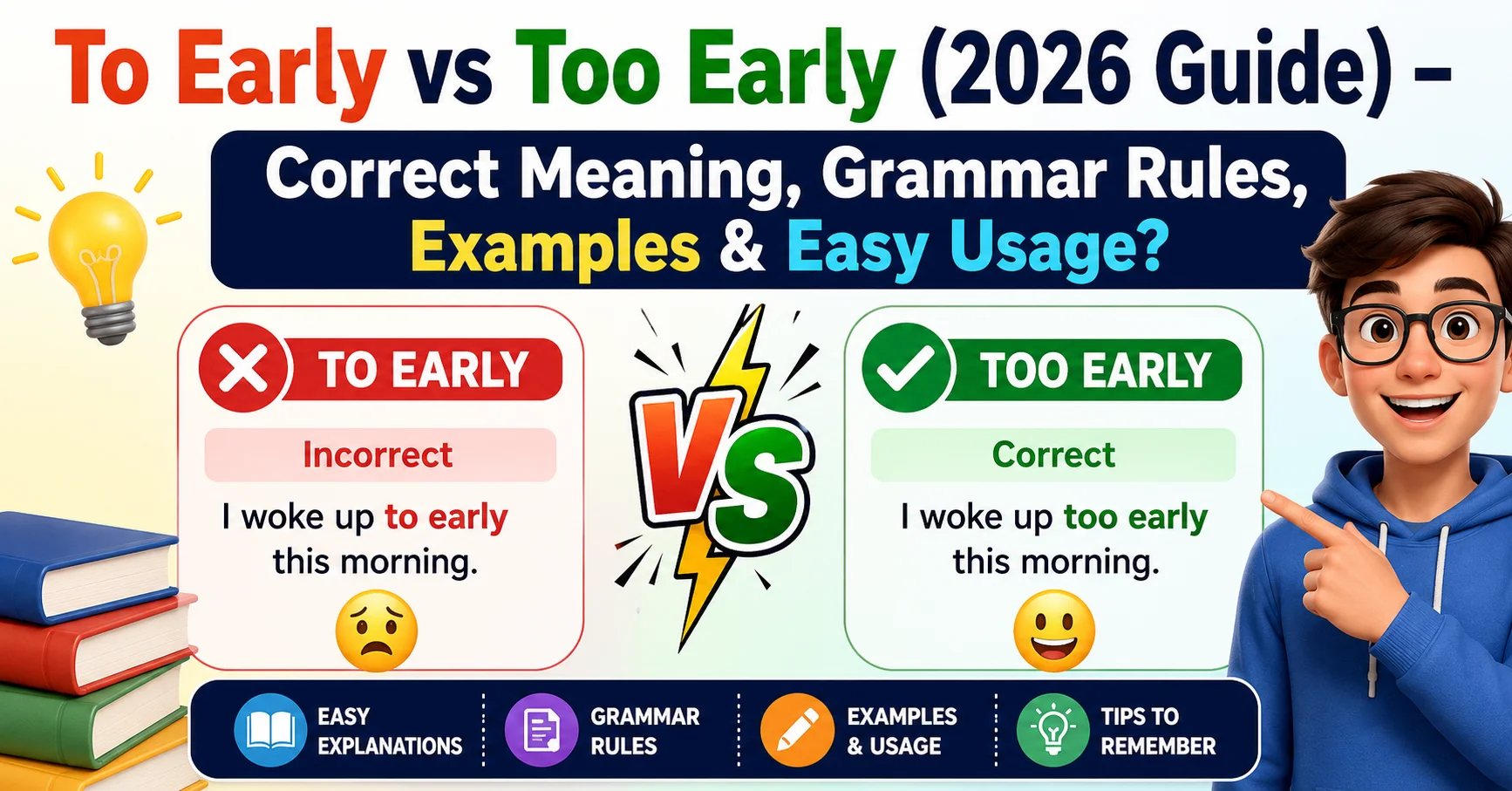
- “I woke up to early.”
- “I woke up too early.”
Only one sentence is correct. The second one is right because “too” means “excessively” or “more than needed.”
Many learners think grammar rules are hard, but this one is easy once you understand the role of each word. Knowing the difference can improve your writing in emails, essays, social media posts, and professional communication.
The Correct Phrase: “Too Early”
In most situations, “too early” is the correct phrase.
“Too” means:
- More than needed
- Excessively
- More than expected
So, “too early” means something happened earlier than desired or earlier than expected.
Examples of “Too Early”
| Sentence | Meaning |
|---|---|
| I arrived too early. | I arrived earlier than needed. |
| It is too early to decide. | The time is not right yet. |
| She woke up too early today. | She woke earlier than normal. |
| The store opened too early for me. | The opening time felt very early. |
You can see that “too” adds the idea of excess or extra amount.
Is “To Early” Ever Correct?
Usually, “to early” is incorrect grammar.
The word “to” is mainly used:
- Before verbs
- To show direction
- To connect phrases
Examples:
- I want to sleep.
- We went to school.
- She likes to read.
Since “early” is an adjective or adverb, “to early” normally does not fit standard grammar rules.
Incorrect Example
❌ I came to early.
Correct Example
✅ I came too early.
In daily English writing, “to early” is almost always a typo or grammar mistake.
Quick Difference Between “To” and “Too”
Here is a simple comparison table that makes the difference easy to remember.
| Word | Meaning | Example |
|---|---|---|
| To | Direction, connection, or part of a verb | I want to learn. |
| Too | Excessively or also | It is too cold outside. |
A helpful trick is this:
“Too” has an extra “o,” just like it means something extra.
That memory trick helps many learners remember the correct spelling.
What Does “Too Early” Mean?
The phrase “too early” means:
- Before the right time
- Earlier than expected
- Earlier than comfortable
People use it in everyday conversations all the time.
Common Situations
| Situation | Example |
|---|---|
| Waking up | I woke up too early. |
| Arriving somewhere | We reached too early. |
| Making decisions | It is too early to judge. |
| Starting work | They started too early. |
The phrase often shows inconvenience, surprise, or poor timing.
Examples of “Too Early” in Daily Life
Learning through examples is the easiest way to remember grammar rules.
At School
A student might say:
“The exam started too early in the morning.”
This means the exam time felt earlier than comfortable.
At Work
An employee may say:
“I joined the meeting too early.”
Maybe nobody else arrived yet.
In Relationships
Someone may say:
“It is too early to talk about marriage.”
This means the relationship is still new.
During Travel
A traveler could say:
“We reached the airport too early.”
Maybe they had to wait for hours.
These real-life examples show how common and useful this phrase is.
Common Grammar Mistakes With “Too Early”
Many English learners repeat similar mistakes. Here are the most common ones.
| Incorrect | Correct |
|---|---|
| I woke up to early. | I woke up too early. |
| She arrived to early. | She arrived too early. |
| It’s to early for dinner. | It’s too early for dinner. |
| They came to early today. | They came too early today. |
One small spelling error can change how professional your writing looks.
Even skilled writers sometimes make this mistake while typing quickly.
Why “Too” Matters in English Grammar
The word “too” is very important in English because it changes meaning completely.
“Too” Can Mean Excess
Examples:
- Too hot
- Too cold
- Too fast
- Too expensive
“Too” Can Also Mean “Also”
Examples:
- I want pizza too.
- She is coming too.
In the phrase “too early,” the word means “excessively early.”
Understanding this helps you avoid many common grammar mistakes.
Easy Memory Trick for “Too Early”
Here is one of the best tricks teachers use.
Remember This:
“Too” has an extra “o” because it means extra.
So:
- Too loud = extra loud
- Too big = extra big
- Too early = extra early
This tiny trick helps students remember the difference for years.
You can even teach this rule to children because it is so simple.
“Too Early” in Text Messages and Social Media
People often write quickly online, so spelling mistakes happen often.
You may see:
- “Its to early.”
- “Why are you awake to early?”
These are incorrect, but they are common online because users type fast.
Correct versions:
- “It’s too early.”
- “Why are you awake too early?”
Using proper grammar online can make your writing look smarter and clearer.
Formal vs Informal Use of “Too Early”
The phrase works in both formal and informal English.
Informal Examples
- “You called me too early.”
- “It’s too early for homework.”
Formal Examples
- “It is too early to predict the final results.”
- “The company believes it is too early for expansion.”
This makes the phrase very flexible in writing and speech.
Synonyms for “Too Early”
Sometimes writers want different wording to avoid repetition.
Here are useful alternatives.
| Phrase | Meaning |
|---|---|
| Prematurely | Before the correct time |
| Ahead of time | Earlier than expected |
| Earlier than planned | Before the planned moment |
| Untimely | Happening at the wrong time |
| Before schedule | Earlier than scheduled |
Example
Instead of:
“We arrived too early.”
You can say:
“We arrived ahead of time.”
Using synonyms improves writing variety and SEO value.
When “Too Early” Can Be Positive
Most people think “too early” sounds negative, but not always.
Sometimes being early is helpful.
Example
“We arrived too early, but we got the best seats.”
Here, arriving early created a benefit.
Another example:
“She prepared too early, so she felt relaxed later.”
Context decides whether the phrase feels positive or negative.
“Too Early” in Movies, Books, and Conversations
This phrase appears often in entertainment and daily speech.
You may hear lines like:
- “It’s too early to celebrate.”
- “You came too early.”
- “Too early for coffee?”
Writers and speakers use it because it sounds natural and clear.
Learning common phrases from real conversations improves English fluency faster.
British vs American English Usage
The good news is that both British and American English use “too early” the same way.
There is no spelling difference here.
Correct Everywhere
✅ Too early
Incorrect Everywhere
❌ To early
So no matter where you live, the grammar rule stays the same.
How Teachers Explain “To Early” vs “Too Early”
Many English teachers use a simple method.
Step 1: Replace “Too”
Ask yourself:
Does the sentence mean “extra” or “more than needed”?
If yes, use “too.”
Example
“The movie started too early.”
Does it mean “extra early”? Yes.
So “too” is correct.
Step 2: Test “To”
Would the sentence work with direction or a verb?
Example:
“I want to sleep.”
Here, “to” connects with the verb “sleep.”
This method works almost every time.
Practice Sentences for Learners
Try fixing these sentences yourself.
| Wrong Sentence | Correct Sentence |
|---|---|
| It is to early to leave. | It is too early to leave. |
| She came to early today. | She came too early today. |
| We woke up to early. | We woke up too early. |
| They arrived to early for class. | They arrived too early for class. |
Practice helps the rule become natural.
Best Ways to Avoid This Mistake
Here are easy ways to stop making this grammar error.
Read Slowly
Fast typing causes many spelling problems.
Use Grammar Tools
Apps like grammar checkers can help spot mistakes.
Learn Homophones
Understanding similar-sounding words improves writing skills.
Proofread Important Writing
Always check:
- Emails
- School assignments
- Blog posts
- Job applications
Small grammar mistakes can affect professionalism.
Why Correct Grammar Builds Trust
Good grammar makes communication clearer.
When readers see many mistakes, they may:
- Lose trust
- Feel confused
- Think the writer lacks attention
Using correct phrases like “too early” helps your writing appear polished and reliable.
This matters in:
- School work
- Business writing
- Blogging
- Social media
- Professional communication
Clear grammar creates stronger communication everywhere.
Frequently Asked Questions
Is “to early” correct grammar?
No. In most cases, “to early” is grammatically incorrect. The correct phrase is “too early.”
What does “too early” mean?
“Too early” means earlier than needed, expected, or comfortable.
Why do people confuse “to” and “too”?
They sound the same when spoken. Because they are homophones, many writers accidentally use the wrong spelling.
How can I remember the correct spelling?
Remember this simple trick:
“Too” has an extra “o” because it means something extra.
Can “too early” be used in formal writing?
Yes. It works in both formal and informal English writing.
Conclusion
Understanding “to early” vs “too early” is much easier than many people think. In almost every situation, “too early” is the correct phrase because “too” means excessively or more than needed.
The phrase “to early” is usually just a spelling mistake caused by fast typing or confusion between homophones.
Once you remember the simple rule that “too” means extra, you can avoid this grammar error forever.
Good grammar may seem small, but it improves communication, professionalism, and confidence. Whether you are writing an email, text message, blog post, or school assignment, using the correct phrase helps your message look clear and trustworthy.
The next time you write about arriving before the right time, you will know exactly which phrase to use: “too early.”
