


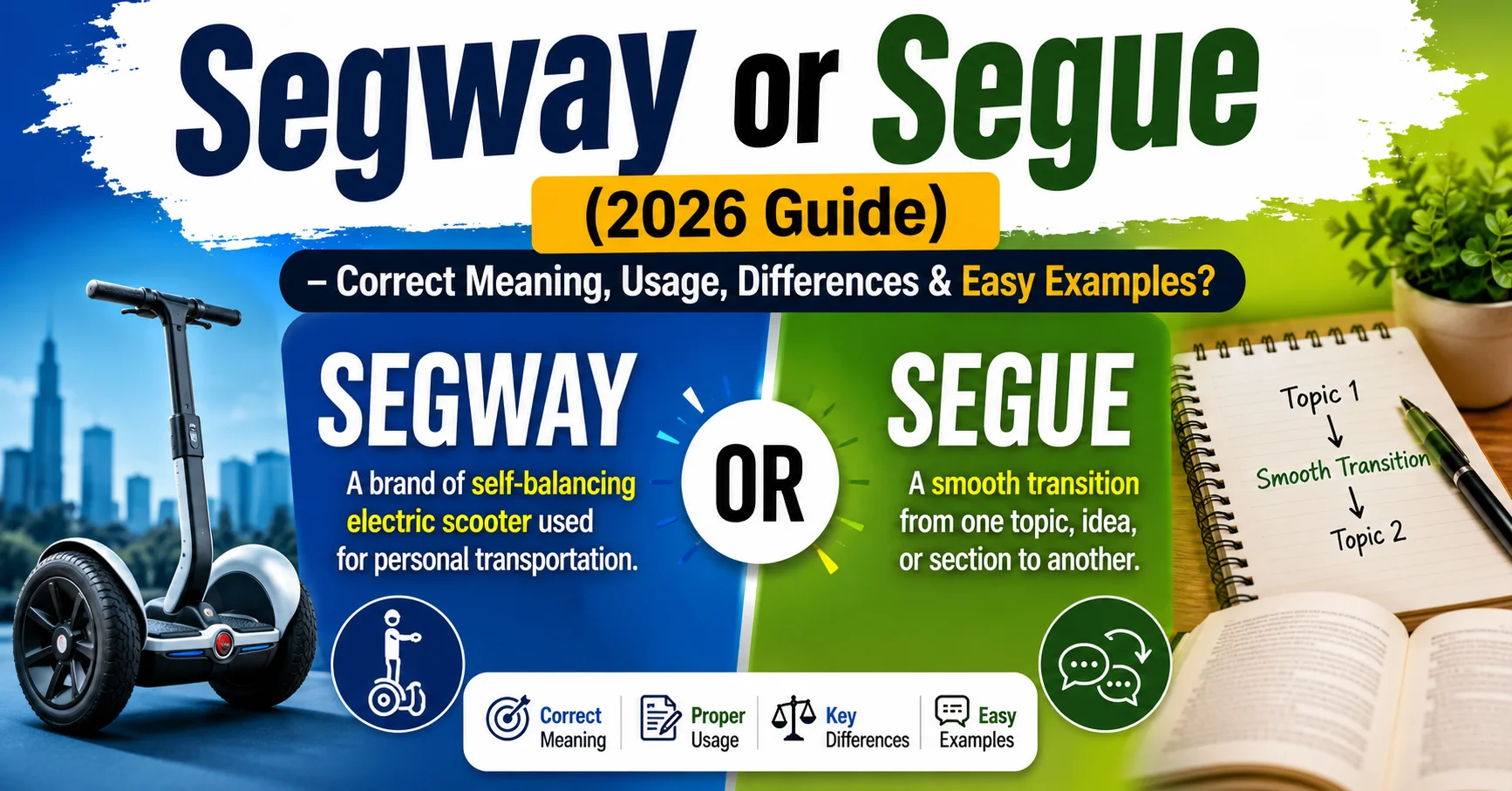
Have you ever typed “segway” when you really meant “segue”? You are not alone. Many people confuse these two words because they sound almost the same. Yet their meanings are completely different. One is a famous two-wheeled vehicle, while the other is a transition between ideas or topics.
The confusion around Segway or Segue happens every day in emails, blogs, social media posts, and school writing. Even experienced writers sometimes use the wrong one. That is why learning the difference matters. Using the correct word makes your writing look smarter, cleaner, and more professional.
In this complete 2026 guide, you will learn the meaning of both words, when to use each one, common mistakes, grammar tips, memory tricks, and plenty of real examples. Everything is explained in a simple way so anyone can understand it easily.
By the end of this article, you will never confuse Segway or Segue again.
Why People Confuse Segway or Segue
The biggest reason people mix up Segway or Segue is pronunciation. Both words sound very similar when spoken aloud. In everyday conversation, you may not even notice the difference.
Another reason is autocorrect and internet habits. Many people have seen “Segway” more often because it is a famous product brand. So when they write “segue,” their brain sometimes chooses the more familiar spelling.
There is also a grammar issue involved. Some people know the spoken word but have never seen the correct spelling in writing. They hear someone say, “That was a smooth segue,” and assume the spelling must be “Segway.”
This confusion is very common in blog articles, YouTube scripts, podcasts, and presentations. The good news is that the difference is actually simple once you understand it clearly.
What Does “Segue” Mean?
The word “segue” is used when moving smoothly from one topic, idea, or section to another. It acts like a bridge in communication.
For example:
- “The teacher used music to segue into the next lesson.”
- “Let me segue into another important point.”
In writing and speaking, “segue” helps conversations flow naturally. It prevents sudden topic changes that feel awkward or confusing.
Simple Definition of Segue
| Word | Meaning | Usage |
|---|---|---|
| Segue | A smooth transition | Writing, speaking, presentations |
The word originally came from Italian music terminology. Over time, English speakers started using it in normal conversations and writing.
Today, “segue” is common in:
- Public speaking
- Blogging
- Podcasts
- Teaching
- Video content
- Business presentations
If you are transitioning from one point to another, “segue” is usually the correct word.
What Does “Segway” Mean?
“Segway” is a brand name. It refers to the self-balancing electric scooter created for personal transportation.
You may have seen tourists riding one in large cities or security guards using them in malls and airports.
Simple Definition of Segway
| Word | Meaning | Usage |
|---|---|---|
| Segway | A two-wheeled electric vehicle | Transportation |
Example sentences:
- “We rented a Segway during our city tour.”
- “The police officer rode a Segway through the park.”
Unlike “segue,” this word has nothing to do with transitions in writing or speech.
That is why saying “Let me segway into the next topic” is technically incorrect.
The Main Difference Between Segway or Segue
The easiest way to remember the difference is this:
- Segue = transition
- Segway = scooter
Here is a quick comparison table to make it even clearer.
| Feature | Segue | Segway |
|---|---|---|
| Part of Speech | Verb/Noun | Proper noun |
| Meaning | Smooth transition | Electric scooter brand |
| Used In | Writing and speaking | Transportation |
| Example | “She segued into another topic.” | “He rode a Segway downtown.” |
This simple comparison solves most confusion instantly.
How to Use “Segue” Correctly in Sentences
Many people understand the meaning but still struggle to use “segue” naturally. The key is to think about movement between ideas.
Here are some easy examples:
- “The speaker segued into the final topic.”
- “That joke was a perfect segue.”
- “She used a story to segue into the lesson.”
- “The movie segues smoothly between scenes.”
Notice how all examples involve a smooth transition.
A good segue makes writing feel organized and pleasant to read. Without proper transitions, content may feel jumpy or disconnected.
Professional writers and speakers use segues constantly because they improve flow and readability.
How to Use “Segway” Correctly in Sentences
“Segway” should only be used when talking about the actual vehicle or the company brand.
Examples include:
- “We explored the city on a Segway.”
- “My cousin bought a Segway last year.”
- “The tour guide taught us how to ride a Segway.”
Since it is a brand name, it should usually start with a capital “S.”
Using “Segway” as a transition word is considered a spelling mistake in formal writing.
Common Mistakes People Make
One of the biggest grammar mistakes online involves using “Segway” when the writer means “segue.”
Here are incorrect examples:
- “Let me segway into another idea.”
- “This segway leads to the next chapter.”
These should actually use “segue.”
Correct Versions
| Incorrect | Correct |
|---|---|
| Let me segway into another point. | Let me segue into another point. |
| That was a nice segway. | That was a nice segue. |
| He segwayed into the topic. | He segued into the topic. |
These errors appear often on social media because many people type based on pronunciation instead of spelling.
Easy Memory Tricks for Segway or Segue
Memory tricks can help you avoid mistakes forever.
Trick #1: Segue Has “UE” Like “Continue”
A segue helps communication continue smoothly.
Both words connect ideas naturally.
Trick #2: Segway Has “Way”
A Segway helps people travel from one place to another physically.
Think of it as a “way” to move around.
Trick #3: Imagine a Scooter
If the sentence has nothing to do with a scooter, you probably need “segue.”
These simple tricks work surprisingly well, especially for students and beginner writers.
Is “Segway” Ever Accepted Instead of “Segue”?
In casual internet conversations, some people use “segway” informally as a verb. However, grammar experts still consider it incorrect in professional writing.
You may see this usage:
- “That segwayed perfectly into the next scene.”
Even though many readers understand the meaning, the correct spelling remains “segued.”
Formal writing should always use “segue.”
This matters in:
- Academic writing
- Business emails
- Articles
- Books
- Professional presentations
Using the correct form improves credibility and trust.
Why Correct Word Choice Matters
Some people think spelling mistakes are small issues. But using the wrong word can affect how readers see your writing.
Correct grammar:
- Builds trust
- Improves readability
- Makes writing more professional
- Helps SEO quality
- Prevents confusion
Imagine reading a business presentation that says:
“Let me segway into sales numbers.”
Many readers would immediately notice the error.
Small grammar mistakes can distract readers from your message.
That is why learning the difference between Segway or Segue is worth your time.
Segue in Writing and Public Speaking
Professional communicators rely heavily on smooth transitions. Strong segues guide readers and listeners naturally from one idea to another.
Without transitions, content feels broken.
Here are common segue phrases:
- “Speaking of that…”
- “This leads to another point.”
- “Now let’s move on.”
- “That brings us to…”
These phrases help conversations flow comfortably.
Examples of Good Segues
| Situation | Example |
|---|---|
| Essay writing | “Now let’s segue into the main argument.” |
| Podcast | “That nicely segues into today’s topic.” |
| Classroom | “The teacher segued into science class.” |
| Presentation | “This chart segues into our next discussion.” |
Strong transitions improve clarity and audience engagement.
Segway Brand History Explained Simply
The Segway vehicle became famous in the early 2000s. It was designed as a futuristic transportation device.
The machine balances automatically using sensors and gyroscopic technology.
People commonly use Segways for:
- Tourism
- Security patrols
- Short-distance travel
- Recreation
Although the brand became globally recognized, its popularity also increased confusion with the word “segue.”
Many people now recognize “Segway” faster than “segue,” which causes spelling mistakes online.
Which Word Appears More Often Online?
Interestingly, “Segway” sometimes appears online even when writers mean “segue.”
Search engines have become better at understanding intent, but grammar still matters.
Professional websites, newspapers, and educational platforms almost always use the correct spelling.
That is important for:
- SEO writing
- Blogging
- Academic content
- Online credibility
Search engines reward clear, high-quality writing. Correct spelling helps your content appear more trustworthy.
Segway or Segue in Business Communication
Business communication depends on clarity. Wrong word usage can make emails and presentations appear careless.
Imagine these two sentences:
- “Let me segue into our quarterly results.”
- “Let me segway into our quarterly results.”
The first sentence looks polished and professional. The second may distract readers or listeners.
Managers, marketers, teachers, and writers often use “segue” during meetings and presentations. Knowing the correct spelling helps you communicate with confidence.
This is especially important if English is your second language. Small grammar details can make a big difference in professional settings.
Real-Life Examples of Segway or Segue
Learning through examples is one of the fastest ways to remember grammar rules.
Correct Use of Segue
- “The conversation segued into sports.”
- “Her story was a perfect segue.”
- “The host smoothly segued into the interview.”
Correct Use of Segway
- “Tourists rode Segways around the museum.”
- “He learned to balance on a Segway.”
- “The Segway moved quietly down the street.”
Reading examples repeatedly helps your brain recognize the correct word automatically.
Quick Grammar Rule Summary
Here is a fast recap you can save for later.
| Word | Remember This |
|---|---|
| Segue | Transition between ideas |
| Segway | Electric scooter brand |
If you are talking about communication, presentations, or topic changes, use “segue.”
If you are talking about transportation, use “Segway.”
That single rule solves almost every situation.
Why This Grammar Mix-Up Keeps Growing
Social media and fast typing habits have increased spelling confusion online. People often type words based on sound instead of accuracy.
Autocorrect also plays a role. Some devices recognize “Segway” faster because it is a brand name.
Another issue is that spoken English hides spelling differences. Since both words sound similar, listeners may never realize they are separate words.
This trend shows why grammar education still matters today. Correct language use improves communication, professionalism, and reader trust.
Best Tips to Never Confuse Them Again
Here are the easiest ways to master Segway or Segue forever:
- Think “segue = smooth transition.”
- Think “Segway = scooter.”
- Ask yourself if the sentence involves transportation.
- Remember that “segue” is common in writing and speaking.
- Proofread important documents carefully.
These habits quickly become automatic with practice.
FAQs About Segway or Segue
Is it “segue” or “segway” in writing?
If you mean a transition between ideas, the correct spelling is “segue.”
Can “Segway” be used as a verb?
Informally, some people use it that way online, but formal grammar considers it incorrect.
Why do segue and Segway sound alike?
Their pronunciations are very similar in spoken English, which causes confusion.
Is Segway a company name?
Yes. Segway is a transportation brand known for self-balancing scooters.
What is the easiest way to remember the difference?
Remember this:
- Segue = transition
- Segway = scooter
Conclusion
Understanding the difference between Segway or Segue is much easier once you break it down clearly. Although the words sound almost identical, their meanings are completely different.
“Segue” is used for smooth transitions in writing and speaking. “Segway” refers to the famous electric scooter brand.
This small grammar detail can make a big difference in communication. Correct usage improves professionalism, readability, and confidence in your writing.
The next time you move from one topic to another, you will know exactly which word to choose. And if someone mentions riding through the city on two wheels, you will recognize the brand instantly.
Mastering small language details like this helps your writing stand out in 2026 and beyond.
