


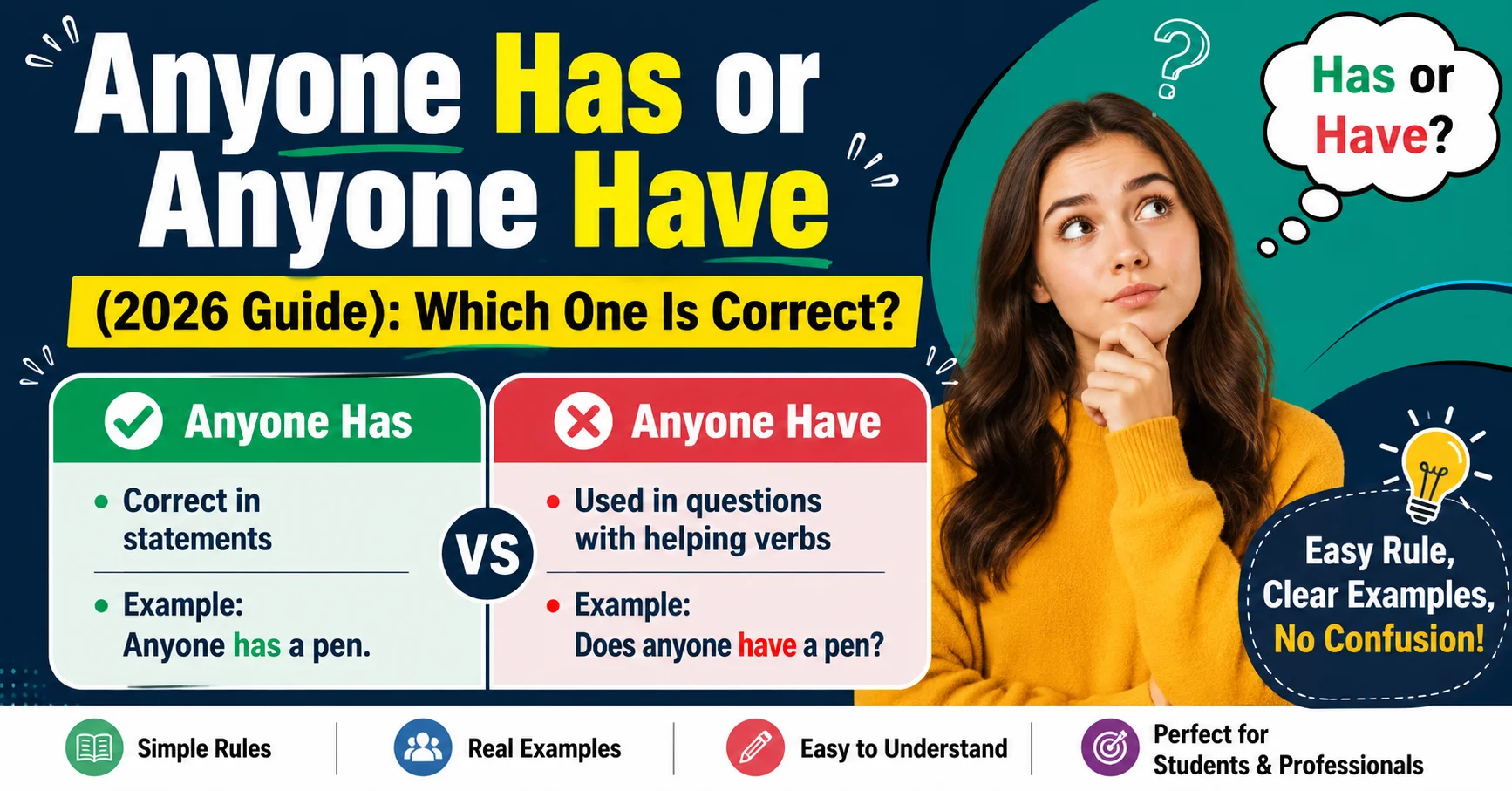
Many English learners get confused about “Anyone Has or Anyone Have.” At first, both phrases may sound correct. But in real English grammar, only one usually works in a sentence.
This mistake is common because the word “anyone” looks plural to some people. It talks about “any person,” so learners sometimes think they should use have instead of has. The good news is that the rule is actually simple once you understand it.
In this complete guide, you will learn the difference between Anyone Has or Anyone Have, when to use each one, common grammar mistakes, easy examples, and tips to remember the correct form forever. The explanations are simple, clear, and beginner-friendly.
By the end of this article, you will confidently know which phrase is correct in everyday English.
Why People Confuse “Anyone Has or Anyone Have”
English grammar has many tricky words. One of them is “anyone.” Even advanced learners sometimes pause before choosing between has and have.
The confusion happens because “anyone” refers to people in general. Since it can mean many possible people, some learners naturally feel that a plural verb should follow. That is why they say things like:
- “Anyone have a pen?”
- “Anyone have questions?”
You may hear these forms in casual speech, especially online or in text messages. However, formal grammar follows a different rule.
In standard English, “anyone” is grammatically singular. Because it is singular, it normally takes singular verbs like has, is, or does.
Here is the simple idea:
| Subject | Correct Verb |
|---|---|
| Anyone | Has |
| Someone | Has |
| Everybody | Has |
| Nobody | Has |
So, when deciding between Anyone Has or Anyone Have, the correct grammar choice is usually “anyone has.”
The Correct Grammar Rule
The easiest way to solve the Anyone Has or Anyone Have problem is to remember one important grammar rule:
Anyone is singular.
Since “anyone” is singular, it uses singular verbs.
That means:
- Correct: “Anyone has the right to ask.”
- Incorrect: “Anyone have the right to ask.”
This rule works the same way with similar words:
| Singular Indefinite Pronoun | Correct Verb |
|---|---|
| Anyone | Has |
| Someone | Has |
| Everyone | Has |
| Nobody | Has |
Think of “anyone” as meaning “any single person.” Even though it can refer to many possible people, the grammar stays singular.
Here are more correct examples:
- “If anyone has questions, please ask.”
- “Anyone who has experience can apply.”
- “Does anyone have a charger?”
- “Anyone has access after approval.”
Notice something important in the third example. After does, we use have, not has. This is because auxiliary verbs change the main verb form.
This is where many learners get confused.
When “Anyone Have” Is Correct
Now comes the important part. Even though “anyone has” is usually correct, there are situations where “anyone have” is also correct.
This happens when another helping verb appears before have.
Examples:
- “Does anyone have a pencil?”
- “Did anyone have your number?”
- “Can anyone have access?”
- “Will anyone have time tomorrow?”
In these sentences, the helping verbs (does, did, can, will) control the grammar. Because of that, the main verb stays in its base form: have.
Here is a simple table:
| Sentence Type | Correct Form |
|---|---|
| Anyone has experience. | Correct |
| Does anyone have experience? | Correct |
| Anyone have experience. | Usually incorrect |
So the real difference between Anyone Has or Anyone Have depends on sentence structure.
Simple Trick to Remember the Rule
A quick memory trick can help you avoid mistakes forever.
Replace “anyone” with “one person.”
If “one person” sounds correct with has, then use has.
Examples:
| Original Sentence | Replace With “One Person” |
|---|---|
| Anyone has the answer. | One person has the answer. |
| Anyone have the answer. | One person have the answer. ❌ |
Now the mistake becomes obvious.
This small trick works in almost every situation. It is one of the easiest ways to master the Anyone Has or Anyone Have grammar rule.
Examples of Correct Usage in Daily English
Real examples make grammar easier to understand. Below are common situations where people use these phrases.
Correct Examples With “Anyone Has”
| Sentence | Why It’s Correct |
|---|---|
| Anyone has the ability to learn. | “Anyone” is singular |
| If anyone has extra notes, share them. | Singular subject |
| Anyone who has talent can improve. | Singular verb agreement |
| Anyone has permission after approval. | Formal grammar |
Correct Examples With “Anyone Have”
| Sentence | Why It’s Correct |
|---|---|
| Does anyone have water? | After “does” use base verb |
| Did anyone have your bag? | After “did” use base verb |
| Can anyone have access? | Modal verbs use base form |
| Will anyone have time later? | Future tense structure |
These examples clearly show why sentence structure matters.
Why Native Speakers Sometimes Say “Anyone Have?”
If you watch movies, read comments online, or listen to casual conversations, you may hear people say:
- “Anyone have a phone charger?”
- “Anyone have ideas?”
- “Anyone have questions?”
Technically, these are incomplete casual forms. In formal English, they should be:
- “Does anyone have a phone charger?”
- “Does anyone have ideas?”
- “Does anyone have questions?”
Native speakers often shorten sentences during fast conversation. This happens in every language. Casual speech does not always follow strict grammar rules.
That does not mean the grammar changed. It simply means the speaker is using informal spoken English.
Here is a comparison:
| Informal Speech | Formal Grammar |
|---|---|
| Anyone have a pen? | Does anyone have a pen? |
| Anyone got snacks? | Has anyone got snacks? |
| Anyone know him? | Does anyone know him? |
So if your goal is correct written English, exams, business writing, or professional communication, stick with proper grammar.
Common Mistakes Learners Make
Many English learners repeat the same grammar mistakes when using Anyone Has or Anyone Have.
Here are the most common ones.
Mistake 1: Using “Have” Without a Helping Verb
❌ “Anyone have a ticket.”
✅ “Does anyone have a ticket?”
This mistake usually comes from hearing informal speech.
Mistake 2: Forgetting Subject-Verb Agreement
❌ “Anyone have permission.”
✅ “Anyone has permission.”
Since “anyone” is singular, the verb should match.
Mistake 3: Mixing Formal and Informal English
Some learners combine formal writing with casual grammar. That creates awkward sentences.
Example:
❌ “Anyone have further questions regarding the meeting?”
Better:
✅ “Does anyone have further questions regarding the meeting?”
Formal situations need proper grammar structure.
Anyone Has or Anyone Have in Questions
Questions create extra confusion because verb order changes.
Here is the correct structure for questions:
| Question Type | Correct Example |
|---|---|
| Present simple | Does anyone have a key? |
| Past simple | Did anyone have the file? |
| Future | Will anyone have time? |
| Modal verb | Can anyone have access? |
Notice that have stays in the base form after helping verbs.
This rule applies to all English subjects:
- Does he have…
- Does she have…
- Does anyone have…
Never write:
❌ “Does anyone has…”
That is incorrect because “does” already carries the tense.
Anyone Has or Anyone Have in Formal Writing
In professional writing, grammar accuracy matters more.
You should avoid incomplete casual forms like:
- “Anyone have updates?”
- “Anyone have concerns?”
Instead, write:
- “Does anyone have updates?”
- “Does anyone have concerns?”
Formal English is important in:
- Emails
- School assignments
- Job applications
- Business communication
- Academic writing
Using proper grammar makes your writing clearer and more trustworthy.
I once reviewed a client email where the writer used “Anyone have feedback?” While the meaning was clear, changing it to “Does anyone have feedback?” instantly sounded more professional.
Small grammar choices can strongly affect how people view your writing.
Differences Between Spoken and Written English
Spoken English often breaks grammar rules for speed and simplicity.
Written English usually follows grammar more carefully.
Here is the difference:
| Spoken English | Written English |
|---|---|
| Anyone have a charger? | Does anyone have a charger? |
| Anyone know the answer? | Does anyone know the answer? |
| Anyone got coffee? | Has anyone got coffee? |
This does not mean spoken English is “wrong.” It simply follows different communication habits.
Still, learners should first master the correct standard grammar before copying casual speech patterns.
Similar Grammar Patterns You Should Know
The same grammar rule applies to many other words besides “anyone.”
Words That Use Singular Verbs
| Word | Correct Verb |
|---|---|
| Everyone | Has |
| Someone | Has |
| Nobody | Has |
| Anybody | Has |
| Everybody | Has |
Examples:
- “Everybody has homework.”
- “Someone has my keys.”
- “Nobody has the answer.”
These words are called indefinite pronouns. Even though they refer to groups or unknown people, they are grammatically singular.
Understanding this pattern makes English grammar much easier.
Easy Practice Sentences
Try these examples yourself.
Choose the Correct Form
- Anyone ___ a notebook?
- Does anyone ___ a notebook?
- Anyone who studies hard ___ success.
- Did anyone ___ your phone?
- Anyone ___ the right to speak.
Answers
| Sentence | Correct Answer |
|---|---|
| Anyone ___ a notebook? | has |
| Does anyone ___ a notebook? | have |
| Anyone who studies hard ___ success. | has |
| Did anyone ___ your phone? | have |
| Anyone ___ the right to speak. | has |
Practice helps grammar become natural.
Why This Grammar Rule Matters
Some people think small grammar mistakes do not matter. But grammar affects clarity, confidence, and professionalism.
Correct grammar helps you:
- Sound more fluent
- Write more clearly
- Avoid confusion
- Pass exams
- Communicate professionally
When learners master small details like Anyone Has or Anyone Have, their overall English improves faster.
Tiny grammar rules create a big difference over time.
Best Way to Memorize “Anyone Has or Anyone Have”
Here is a simple summary method:
Use “Has” When:
- “Anyone” is the main subject
- No helping verb appears
- The sentence is a statement
Examples:
- “Anyone has potential.”
- “If anyone has questions, ask me.”
Use “Have” When:
- A helping verb comes first
- The sentence uses does, did, can, will, should, or may
Examples:
- “Does anyone have water?”
- “Can anyone have access?”
This simple pattern solves most confusion instantly.
Quick Comparison Chart
| Situation | Correct Form |
|---|---|
| Statement | Anyone has |
| Question with “does” | Anyone have |
| Question with “did” | Anyone have |
| Modal verb sentence | Anyone have |
| Informal speech | Anyone have |
| Formal writing | Anyone has / Does anyone have |
Keep this chart in mind whenever you feel confused.
FAQs About Anyone Has or Anyone Have
Is “Anyone Have” grammatically correct?
By itself, usually no. Standard grammar normally requires “anyone has” or “does anyone have.” However, native speakers sometimes shorten sentences in casual conversation.
Why is “anyone” singular?
“Anyone” means any single person, so English grammar treats it as singular even though it can refer to many possible people.
Which is correct: “Does anyone has” or “Does anyone have”?
The correct form is:
✅ “Does anyone have”
After “does,” the main verb always stays in its base form.
Can I use “Anyone Have” in casual speech?
Yes, many native speakers use it informally in conversation, texts, and online comments. But it is better to avoid it in formal writing.
Is “Anyone Has” always correct?
Not always. It works in statements, but in questions or sentences with helping verbs, you usually need “have.”
Example:
✅ “Anyone has experience.”
✅ “Does anyone have experience?”
Conclusion
Understanding Anyone Has or Anyone Have becomes easy once you learn the core grammar rule.
The word “anyone” is singular, so it normally uses has. However, when a helping verb like does, did, or can appears, the verb changes to have.
That means:
- ✅ “Anyone has talent.”
- ✅ “Does anyone have talent?”
- ❌ “Anyone have talent.” (formal grammar)
You may still hear casual shortened versions in spoken English, but standard grammar follows clear rules.
The best way to remember this is simple:
Replace “anyone” with “one person.”
If “one person has” sounds right, then “anyone has” is also right.
Mastering small grammar details like this can improve your writing, speaking, and confidence in English. The more examples you practice, the more natural the rule will feel.
