


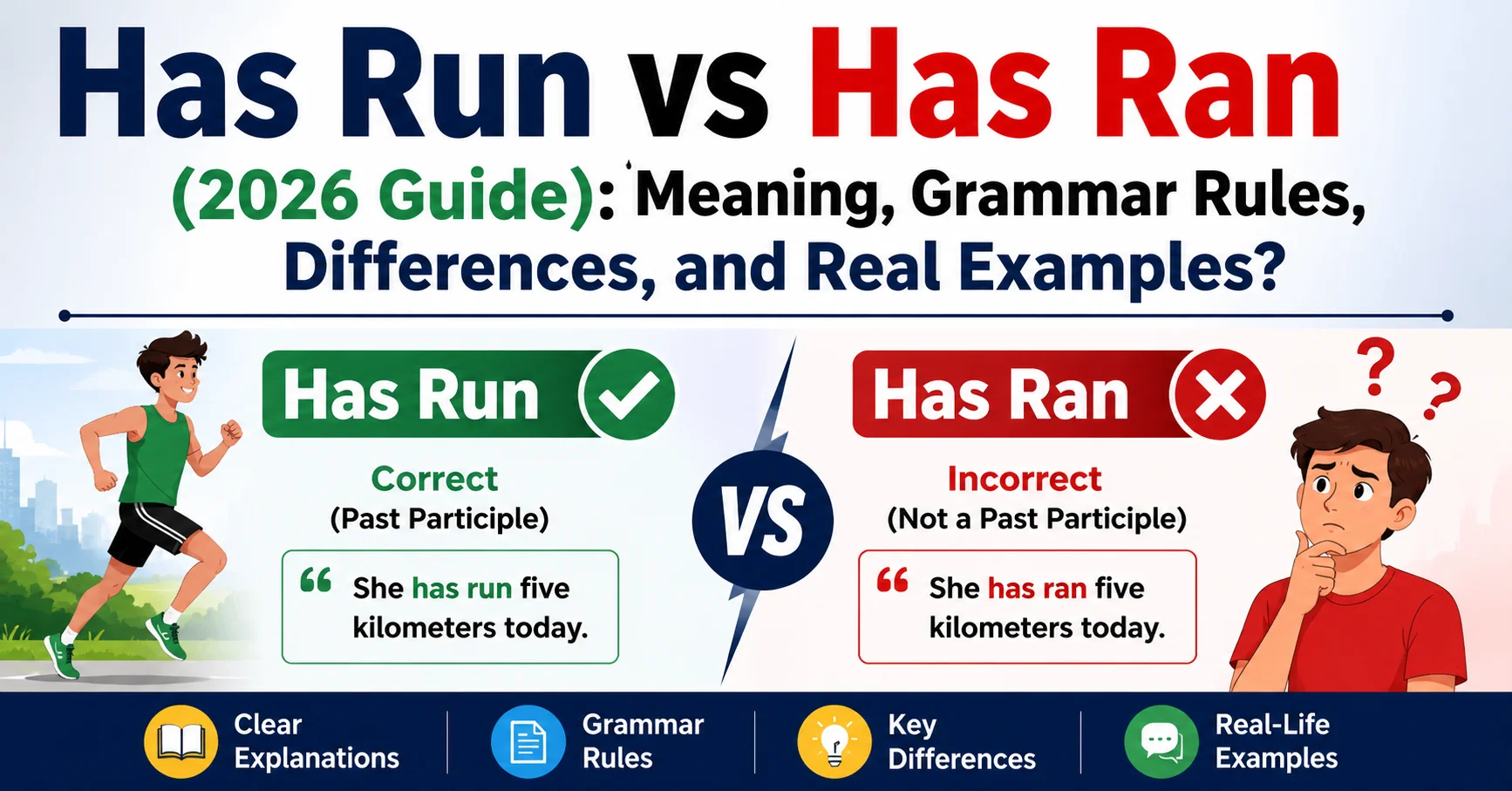
English grammar can feel confusing at times. One common mistake people make is using “has run” vs “has ran.” Both phrases look similar, but only one is grammatically correct in standard English.
Many learners hear people say “has ran” in casual speech. Because of this, they assume it is correct. But grammar rules tell a different story. Understanding the difference can help you speak and write more clearly.
In this complete 2026 guide, you will learn the real difference between has run vs has ran, when to use each phrase, common mistakes to avoid, and many simple examples. By the end, you will feel more confident using these words correctly in everyday conversations and writing.
Why People Confuse “Has Run” and “Has Ran”
The confusion happens because the verb run is irregular. Irregular verbs do not follow normal grammar patterns. Instead of adding “-ed” for the past tense, they change form.
Here are the three main forms of the verb:
| Verb Form | Example |
|---|---|
| Base Form | run |
| Past Tense | ran |
| Past Participle | run |
This table explains the problem clearly. The word ran is the simple past tense. The word run is the past participle.
When we use helping verbs like has, have, or had, we must use the past participle form. That means the correct phrase is has run, not has ran.
Many native speakers still say “has ran” in casual speech. However, grammar experts consider it incorrect in formal English.
What Does “Has Run” Mean?
The phrase has run uses the present perfect tense. It describes an action that happened in the past but still connects to the present.
For example:
- She has run five miles today.
- The machine has run perfectly all week.
- He has run this company for years.
In each sentence, the action started in the past but matters now.
The structure is simple:
| Subject | Helping Verb | Past Participle |
|---|---|---|
| He | has | run |
| She | has | run |
| The dog | has | run |
This structure follows standard English grammar rules.
If you want your writing to sound professional, always use has run instead of has ran.
Is “Has Ran” Ever Correct?
In standard grammar, has ran is incorrect.
The word ran should never follow the helping verb has. The same rule applies to have and had.
Incorrect examples:
- He has ran to the store.
- She has ran every morning.
- My dog has ran away.
Correct versions:
- He has run to the store.
- She has run every morning.
- My dog has run away.
Some regional dialects use “has ran” in casual conversation. You may hear it in movies, songs, or local speech. Still, teachers, editors, and grammar experts consider it nonstandard English.
If you are writing for school, work, blogging, or business, use has run every time.
Understanding the Present Perfect Tense
The present perfect tense often causes confusion for English learners. That is why many people struggle with has run vs has ran.
The present perfect tense uses:
\text{Subject} + \text{has/have} + \text{past participle}
Here are examples:
| Correct Sentence | Why It Works |
|---|---|
| She has eaten breakfast. | “Eaten” is the past participle |
| They have gone home. | “Gone” is the past participle |
| He has run fast today. | “Run” is the past participle |
Notice something important. The verb after has is never the simple past tense.
That is why “has ran” breaks the grammar rule.
A simple trick can help. If the sentence includes has, have, or had, use the third form of the verb.
Simple Past vs Present Perfect
Another reason people confuse has run vs has ran is because they mix up verb tenses.
Here is the difference:
| Tense | Example | Usage |
|---|---|---|
| Simple Past | He ran yesterday. | Finished action |
| Present Perfect | He has run today. | Past action linked to now |
The sentence “He ran yesterday” talks about a completed event in the past.
The sentence “He has run today” means the action happened earlier today and still matters.
This difference is small but important.
Many learners accidentally combine the two tenses and say “He has ran yesterday.” That sentence is grammatically incorrect because it mixes present perfect structure with the simple past verb form.
Easy Trick to Remember the Difference
Grammar becomes easier when you use memory tricks.
Here is one simple rule:
“Has” always needs the third verb form.
For the verb run, the forms are:
- Run
- Ran
- Run
So:
- Correct: has run
- Incorrect: has ran
You can test the sentence with another verb.
For example:
- She has eaten. ✅
- She has ate. ❌
The same rule applies to run.
This small trick helps many English learners avoid grammar mistakes in emails, essays, and conversations.
Real-Life Examples of “Has Run”
Seeing examples in real situations makes grammar easier to understand.
Here are correct examples using has run:
| Sentence | Meaning |
|---|---|
| Sarah has run three marathons. | She completed three marathons |
| The software has run smoothly. | The software worked well |
| He has run this shop since 2018. | He manages the shop |
| My phone has run out of battery. | The battery is empty |
Notice how natural these sentences sound.
Now compare them with incorrect versions:
- Sarah has ran three marathons. ❌
- The software has ran smoothly. ❌
- My phone has ran out of battery. ❌
Once you practice enough, the correct form starts sounding natural automatically.
Common Grammar Mistakes Related to “Has Run”
Many grammar mistakes happen because people memorize rules without understanding them.
Here are some common errors connected to has run vs has ran.
Mixing Tenses
Incorrect:
- He has ran yesterday.
Correct:
- He ran yesterday.
- He has run today.
Using the Wrong Verb Form
Incorrect:
- She has drank water.
Correct:
- She has drunk water.
Forgetting Helping Verbs
Incorrect:
- He run fast.
Correct:
- He runs fast.
- He has run fast before.
Learning verb forms carefully can improve your grammar quickly.
Why Native Speakers Sometimes Say “Has Ran”
English changes across regions and cultures. Some native speakers use grammar informally in daily speech.
You may hear phrases like:
- “He has went there.”
- “She has ate already.”
- “They have ran away.”
These phrases are common in some dialects. However, they are still considered incorrect in formal English.
This is important for students, bloggers, and professionals. If you want clear and polished writing, follow standard grammar rules.
That means using:
- has gone
- has eaten
- has run
instead of incorrect alternatives.
How Schools and Grammar Experts View “Has Ran”
Teachers and grammar experts strongly prefer standard English grammar.
Most dictionaries and grammar guides agree that has ran is incorrect.
Professional writing always uses has run.
This includes:
- School essays
- News articles
- Blog posts
- Job applications
- Business emails
- Books
Using correct grammar helps readers trust your writing. It also improves your credibility.
Even small grammar mistakes can make writing appear less polished.
That is why understanding has run vs has ran matters more than many people think.
Examples in Everyday Conversation
Grammar rules feel easier when connected to daily life.
Here are simple conversation examples using has run correctly.
At School
- Liam has run faster this year.
- Our team has run many practice drills.
At Home
- Mom has run the dishwasher already.
- The baby has run around all morning.
At Work
- The manager has run several meetings today.
- The system has run without errors.
In Sports
- The athlete has run ten laps.
- She has run professionally for years.
These examples show how often the phrase appears in real English.
“Has Been Running” vs “Has Run”
Some learners also confuse has run with has been running.
These two phrases are similar but not identical.
| Phrase | Meaning |
|---|---|
| Has run | Focuses on completed action |
| Has been running | Focuses on ongoing action |
Examples:
- He has run five miles today.
- He has been running since morning.
The first sentence highlights completion.
The second highlights duration.
Both are correct, but they communicate slightly different meanings.
Best Ways to Practice Correct Grammar
Improving grammar takes practice. Luckily, small daily habits can help a lot.
Read More English Content
Reading books, blogs, and articles helps you notice correct grammar naturally.
Listen Carefully
Pay attention to grammar in podcasts, news videos, and educational content.
Write Daily
Write short paragraphs using present perfect tense.
For example:
- I have finished my homework.
- She has run every day this week.
Use Verb Charts
Memorizing irregular verbs helps avoid mistakes.
Here are some useful examples:
| Base Verb | Past Tense | Past Participle |
|---|---|---|
| go | went | gone |
| eat | ate | eaten |
| run | ran | run |
| drink | drank | drunk |
These charts improve grammar memory over time.
Why Correct Grammar Builds Trust
Grammar is not only about rules. It also affects communication and trust.
When readers see correct grammar, they feel more confident in the writer.
For example:
- Correct grammar sounds professional.
- Incorrect grammar can create confusion.
- Clear writing improves readability.
This matters online more than ever in 2026. Search engines and readers both prefer content that feels trustworthy and helpful.
Using the correct phrase has run instead of has ran shows attention to detail and language accuracy.
Common Sentences Fixed the Right Way
Here are some commonly mistaken sentences corrected properly.
| Incorrect | Correct |
|---|---|
| He has ran home. | He has run home. |
| She has ran every day. | She has run every day. |
| The dog has ran away. | The dog has run away. |
| My car has ran fine. | My car has run fine. |
Practice reading the correct versions aloud. This helps train your ear for natural grammar.
Frequently Asked Questions
1. Is “has ran” grammatically correct?
No. “Has ran” is incorrect in standard English grammar. The correct phrase is “has run.”
2. Why is “has run” correct?
“Has” requires the past participle form of the verb. The past participle of “run” is “run.”
3. What tense is “has run”?
“Has run” is in the present perfect tense.
4. Can native speakers say “has ran”?
Some native speakers use it in casual dialects, but grammar experts consider it incorrect in formal English.
5. How can I remember the correct form?
Remember this rule: after “has,” always use the third verb form. For “run,” the third form is “run.”
Conclusion
Understanding has run vs has ran becomes much easier once you learn the verb forms correctly. The phrase has run follows standard grammar rules because it uses the past participle form of the verb “run.” Meanwhile, has ran is considered incorrect in formal English.
This small grammar difference matters in writing, school, business, and everyday communication. Using correct grammar helps your sentences sound clearer, smarter, and more professional.
The good news is that this mistake becomes easier to avoid with practice. Read often, write simple sentences, and remember the three forms of irregular verbs.
When in doubt, remember this easy rule:
- He ran yesterday.
- He has run today.
That one trick can save you from many grammar mistakes in the future.
