

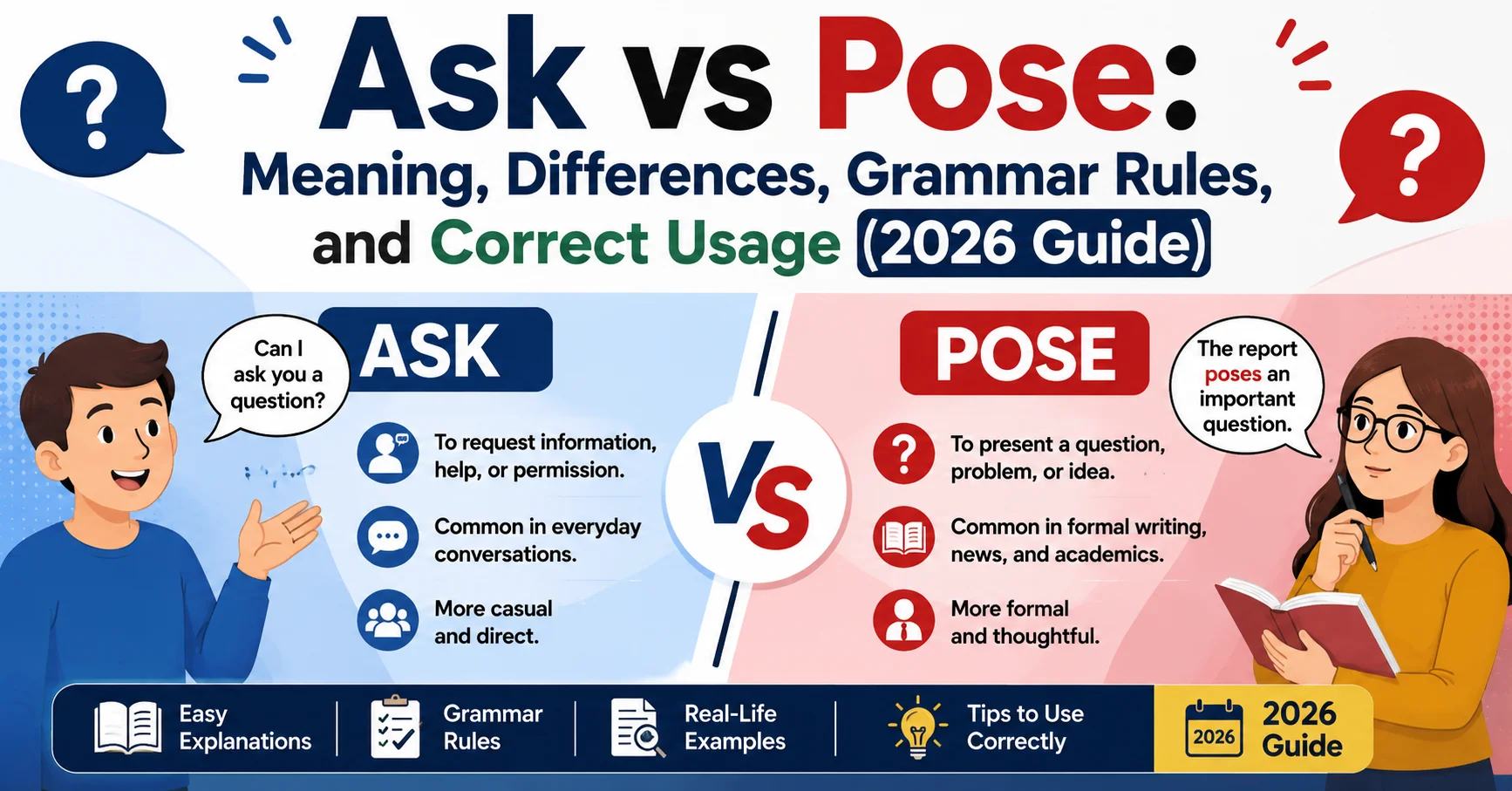
Words may seem simple, but small differences can change the whole meaning of a sentence. One common example is Ask vs Pose. Many English learners use these words in the same way, but they are not always interchangeable.
Both words involve questions, requests, or communication. However, they are used in different situations. “Ask” sounds direct and natural in daily speech. “Pose” often sounds formal or thoughtful. Knowing when to use each word can improve your writing and speaking skills.
In this detailed 2026 guide, you will learn the real difference between Ask vs Pose, how native speakers use them, grammar rules, examples, mistakes to avoid, and simple tricks to remember the correct usage.
What Does “Ask” Mean?
The word “ask” is one of the most common verbs in English. It means to request information, help, permission, or something else.
People use “ask” in normal conversations every day. It feels natural, friendly, and simple.
Examples of “Ask”
| Sentence | Meaning |
|---|---|
| I want to ask a question. | Requesting information |
| She asked for help. | Requesting support |
| Can I ask your name? | Requesting details |
| He asked permission to leave. | Seeking approval |
The word works well in both formal and informal English. You can use it with friends, teachers, coworkers, or family.
What Does “Pose” Mean?
The word “pose” has several meanings, but in communication, it usually means presenting a question, challenge, or problem in a thoughtful way.
It sounds more formal than “ask.” Writers, journalists, teachers, and researchers often use it.
Examples of “Pose”
| Sentence | Meaning |
|---|---|
| The teacher posed an interesting question. | Presented a thoughtful question |
| Climate change poses serious risks. | Creates risks or problems |
| The article posed a challenge to readers. | Presented a challenge |
| She posed a difficult problem. | Introduced a problem |
When comparing Ask vs Pose, remember this simple idea:
- Ask = request
- Pose = present
That small difference changes how the sentence feels.
Main Difference Between Ask vs Pose
The easiest way to understand Ask vs Pose is by looking at tone and purpose.
“Ask” focuses on getting an answer or response. “Pose” focuses on presenting an idea, issue, or question for discussion.
Quick Comparison Table
| Feature | Ask | Pose |
|---|---|---|
| Tone | Casual and common | Formal and thoughtful |
| Main Purpose | Request something | Present something |
| Everyday Use | Very common | Less common |
| Used in Conversations | Yes | Sometimes |
| Used in Academic Writing | Yes | Often |
| Sounds More Professional | No | Yes |
This difference matters in essays, emails, interviews, and professional communication.
When to Use “Ask”
Use “ask” when you want information, help, advice, or permission.
It is best for everyday situations because it sounds natural and friendly.
Common Situations
- Asking questions
- Asking for directions
- Asking permission
- Asking for help
- Asking someone to do something
Examples in Real Life
| Situation | Correct Sentence |
|---|---|
| School | I asked the teacher for extra time. |
| Office | She asked her manager for feedback. |
| Travel | We asked for directions downtown. |
| Friends | He asked me to join the party. |
In most daily conversations, “ask” is the safer choice.
When to Use “Pose”
Use “pose” when introducing a question, issue, danger, or challenge in a serious or formal way.
This word appears often in news articles, research papers, business reports, and presentations.
Common Situations
- Presenting difficult questions
- Discussing risks
- Introducing challenges
- Academic writing
- Professional discussions
Examples in Real Life
| Situation | Correct Sentence |
|---|---|
| News Article | The report posed serious concerns. |
| Research | Scientists posed a new theory. |
| Classroom | The professor posed a complex question. |
| Business | Rising costs pose challenges for companies. |
Compared to “ask,” the word “pose” sounds deeper and more analytical.
Ask vs Pose in Questions
This is where many learners get confused.
Both words can connect with questions, but they create different tones.
Using “Ask”
“Ask” sounds direct and conversational.
- She asked a question.
- I want to ask something.
- May I ask why?
Using “Pose”
“Pose” sounds formal or intellectual.
- The speaker posed an important question.
- The article posed difficult questions.
- The scientist posed a theory.
Simple Rule
If you are talking normally, use “ask.”
If you are writing formally or discussing ideas deeply, “pose” may work better.
Grammar Rules for Ask vs Pose
Understanding grammar helps avoid mistakes.
Grammar Pattern for “Ask”
| Structure | Example |
|---|---|
| Ask + question | Ask a question |
| Ask + person | Ask him |
| Ask + for + thing | Ask for help |
| Ask + to + action | Ask her to come |
Grammar Pattern for “Pose”
| Structure | Example |
|---|---|
| Pose + question | Pose a question |
| Pose + problem | Pose a problem |
| Pose + threat | Pose a threat |
| Pose + challenge | Pose a challenge |
You usually do not say:
❌ “Pose for help”
❌ “Pose him a question”
Those sound unnatural in English.
Common Mistakes People Make
Many English learners mix these words because both can involve questions.
Here are common mistakes and fixes.
Mistake 1: Using “Pose” in Casual Speech
❌ I posed my friend where the bus stop was.
✅ I asked my friend where the bus stop was.
“Pose” sounds too formal here.
Mistake 2: Using “Ask” in Formal Writing
❌ The report asked several ethical concerns.
✅ The report posed several ethical concerns.
In academic or professional writing, “pose” may sound stronger.
Mistake 3: Wrong Grammar Structure
❌ She posed for information.
✅ She asked for information.
“Ask for” is the correct phrase.
Ask vs Pose in Academic Writing
In essays, reports, and research papers, both words appear often.
But they serve different purposes.
“Ask” in Academic Writing
Used when researchers seek information.
Example:
- The survey asked participants about sleep habits.
“Pose” in Academic Writing
Used when introducing theories, problems, or questions.
Example:
- The study posed an important ethical issue.
Academic Comparison Table
| Sentence Type | Better Choice |
|---|---|
| Requesting answers | Ask |
| Introducing problems | Pose |
| Survey questions | Ask |
| Philosophical discussions | Pose |
If you write formal content, learning Ask vs Pose can improve professionalism.
Ask vs Pose in Business English
Business communication depends heavily on tone.
Choosing the right word helps sound clear and confident.
Use “Ask” For:
- Requests
- Emails
- Team communication
- Customer support
Examples:
- I’d like to ask about pricing.
- She asked for the report yesterday.
Use “Pose” For:
- Strategic discussions
- Risk analysis
- Leadership presentations
Examples:
- Market changes pose new challenges.
- The proposal poses financial risks.
Professionals often prefer “pose” when discussing serious issues.
Difference in Tone and Feeling
Tone matters more than many people realize.
Even when two words share similar meanings, they create different impressions.
Tone of “Ask”
- Friendly
- Direct
- Natural
- Personal
Tone of “Pose”
- Formal
- Serious
- Intellectual
- Professional
Example Comparison
| Sentence | Tone |
|---|---|
| She asked a question. | Casual |
| She posed a question. | Formal |
Both are correct, but the feeling changes.
Real-Life Examples of Ask vs Pose
Seeing examples helps you remember the difference faster.
Everyday Examples
- Can I ask you something?
- He asked for water.
- She asked the teacher for help.
Formal Examples
- The documentary posed difficult questions.
- Rising inflation poses economic risks.
- The lawyer posed a strong argument.
One helpful trick is this:
If the sentence sounds like normal conversation, “ask” usually works best.
Synonyms Related to Ask vs Pose
Learning related words builds stronger vocabulary.
Synonyms for “Ask”
| Word | Meaning |
|---|---|
| Request | Politely seek something |
| Inquire | Ask formally |
| Question | Seek answers |
| Seek | Try to obtain |
Synonyms for “Pose”
| Word | Meaning |
|---|---|
| Present | Introduce |
| Raise | Bring up |
| Introduce | Mention formally |
| Create | Cause something |
These synonyms help avoid repetition in writing.
Simple Memory Trick
A small trick can help you remember Ask vs Pose forever.
Remember This:
- Ask = wanting an answer
- Pose = presenting an idea
Think of it this way:
When you ask, you expect a reply.
When you pose, you introduce something for thought.
This simple idea makes the difference much easier.
Why Understanding Ask vs Pose Matters
Many learners ignore small vocabulary differences. But these details improve fluency.
Using the correct word helps you:
- Sound more natural
- Write professionally
- Improve clarity
- Avoid awkward sentences
- Build confidence in English
Native speakers notice word choice more than grammar mistakes sometimes.
That is why mastering Ask vs Pose is useful for students, writers, and professionals.
Best Choice for Everyday English
If you are unsure which word to use, choose “ask.”
It works in most situations and sounds natural.
“Pose” is better for:
- Formal writing
- Academic discussion
- Professional analysis
- Serious topics
This simple approach prevents many mistakes.
FAQs About Ask vs Pose
Is “pose a question” correct?
Yes, it is correct. It means presenting a question thoughtfully or formally.
Can “ask” and “pose” mean the same thing?
Sometimes they overlap, especially with questions. However, the tone and style differ.
Which word is more formal?
“Pose” is more formal than “ask.”
Do native speakers use “pose” often?
Yes, especially in academic, business, and news writing. But “ask” is more common in daily speech.
Should I use “ask” in casual conversations?
Yes. “Ask” is the best choice for everyday English conversations.
Conclusion
Understanding Ask vs Pose may seem small, but it can greatly improve your English. Both words involve communication, questions, and ideas. Still, they create different tones and meanings.
Use “ask” for normal requests, questions, and conversations. It sounds friendly and natural. Use “pose” when introducing thoughtful questions, risks, or challenges in formal settings.
The key difference is simple:
- “Ask” seeks answers.
- “Pose” presents ideas.
Once you remember that rule, choosing the correct word becomes much easier.
The next time you write an email, essay, or message, pay attention to your word choice. Small improvements like this can make your English sound clearer, smarter, and more professional in 2026 and beyond.
