

Have you ever stopped while writing and wondered whether to use “world-class” or “world class”? You are not alone. Many writers, students, business owners, and even professional marketers get confused by these two forms. At first glance, they look almost the same. But the small hyphen changes how the phrase works in a sentence.
Understanding World-Class vs World Class is important for good grammar, strong SEO writing, professional communication, and polished content. A tiny punctuation mark can change clarity and improve readability. That matters more than ever in 2026, especially with Google focusing heavily on high-quality and people-first content.
In this guide, you will learn the exact difference between these terms, when to use each one, common mistakes, grammar rules, SEO usage tips, and real-world examples. Everything is explained in simple language so anyone can understand it easily.
Why People Get Confused About World-Class vs World Class
The confusion usually comes from how English handles compound words. Some phrases use hyphens in certain situations but remove them in others. That is exactly what happens with World-Class vs World Class.
Many people see both versions online. One website may write “world-class service,” while another says “service is world class.” Since both appear correct, writers often feel unsure.
The good news is that there is a very simple grammar rule behind it. Once you understand that rule, choosing the correct version becomes easy every time.
Another reason for confusion is that modern content writing changes quickly. Social media captions, blog posts, ads, and product descriptions sometimes ignore grammar rules completely. That makes readers pick up incorrect habits without realizing it.
Learning the proper usage helps your writing look more professional, trustworthy, and polished.
The Simple Difference Between World-Class vs World Class
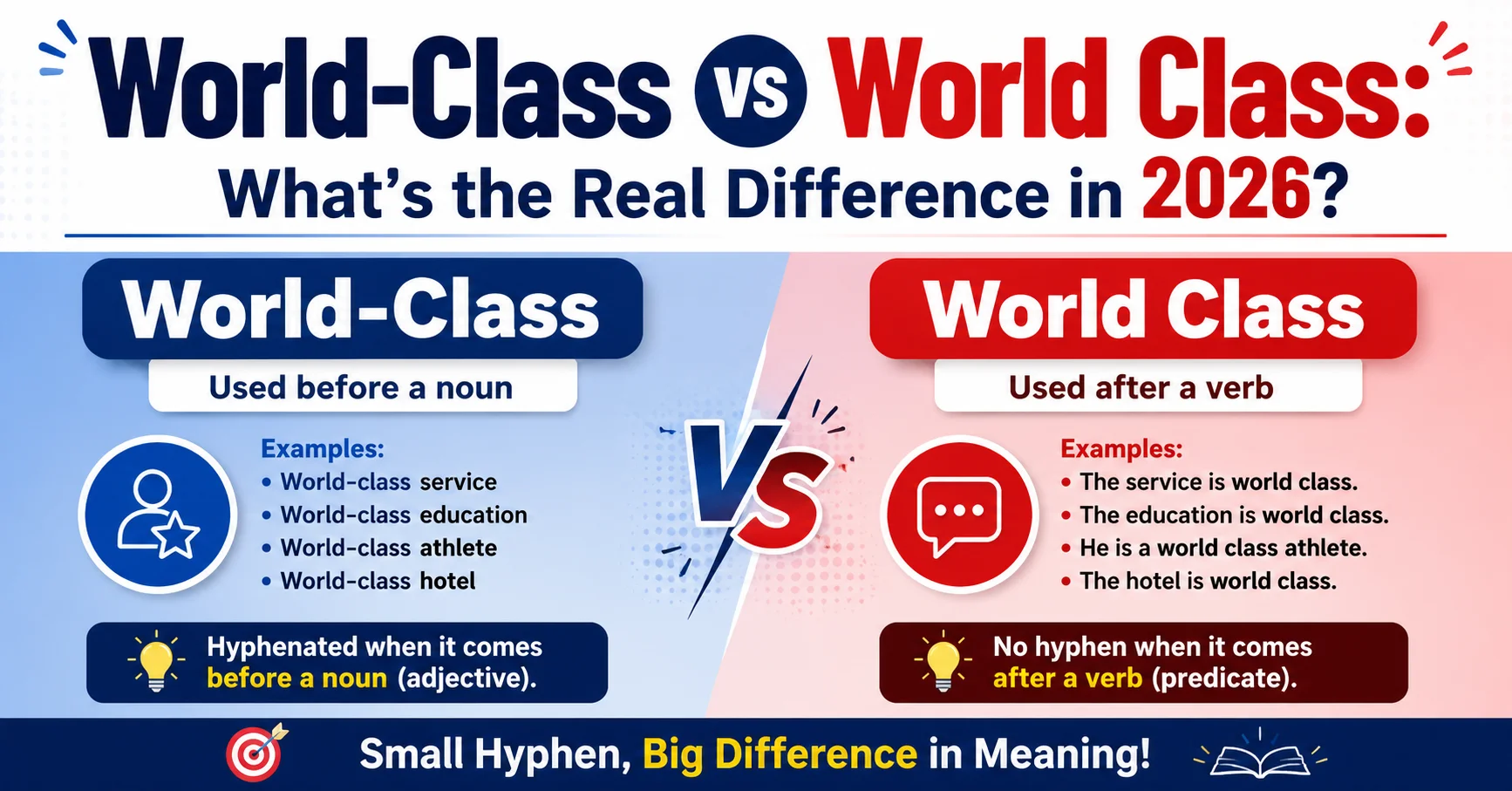
Here is the easiest way to understand it:
| Version | Usage | Example |
|---|---|---|
| World-class | Used before a noun as an adjective | World-class hotel |
| World class | Used after a verb or noun phrase | The hotel is world class |
The hyphen connects two words into one describing term. Without the hyphen, the phrase works differently in the sentence.
This is the core rule behind World-Class vs World Class.
What Does “World-Class” Mean?
“World-class” means something is among the best in the world. It describes high quality, excellence, or outstanding performance.
When used with a hyphen, it becomes a compound adjective. That means it directly describes a noun.
Examples:
- A world-class athlete
- A world-class restaurant
- A world-class education
- A world-class experience
In each example, the phrase comes before the noun and acts like one describing unit.
Common Industries Using “World-Class”
| Industry | Example Phrase |
|---|---|
| Sports | World-class player |
| Business | World-class customer support |
| Travel | World-class resort |
| Education | World-class university |
| Technology | World-class software |
Businesses often use this phrase in branding because it sounds powerful and professional.
What Does “World Class” Mean Without the Hyphen?
Without the hyphen, “world class” usually appears after a linking verb like “is,” “was,” or “feels.”
Examples:
- Their customer support is world class.
- This hotel feels world class.
- Her singing ability is world class.
In these examples, the phrase describes the subject after the verb instead of directly before the noun.
This structure is common in casual writing and conversation.
Grammar Rule Behind World-Class vs World Class
The grammar rule is actually very simple.
Use the Hyphen Before a Noun
When the phrase comes before a noun, use a hyphen.
Correct examples:
- World-class chef
- World-class stadium
- World-class training center
Incorrect examples:
- World class chef
- World class stadium
The hyphen prevents confusion and improves readability.
Do Not Use the Hyphen After a Verb
When the phrase comes after a linking verb, remove the hyphen.
Correct examples:
- The chef is world class.
- The stadium feels world class.
- Their service remains world class.
Incorrect examples:
- The chef is world-class.
- The service remains world-class.
This is the main grammar principle behind World-Class vs World Class.
Why Hyphens Matter in English Writing
Hyphens may seem small, but they help readers understand sentences faster.
Imagine reading this:
- Small business owner support
Now compare it to this:
- Small-business owner support
The second sentence is clearer because the hyphen groups words together properly.
The same thing happens with World-Class vs World Class. The hyphen improves sentence structure and removes confusion.
Professional writers, editors, journalists, and SEO experts pay close attention to these details because readability affects trust.
Real Examples of World-Class vs World Class
Here are some practical examples to make things clearer.
| Correct Sentence | Why It Works |
|---|---|
| They built a world-class hospital. | Before noun |
| The hospital is world class. | After verb |
| She received world-class training. | Before noun |
| Her training feels world class. | After verb |
| We offer world-class solutions. | Before noun |
| Their solutions are world class. | After verb |
Once you practice this pattern, it becomes natural.
Common Mistakes Writers Make
Many writers mix these forms incorrectly. Here are the most common errors.
Mistake 1: Forgetting the Hyphen Before a Noun
Incorrect:
- They provide world class support.
Correct:
- They provide world-class support.
Mistake 2: Adding a Hyphen After a Verb
Incorrect:
- Their support is world-class.
Correct:
- Their support is world class.
Mistake 3: Using Both Styles Randomly
Consistency matters. A professional article should follow proper grammar rules throughout the content.
World-Class vs World Class in SEO Writing
SEO writers often use this phrase in headings, product descriptions, and marketing pages.
Google values readability and clarity. Correct grammar helps content appear more trustworthy and easier to understand.
Here is how professional SEO writers use the phrase:
Before a Noun
- World-class SEO services
- World-class digital marketing
- World-class content strategy
After a Verb
- Our services are world class.
- Their support remains world class.
Using the correct form can improve user experience, which is important for modern search rankings.
How Brands Use “World-Class” in Marketing
Companies love the phrase “world-class” because it signals quality and authority.
You will often see phrases like:
- World-class customer service
- World-class innovation
- World-class security
- World-class infrastructure
The phrase creates a strong emotional impact. It tells customers the company offers premium value.
However, overusing it can make writing sound exaggerated or generic. Smart brands support the phrase with real proof, examples, and results.
Better Marketing Example
Weak:
- We provide world-class solutions.
Strong:
- We provide world-class solutions trusted by over 500 global companies.
Specific details increase trust.
Is “World-Class” Overused?
Yes, sometimes it is.
Many businesses use the phrase without explaining why they deserve it. Readers today are smarter and more skeptical. They want evidence.
If you use “world-class,” support it with facts like:
- Awards
- Experience
- Certifications
- Customer reviews
- Performance data
This aligns better with Google’s E-E-A-T guidelines.
Alternatives to World-Class
Sometimes repeating the phrase too often can hurt readability. Here are some useful alternatives.
| Alternative | Best Use |
|---|---|
| Outstanding | General quality |
| Elite | Sports or performance |
| Top-tier | Business and marketing |
| Exceptional | Formal writing |
| Premium | Products and services |
| Industry-leading | Corporate content |
| High-quality | General use |
| Best-in-class | Technology and business |
Using variations improves natural writing flow.
World-Class vs World Class in Formal Writing
Formal writing usually follows strict grammar rules. That means hyphen placement becomes very important.
Academic writing, journalism, and business communication generally use:
- “World-class” before nouns
- “World class” after verbs
Professional editors pay close attention to these patterns.
Example in Business Writing
Correct:
- We built a world-class support system.
Correct:
- Our support system is world class.
Following these standards makes your writing appear more polished and authoritative.
How Journalists Use These Terms
News websites and professional publications usually follow style guides like AP Style or Chicago Style.
These style guides support compound hyphenation before nouns.
That means journalists often write:
- World-class athlete
- World-class museum
- World-class facility
But after a verb, they usually remove the hyphen:
- The facility is world class.
Understanding editorial standards helps writers sound more professional.
The History of Compound Adjectives
English grammar has used compound adjectives for centuries. Hyphens were created to help readers understand grouped ideas quickly.
Examples include:
- Long-term investment
- High-quality product
- Well-known actor
- Full-time employee
“World-class” follows the same pattern.
Over time, some compound words lose hyphens completely. Others keep them permanently. Language changes slowly through common usage.
Why This Grammar Rule Matters Online
Online readers scan content quickly. Clear grammar improves readability and user experience.
Google’s Helpful Content system values:
- Easy readability
- Clear sentence structure
- Helpful information
- Human-focused writing
Using World-Class vs World Class correctly supports all these goals.
Small grammar improvements can make articles feel more trustworthy and professional.
Examples in Everyday Conversations
You probably hear these phrases often without noticing.
Everyday Spoken Examples
- That restaurant is world class.
- She has world-class skills.
- Their training center feels world class.
- They offer world-class hospitality.
Native speakers naturally switch between both forms depending on sentence structure.
Quick Memory Trick for World-Class vs World Class
Here is an easy trick to remember forever:
Before the Noun = Hyphen
- World-class hotel
- World-class chef
After the Verb = No Hyphen
- The hotel is world class.
- The chef is world class.
This simple memory trick works almost every time.
Comparison Table for Easy Understanding
| Sentence Position | Correct Form | Example |
|---|---|---|
| Before noun | World-class | World-class technology |
| After verb | World class | The technology is world class |
| Marketing headline | World-class | World-class design solutions |
| Casual statement | World class | Their design is world class |
Tables like this make grammar rules easier to remember.
How Teachers Explain Compound Adjectives
Teachers often explain compound adjectives as “teamwork words.” Two words work together to describe one noun.
For example:
- Fast-moving train
- High-speed internet
- World-class athlete
The hyphen tells readers the words belong together.
Without the hyphen, sentences may feel awkward or confusing.
Should You Always Use the Phrase?
Not always.
While World-Class vs World Class is useful, repeating it too much can weaken your writing.
Good writers mix vocabulary naturally. They use specific examples instead of relying only on praise words.
For example:
Weak:
- We provide world-class service.
Better:
- Our support team answers customer questions within two minutes.
Specific proof builds stronger trust.
Tips for Better Professional Writing
Here are practical writing tips you can use immediately.
1. Read Sentences Out Loud
If the phrase sounds connected before a noun, use the hyphen.
2. Keep Sentences Simple
Short sentences improve readability.
3. Avoid Marketing Overload
Do not overuse promotional phrases.
4. Focus on Clarity
Clear writing always wins.
5. Follow Consistent Grammar
Consistency improves professionalism.
How AI Writing Tools Handle World-Class vs World Class
Modern AI tools sometimes misuse hyphens. That is why human editing still matters.
Even advanced grammar software can occasionally miss context-based hyphen rules.
When editing content, always check:
- Is the phrase before a noun?
- Is it after a verb?
- Does the sentence sound natural?
Human review improves accuracy and trustworthiness.
FAQs About World-Class vs World Class
Is “world-class” hyphenated?
Yes, when it comes before a noun. Example: “world-class service.”
Is “world class” correct without a hyphen?
Yes, when used after a verb. Example: “Their service is world class.”
Which version is better for SEO?
Both are correct depending on sentence structure. Good SEO writing focuses on readability and proper grammar.
Why do compound adjectives use hyphens?
Hyphens help readers understand grouped descriptive words more clearly.
Final Thoughts on World-Class vs World Class
Understanding World-Class vs World Class is easier than most people think. The key difference comes down to sentence position and grammar structure.
Use “world-class” before a noun because it acts as a compound adjective.
Use “world class” after a verb because it works as a descriptive phrase instead.
These small grammar details matter in professional writing, SEO content, journalism, business communication, and everyday English. Correct usage improves readability, trust, and clarity.
As online content becomes more competitive in 2026, polished writing matters more than ever. Readers trust content that feels natural, helpful, and professionally written.
The next time you write this phrase, remember the simple rule:
- Before noun = world-class
- After verb = world class
Once you learn that pattern, you will never confuse them again.
