


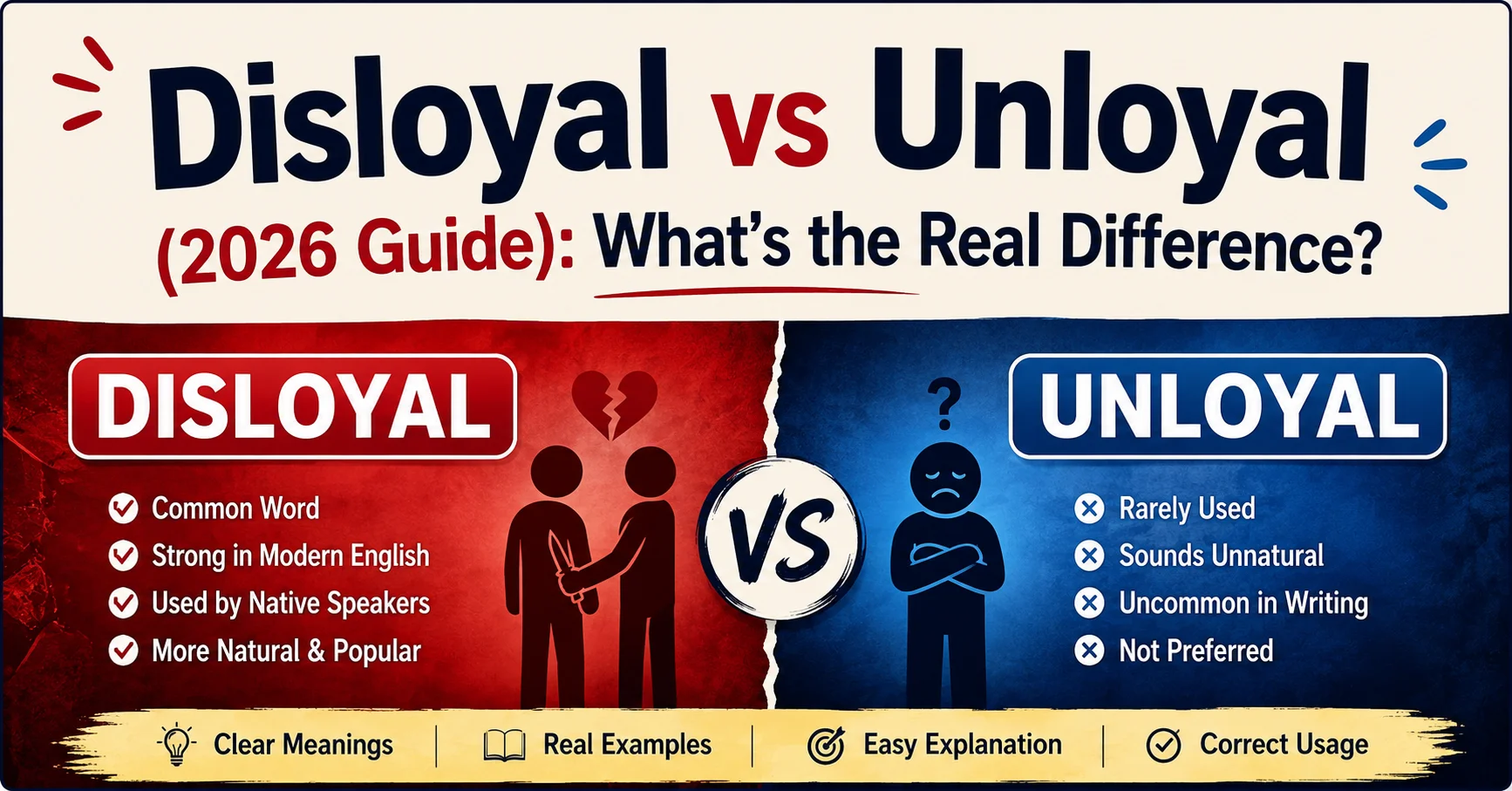
People often confuse Disloyal vs Unloyal because both words talk about loyalty. At first glance, they seem identical. But in real English, one word is much more common and natural than the other. If you have ever wondered which word sounds correct, you are not alone.
Many English learners, students, and even native speakers search for the difference between these two words. The good news is that the answer is simple once you understand how each word is used in daily conversations and writing.
In this complete guide, you will learn the exact meaning of both words, when to use them, and why one sounds more natural. You will also see examples, grammar tips, comparison tables, and common mistakes people make. By the end, you will confidently know how to use these words correctly in real life.
Why People Confuse Disloyal and Unloyal
English has many words that use prefixes like “dis-” and “un-.” Both prefixes can create negative meanings. That is why many people think disloyal and unloyal mean the same thing.
For example:
- Happy → Unhappy
- Honest → Dishonest
- Loyal → ?
This is where confusion begins. Some learners expect “unloyal” to be the natural opposite of loyal. It sounds logical because many English words use “un-” for opposites. But English does not always follow perfect rules.
Native speakers almost always use disloyal instead of unloyal. While “unloyal” exists in dictionaries, it sounds uncommon and unnatural in modern English. Most teachers, writers, and editors prefer “disloyal.”
Understanding this difference helps your English sound smoother and more professional.
What Does “Loyal” Mean?
Before comparing Disloyal vs Unloyal, it helps to understand the base word: loyal.
A loyal person stays faithful, supportive, and trustworthy. Loyalty often appears in friendships, relationships, jobs, sports teams, and families.
Examples of Loyal:
- A loyal friend keeps your secrets safe.
- Loyal employees support their company.
- A loyal dog stays beside its owner.
Loyalty is usually seen as a positive quality. People admire loyalty because it shows trust and commitment.
Table: Meaning of Loyal in Different Situations
| Situation | Meaning of Loyal |
|---|---|
| Friendship | Staying supportive |
| Marriage | Being faithful |
| Workplace | Supporting the company |
| Sports | Supporting one team |
| Family | Standing by relatives |
When someone is not loyal, we need a negative word. That is where “disloyal” and “unloyal” enter the conversation.
What Does “Disloyal” Mean?
The word disloyal means someone is not faithful, supportive, or trustworthy. It often suggests betrayal or a lack of commitment.
This word is very common in modern English. You will hear it in movies, books, schools, workplaces, and daily conversations.
Examples:
- He was disloyal to his best friend.
- The employee became disloyal after sharing company secrets.
- Many fans called the player disloyal after he changed teams.
The word usually carries a strong emotional feeling. It often suggests disappointment or broken trust.
Common Situations Where “Disloyal” Is Used
| Context | Example |
|---|---|
| Relationships | A disloyal partner lied repeatedly |
| Friendship | A disloyal friend shared private information |
| Workplace | A disloyal worker leaked company data |
| Politics | Citizens accused the leader of being disloyal |
| Sports | Fans viewed the transfer as disloyal |
Most English speakers naturally choose this word.
What Does “Unloyal” Mean?
The word unloyal technically means “not loyal.” However, it is rarely used in modern English.
Many dictionaries list it as a real word, but native speakers almost never say it in daily conversation. In fact, hearing “unloyal” can sound strange or outdated.
Example:
- She seemed unloyal to the group.
Although the sentence is understandable, most people would naturally say:
- She seemed disloyal to the group.
That is why English teachers usually recommend avoiding “unloyal” in normal writing and speaking.
Why “Unloyal” Sounds Unnatural
English developed over hundreds of years. Some words became popular while others slowly disappeared. “Disloyal” became the preferred form because speakers used it more often.
Language does not always follow perfect grammar patterns. Sometimes usage matters more than logic.
Disloyal vs Unloyal: The Main Difference
The biggest difference between Disloyal vs Unloyal is common usage.
Both words technically mean “not loyal,” but only one sounds natural in modern English.
Quick Comparison Table
| Feature | Disloyal | Unloyal |
|---|---|---|
| Common in modern English | Yes | Rare |
| Sounds natural | Yes | Usually no |
| Found in dictionaries | Yes | Yes |
| Used by native speakers | Very often | Very rarely |
| Best choice for writing | Yes | Usually avoid |
If you want your English to sound fluent and natural, use disloyal.
Why Native Speakers Prefer “Disloyal”
Native English speakers learn words through repeated exposure. Since books, movies, teachers, and media mostly use “disloyal,” that version feels correct to most people.
When a word becomes common over time, it usually replaces less popular alternatives.
For example:
- Incomplete is common.
- Uncomplete sounds wrong.
Similarly:
- Disloyal is common.
- Unloyal sounds awkward.
This happens because English grows through habit and culture, not strict logic alone.
I personally noticed this while editing online content. Writers almost always use “disloyal” in articles, news stories, and reviews. Seeing “unloyal” feels unusual even when it is technically understandable.
Is “Unloyal” Grammatically Incorrect?
No, “unloyal” is not completely wrong. Some dictionaries recognize it as a valid word. However, being correct does not always mean being natural.
Many rare English words are technically correct but sound odd in conversation.
Think About These Examples:
- “Irregardless” exists, but many people dislike it.
- “Ain’t” appears in dictionaries, but formal writing avoids it.
The same idea applies here.
So if someone uses “unloyal,” native speakers will probably understand the meaning. Still, most people would choose “disloyal” instead.
Real-Life Examples of Disloyal vs Unloyal
Seeing real examples makes the difference easier to understand.
Table: Natural vs Unnatural Usage
| Sentence | Natural? |
|---|---|
| He was disloyal to his family. | Yes |
| He was unloyal to his family. | Sounds awkward |
| The employee became disloyal. | Yes |
| The employee became unloyal. | Rare usage |
| Fans called the player disloyal. | Very natural |
| Fans called the player unloyal. | Uncommon |
Notice how “disloyal” feels smoother and more familiar.
Common Mistakes People Make
Many learners make small mistakes when comparing Disloyal vs Unloyal. Here are the most common ones.
1. Using “Unloyal” in Formal Writing
This can make your writing sound unnatural.
2. Thinking Both Words Are Equally Common
They are not. “Disloyal” is far more popular.
3. Mixing Tone and Meaning
“Disloyal” often sounds stronger emotionally.
4. Translating Directly From Another Language
Some languages use simple negative prefixes differently. English usage may not match perfectly.
Table: Mistakes and Better Choices
| Mistake | Better Option |
|---|---|
| She is unloyal. | She is disloyal. |
| An unloyal employee | A disloyal employee |
| Unloyal behavior | Disloyal behavior |
How to Remember the Correct Word Easily
A simple trick can help you remember the better choice.
Memory Tip:
Think of these common words:
- Disrespect
- Dishonest
- Disagree
Now connect that pattern with:
- Disloyal
The “dis-” prefix often appears in strong negative behaviors involving trust or actions.
This makes “disloyal” feel more natural in English.
Another helpful method is reading books, blogs, and news articles. You will notice that professional writers almost always use “disloyal.”
Can You Use “Unloyal” in Any Situation?
Yes, but it is uncommon.
Some writers may use “unloyal” for stylistic reasons, poetry, or historical writing. Older texts sometimes contain the word more often than modern English does.
Still, if your goal is clear and modern communication, “disloyal” remains the safer choice.
Rare Example:
- The knight was considered unloyal to the crown.
Even here, many modern readers would prefer “disloyal.”
Disloyal vs Unloyal in American and British English
Interestingly, both American and British English strongly prefer “disloyal.”
Whether you read:
- American newspapers
- British novels
- Online blogs
- Academic writing
You will almost always find “disloyal.”
That consistency makes the choice easier for English learners.
Table: Usage Around the English-Speaking World
| Region | Preferred Word |
|---|---|
| United States | Disloyal |
| United Kingdom | Disloyal |
| Canada | Disloyal |
| Australia | Disloyal |
The pattern stays nearly the same everywhere.
Emotional Meaning Behind “Disloyal”
The word “disloyal” often feels emotional because it suggests broken trust.
When someone is called disloyal, people may feel:
- Hurt
- Betrayed
- Angry
- Disappointed
For example:
- A disloyal friend breaks confidence.
- A disloyal partner breaks trust.
- A disloyal employee damages a company.
That emotional strength is another reason the word became more popular than “unloyal.”
It sounds more powerful and expressive.
Better Alternatives to Disloyal
Sometimes another word works even better depending on the situation.
Synonyms for Disloyal
| Word | Meaning |
|---|---|
| Faithless | Not faithful |
| Betraying | Breaking trust |
| Treacherous | Dangerous betrayal |
| Unfaithful | Not loyal in relationships |
| False | Not trustworthy |
Each word has a slightly different tone.
For example:
- “Unfaithful” is common in romantic relationships.
- “Treacherous” sounds more dramatic.
Choosing the right word improves clarity and writing quality.
How Writers and Editors Handle These Words
Professional editors usually replace “unloyal” with “disloyal.”
Why?
Because writing should sound natural to readers. Even if “unloyal” is technically valid, it can interrupt the reading flow.
I have seen this happen often in blog editing and SEO writing. Editors prefer words readers instantly recognize. Since “disloyal” is more familiar, it creates smoother communication.
This matters especially for:
- Blog posts
- School essays
- Business writing
- Website content
- Social media captions
Clear language always wins.
When Loyalty Matters Most
Understanding loyalty helps you understand why the opposite matters too.
People value loyalty in many areas of life:
- Family relationships
- Friendships
- Marriage
- Business partnerships
- Teams and communities
When loyalty disappears, trust weakens.
That is why words like “disloyal” carry emotional weight. They describe more than behavior. They describe broken trust between people.
Language becomes stronger when emotions connect to meaning.
Simple Rule to Follow
If you only remember one thing from this guide, remember this:
Use “disloyal” in almost every situation.
It is:
- More natural
- More common
- More modern
- More professional
You can understand “unloyal,” but you rarely need it.
That simple rule will help your English sound more fluent.
FAQs About Disloyal vs Unloyal
1. Is “unloyal” a real word?
Yes, “unloyal” exists in dictionaries. However, it is very uncommon in modern English.
2. Which word sounds more natural?
“Disloyal” sounds much more natural to native English speakers.
3. Can I use “unloyal” in essays?
You can, but most teachers and editors prefer “disloyal.”
4. Are disloyal and unloyal exactly the same?
Their meanings are similar, but their usage differs greatly.
5. Why do people rarely use “unloyal”?
Because “disloyal” became the standard word through common usage over time.
Conclusion
The debate around Disloyal vs Unloyal becomes simple once you understand real English usage. Both words technically mean “not loyal,” but only one sounds natural in modern communication.
“Disloyal” is the clear winner. It appears in conversations, books, websites, movies, and professional writing. Native speakers trust and recognize it instantly. Meanwhile, “unloyal” feels rare and awkward in most situations.
If you want stronger, smoother, and more fluent English, choose “disloyal” almost every time. It is the safer and more natural option.
Language learning becomes easier when you focus on real-world usage instead of strict grammar rules alone. The more you read and listen to English, the more these patterns become clear.
Have you ever heard someone use “unloyal” in real life? Most people have not. That alone shows which word modern English truly prefers.
