


Have you ever heard someone say, “There’s a dog in the street,” while another person says, “I saw him on the street”? At first, both phrases may sound almost the same. But in English, small word changes can create very different meanings.
The confusion around In the Street vs On the Street is very common. Many English learners use these phrases incorrectly because both talk about streets and locations. Yet native speakers choose one or the other depending on the situation.
This guide will explain the difference in the easiest way possible. You will learn when to use each phrase, why the meaning changes, and how native speakers actually use them in real conversations. You’ll also see examples, grammar tips, memory tricks, and common mistakes people make.
By the end of this article, you’ll feel confident using both expressions naturally in daily English.
Why People Get Confused About “In the Street vs On the Street”
English prepositions can be tricky. Words like in, on, and at seem small, but they completely change meaning.
The phrases In the Street vs On the Street confuse people because both refer to streets. However, the speaker’s focus changes depending on which preposition they choose.
Usually:
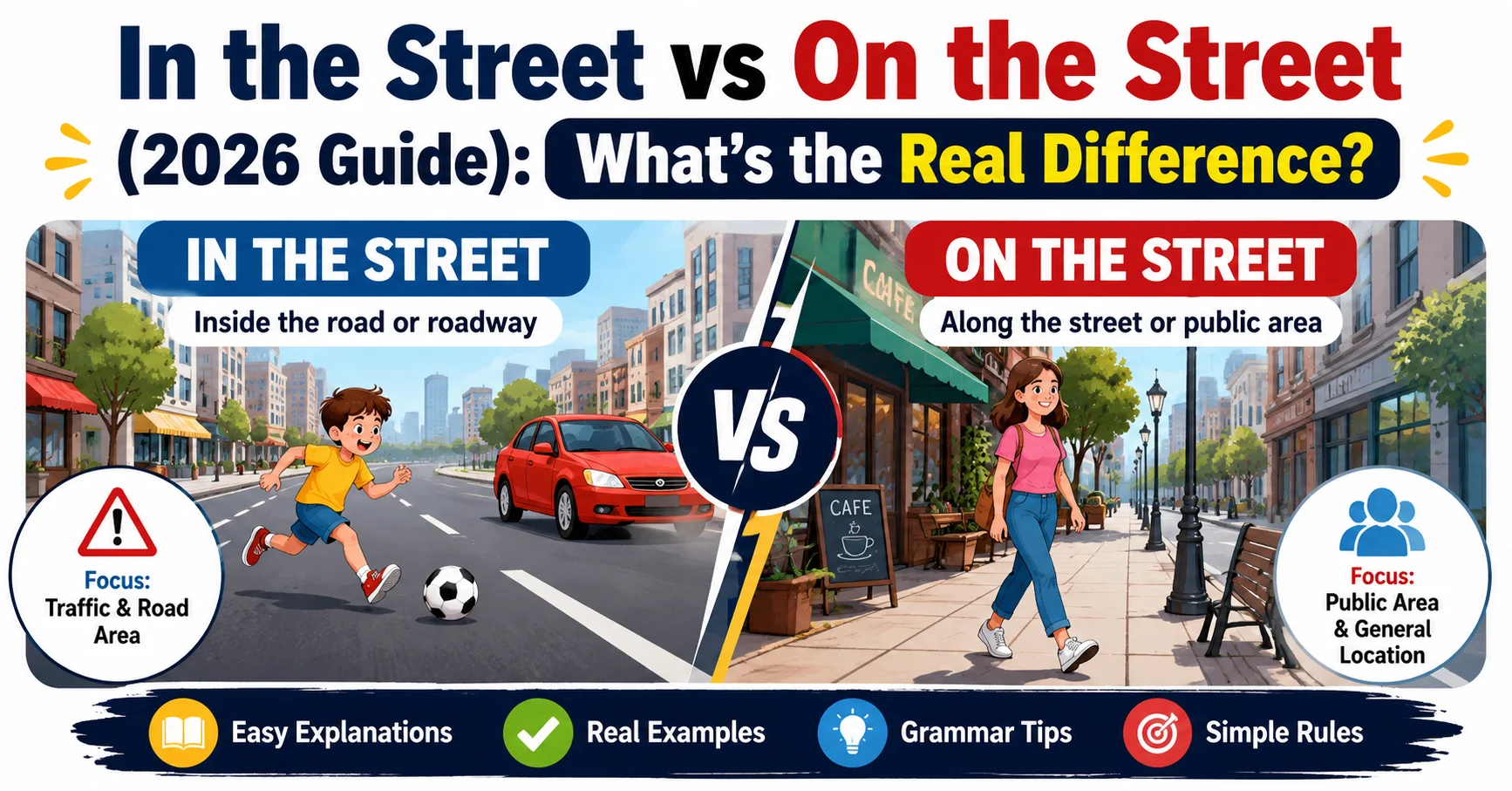
- In the street means physically inside the roadway.
- On the street often means along the street, living without a home, or generally outside in public.
This difference may seem tiny, but it matters a lot in real communication. Imagine a parent shouting:
“Don’t play in the street!”
They mean the child is standing where cars drive. That could be dangerous.
Now compare that with:
“I met him on the street.”
This simply means the meeting happened outside somewhere along the road or sidewalk.
The meanings are connected, but they are not identical.
Simple Definition of “In the Street”
The phrase in the street usually means something is located directly inside the road area where vehicles move.
People often use it when talking about:
- Cars
- Traffic
- Children playing
- Objects blocking the road
- Dangerous situations
Here are some examples:
- The ball rolled in the street.
- A cat was sleeping in the street.
- Kids should not run in the street.
In these examples, the object or person is physically inside the roadway itself.
Quick Meaning Table
| Phrase | Meaning | Common Use |
|---|---|---|
| In the street | Inside the road area | Traffic, danger, movement |
| On the street | Along the street/public area | Location or public life |
The easiest way to remember this is:
“In” often suggests being inside a space.
That is why we say “in the room,” “in the car,” and sometimes “in the street.”
Simple Definition of “On the Street”
The phrase on the street has several meanings in English. The most common meaning is being somewhere along a street or in a public outdoor area.
Examples:
- I saw her on the street yesterday.
- There are many cafés on the street.
- We walked together on the street.
In American English especially, people often use this phrase for general public areas near roads and sidewalks.
But there’s another important meaning too.
“On the Street” Can Mean Homeless
English speakers also use on the street to describe homelessness.
Examples:
- After losing his job, he ended up on the street.
- Many charities help people living on the street.
In this case, the phrase has nothing to do with standing on pavement. It refers to having no permanent home.
Meaning Comparison Table
| Phrase | Meaning |
|---|---|
| On the street | Outside in public |
| On the street | Along a road or sidewalk |
| On the street | Homeless |
This is why context matters so much.
The Main Difference Between In the Street vs On the Street
The biggest difference between In the Street vs On the Street is location and perspective.
“In the Street”
This focuses on the inside area of the roadway.
“On the Street”
This focuses on the street as a public place or general location.
Think of it this way:
| Expression | Focus |
|---|---|
| In the street | Inside the road |
| On the street | Around or along the road |
Here’s a real-life example:
- A child playing in the street is likely standing where cars drive.
- A musician performing on the street is probably standing on the sidewalk.
Both involve streets, but the image changes completely.
Native speakers naturally understand this difference because the preposition changes the scene in their minds.
British English vs American English Usage
One interesting part of In the Street vs On the Street is that British and American English sometimes use these phrases differently.
In British English, people often say:
- “She lives in this street.”
In American English, speakers usually prefer:
- “She lives on this street.”
Both are correct depending on regional style.
Regional Usage Table
| Situation | British English | American English |
|---|---|---|
| Talking about residence | In this street | On this street |
| Talking about roadway danger | In the street | In the street |
| Talking about public areas | On the street | On the street |
So if you hear different versions online, don’t panic. Sometimes the difference comes from regional English habits.
When You Should Use “In the Street”
You should use in the street when something is physically within the driving area of the road.
This usually includes movement, danger, or objects blocking traffic.
Common Situations
- A child running in traffic
- Trash lying in the roadway
- Cars parked badly
- Animals crossing
Examples
- There was broken glass in the street.
- Someone left a bicycle in the street.
- The dog suddenly ran in the street.
These examples create a visual picture of something occupying road space.
Helpful Memory Trick
If a car could hit it, “in the street” probably works.
That simple rule helps many English learners remember the difference quickly.
When You Should Use “On the Street”
Use on the street when speaking generally about public outdoor areas connected to roads.
This phrase works for:
- Walking outside
- Public activity
- Businesses
- Sidewalks
- City life
Examples
- I bought flowers on the street.
- Street musicians played music on the street.
- We met randomly on the street.
The phrase often gives a broad sense of location instead of an exact physical position.
Another Meaning: Information From Ordinary People
English also uses “on the street” in expressions like:
- “Word on the street is…”
- “People on the street think…”
This means public opinion or common talk.
Common Mistakes English Learners Make
Many learners mix up In the Street vs On the Street because direct translation from their native language may not work.
Here are the most common mistakes.
Mistake #1: Using “On the Street” for Traffic Danger
❌ The children are playing on the street.
This sounds less dangerous in some contexts.
✅ The children are playing in the street.
This clearly shows they are inside the road area.
Mistake #2: Using “In the Street” for Public Walking
❌ I saw him in the street yesterday.
This can sound unusual unless he was standing in traffic.
✅ I saw him on the street yesterday.
This sounds more natural.
Mistake #3: Forgetting the Homeless Meaning
Some learners hear:
“He’s living on the street.”
They imagine someone literally sleeping on pavement. While that image may be true, the phrase actually means homelessness.
Understanding hidden meanings improves fluency greatly.
Real-Life Examples of In the Street vs On the Street
Real examples help grammar stick better in memory.
Example Set 1
- There’s water in the street after the storm.
- There are many restaurants on the street.
Example Set 2
- A truck stopped suddenly in the street.
- I met an old friend on the street.
Example Set 3
- Children shouldn’t sit in the street.
- Artists sell paintings on the street.
Notice how “in” feels more physical and exact, while “on” feels broader and more public.
How Native Speakers Naturally Use These Phrases
Native speakers usually choose these expressions without thinking about grammar rules. Instead, they imagine the scene.
If something is blocking traffic or sitting in the roadway, they often use:
- In the street
If something happens generally outside in public, they often use:
- On the street
This natural image-based thinking is important. English fluency becomes easier when you picture situations instead of memorizing strict rules.
Native Usage Patterns
| Situation | Natural Phrase |
|---|---|
| Car accident location | In the street |
| Meeting someone outside | On the street |
| Public performance | On the street |
| Ball rolling near cars | In the street |
These patterns appear constantly in movies, books, and conversations.
Easy Grammar Rule to Remember Forever
Here’s one of the easiest grammar tricks for In the Street vs On the Street.
Use “In” for Physical Position
Think about being physically inside the roadway.
Use “On” for General Public Space
Think about outdoor public life connected to streets.
Super Simple Formula
| Preposition | Think About |
|---|---|
| In | Inside road area |
| On | Public outdoor area |
This quick mental shortcut works in most situations.
Similar English Phrases That Cause Confusion
English has many similar preposition pairs that confuse learners just like In the Street vs On the Street.
Here are a few examples.
| Confusing Pair | Difference |
|---|---|
| In bed vs On the bed | Sleeping vs physically on top |
| In the car vs On the car | Inside vs physically on top |
| At school vs In school | Location vs student status |
| In the corner vs On the corner | Inside a room vs street intersection |
Learning these patterns helps improve overall English grammar skills.
Mini Quiz: Test Yourself
Choose the correct phrase.
1. The kids were playing ___ the street.
Answer: in the street
2. I saw a singer performing ___ the street.
Answer: on the street
3. Many people lost homes and lived ___ the street.
Answer: on the street
4. A broken bike was lying ___ the street.
Answer: in the street
5. We met accidentally ___ the street yesterday.
Answer: on the street
Practice like this helps your brain remember the difference faster.
Why Prepositions Matter So Much in English
Prepositions are tiny words, but they carry huge meaning. Using the wrong one can confuse listeners or create strange mental images.
Imagine saying:
“There’s a man in the street.”
People may picture someone standing in traffic.
But if you say:
“There’s a man on the street.”
People imagine someone outside nearby.
The meaning changes instantly.
That’s why mastering phrases like In the Street vs On the Street improves both grammar and natural communication.
Best Tips to Master In the Street vs On the Street
Here are some practical tips that actually help.
Read English Daily
Books and articles help you see natural usage patterns.
Listen to Native Speakers
Movies, podcasts, and YouTube videos improve understanding quickly.
Picture the Scene
Visual thinking makes grammar easier.
Practice Writing Sentences
Create your own examples every day.
Learn Through Context
Avoid memorizing isolated rules only.
These methods help grammar feel natural instead of stressful.
FAQs About In the Street vs On the Street
Is “in the street” grammatically correct?
Yes. It is correct when talking about something physically inside the roadway.
Is “on the street” more common?
Yes. Native speakers use it more often for general public outdoor situations.
Can “on the street” mean homeless?
Yes. It commonly describes someone without a home.
Why do British and American English differ?
Regional speaking habits developed differently over time. Both versions can still be correct.
Which phrase should I use for meeting someone outside?
Usually, “on the street” sounds more natural.
Final Thoughts on In the Street vs On the Street
Understanding In the Street vs On the Street becomes much easier once you focus on the image behind each phrase.
Use in the street when something is physically inside the road area. Use on the street for public outdoor situations, sidewalks, city life, or homelessness.
The difference may seem small at first, but native speakers notice it immediately. Choosing the correct phrase makes your English sound clearer, more natural, and more confident.
The best way to master these expressions is through practice. Read real examples, listen carefully, and try using both phrases in daily conversation.
