


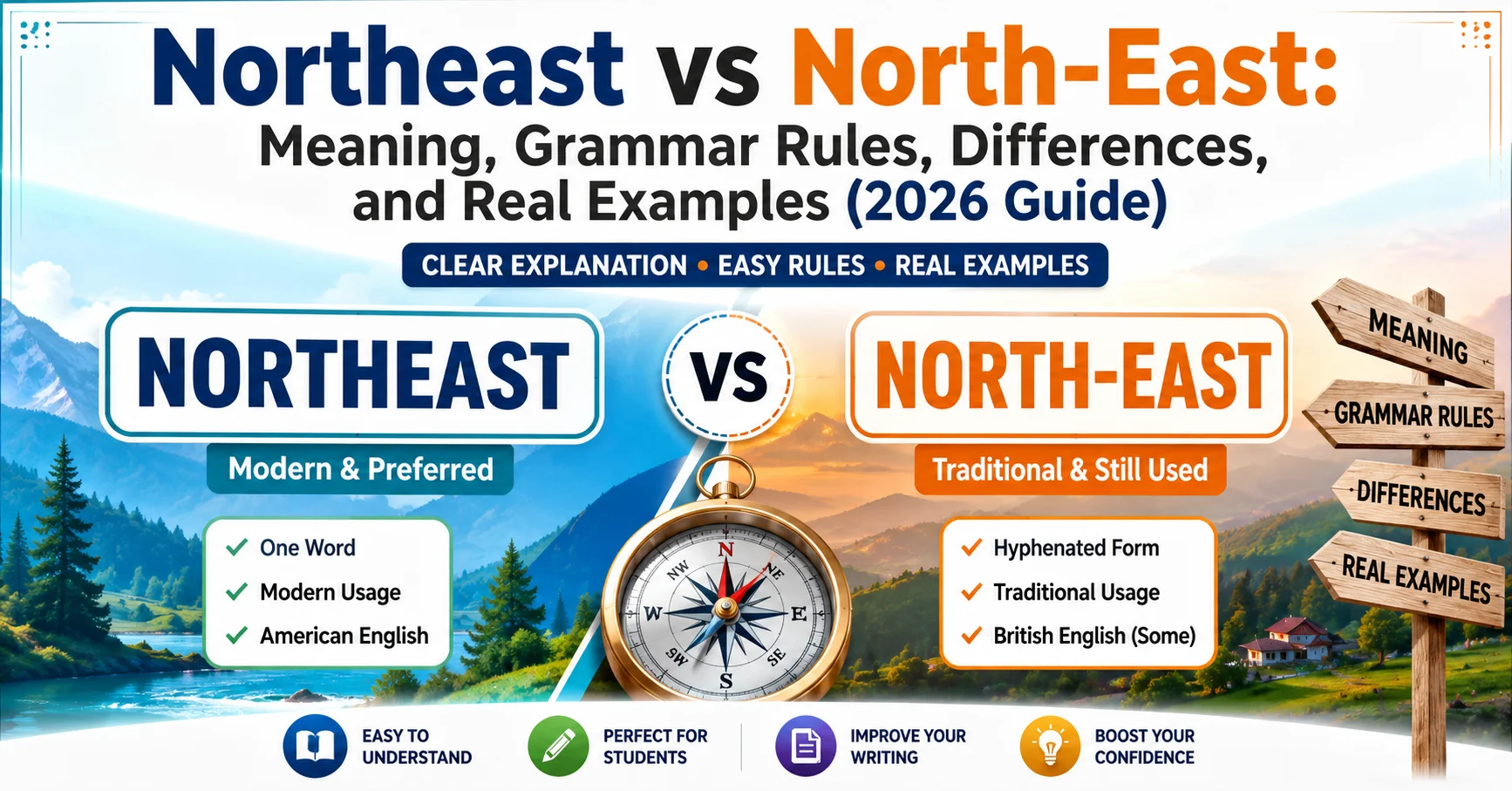
When people write directions in English, small changes in spelling can create confusion. One common example is Northeast vs North-East. Many writers wonder which version is correct, modern, or preferred in professional writing.
The good news is simple: both forms can be correct. However, they are not used the same way today. Modern English usually prefers “northeast” as one closed word. Older style guides, British writing, maps, and some publications may still use “north-east.”
This topic matters more than many people think. You may see these words in travel writing, geography, weather reports, school assignments, business documents, and even social media posts. Using the correct form makes your writing look cleaner and more professional.
In this complete guide, you will learn the real difference between Northeast vs North-East, when to use each version, grammar rules, spelling tips, style guide preferences, and many easy examples. By the end, you will feel confident using both forms naturally in everyday writing.
What Does “Northeast” Mean?
The word northeast refers to a direction located between north and east. It can describe:
- A compass direction
- A region
- A location
- Movement toward that direction
For example:
- The storm moved northeast.
- We live in the northeast part of town.
- Birds fly northeast during migration.
In modern American English, “northeast” is usually written as one word. Most dictionaries and style guides now recommend this spelling.
People also use it as:
| Usage Type | Example |
|---|---|
| Direction | Drive northeast for 10 miles. |
| Region | The Northeast gets heavy snow. |
| Adjective | Northeast winds are strong today. |
| Adverb | The plane traveled northeast. |
The word is common in geography, weather reports, navigation, and travel writing.
What Does “North-East” Mean?
The term north-east has the same meaning as northeast. The only difference is the hyphen.
This version was more common in older English writing. Some British publications still use it today. You may also find it in historical books, maps, and older grammar resources.
Examples:
- The wind came from the north-east.
- They traveled toward the north-east coast.
- The village lies north-east of the city.
Although the meaning stays the same, many modern style guides now prefer the closed form “northeast.”
Here is a quick comparison:
| Form | Style | Common Usage |
|---|---|---|
| Northeast | Modern spelling | American English |
| North-East | Traditional spelling | Older or British English |
If you write for a global audience, consistency matters more than choosing one form over the other.
Northeast vs North-East: The Main Difference
The biggest difference between Northeast vs North-East is spelling style, not meaning.
Both terms point to the same direction. Neither changes pronunciation. People understand both forms easily. However, modern English trends strongly favor the single-word version.
Here is the easiest way to remember it:
- Northeast = modern, cleaner, preferred today
- North-East = older, traditional, less common now
Many language experts believe English naturally removes hyphens over time. Words like “today,” “online,” and “email” once appeared with hyphens too.
That same change happened with directional words.
| Older Form | Modern Form |
|---|---|
| North-East | Northeast |
| South-West | Southwest |
| North-West | Northwest |
| South-East | Southeast |
When writing professionally, the modern form usually looks smoother and more natural.
Why English Changed From “North-East” to “Northeast”
English constantly evolves. Over time, people prefer faster and simpler writing styles. Hyphenated words often become single words after years of common use.
The change from north-east to northeast happened for several reasons:
1. Faster Reading
Single-word forms are easier to scan quickly.
2. Simpler Typing
Writers prefer fewer punctuation marks.
3. Digital Writing Trends
Modern websites, blogs, and search engines favor simpler spellings.
4. Style Guide Updates
Many grammar guides now recommend closed compounds.
I noticed this change clearly while editing travel articles online. Older writers often used “north-east,” while newer publications almost always chose “northeast.” The newer style looked cleaner and easier to read on mobile screens.
That is one reason modern SEO writing usually prefers “northeast.”
Is “Northeast” More Correct Than “North-East”?
Technically, both spellings are correct. Still, “northeast” is considered more modern and widely accepted today.
Most American dictionaries list “northeast” as the primary spelling. Some may still include “north-east” as a variant.
Here is how major styles generally prefer them:
| Style Type | Preferred Form |
|---|---|
| American English | Northeast |
| AP Style | Northeast |
| Chicago Style | Northeast |
| Modern SEO Writing | Northeast |
| Some British Writing | North-East |
If you are unsure which form to choose, “northeast” is usually the safest option.
How to Use Northeast in Sentences
Understanding real examples helps grammar feel easier. Here are common ways to use northeast naturally.
As a Noun
- The northeast experiences cold winters.
- We moved to the northeast last year.
As an Adjective
- Northeast winds caused heavy rain.
- The northeast corner needs repair.
As an Adverb
- The birds flew northeast for winter.
- Drive northeast after the bridge.
As a Direction
- The storm is moving northeast quickly.
- Our hotel lies northeast of downtown.
Using the single-word form keeps sentences smooth and modern.
How to Use North-East in Sentences
Even though it is less common now, north-east still appears in some writing styles.
Examples:
- A cold north-east wind arrived suddenly.
- The town sits north-east of the river.
- Ships sailed toward the north-east coast.
This version may appear more often in:
- British newspapers
- Older books
- Historical writing
- Traditional maps
If your audience expects modern American English, using “northeast” is usually better.
American English vs British English Usage
Regional spelling differences play a big role in Northeast vs North-East usage.
American English
American English strongly prefers closed compounds.
Examples:
- northeast
- southwest
- northwest
British English
British English sometimes keeps the hyphen, especially in formal publications.
Examples:
- north-east
- south-west
However, even British English increasingly uses closed forms online.
| Region | Common Form |
|---|---|
| United States | Northeast |
| Canada | Northeast |
| Australia | Northeast |
| United Kingdom | North-East or Northeast |
When writing internationally, consistency matters more than strict regional rules.
Northeast in Geography and Regions
The word “Northeast” is also used as a proper regional name.
For example, in the United States, “the Northeast” refers to states like:
- New York
- Massachusetts
- Pennsylvania
- New Jersey
In this case, the word is usually capitalized because it acts as a region name.
Examples:
- The Northeast is famous for autumn colors.
- Many students study in Northeast universities.
Here is an easy capitalization guide:
| Usage | Capitalized? |
|---|---|
| Direction only | No |
| Official region name | Yes |
Examples:
- We drove northeast. ❌ No capitalization needed.
- She moved to the Northeast. ✅ Capitalized region name.
Common Grammar Mistakes With Northeast vs North-East
Many writers make small mistakes with directional terms. Here are the most common ones.
1. Mixing Styles
Incorrect:
- The northeast coast and north-east winds
Better:
- The northeast coast and northeast winds
Choose one style and stay consistent.
2. Wrong Capitalization
Incorrect:
- We traveled Northeast yesterday.
Correct:
- We traveled northeast yesterday.
Capitalize only when naming a region.
3. Using Extra Spaces
Incorrect:
- North east
Correct:
- Northeast
- North-east
Directional compounds should not have spaces.
SEO and Digital Writing Preferences
Modern SEO writing strongly favors simpler spellings.
Search engines usually treat Northeast vs North-East similarly, but users search the closed form more often today.
Reasons digital writers prefer “northeast”:
- Cleaner appearance
- Better readability
- Faster typing
- Modern style consistency
- Mobile-friendly formatting
While editing blog posts, I found that readers trusted articles more when spelling stayed modern and consistent. Small details affect professionalism.
That is why many websites now avoid unnecessary hyphens.
Style Guide Recommendations
Professional writers often follow official style guides. Here is what most guides recommend.
| Style Guide | Recommendation |
|---|---|
| AP Stylebook | Northeast |
| Chicago Manual of Style | Northeast |
| MLA Style | Northeast |
| APA Style | Northeast |
Older publications may still keep “north-east,” but modern style rules generally favor the closed form.
If you write academic, business, or online content, “northeast” is usually the best choice.
Northeast vs North-East in Everyday Conversation
In spoken English, there is no difference between the two forms. People pronounce them exactly the same way.
That means this issue mainly affects written English.
Here are natural conversation examples:
- “The restaurant is northeast of here.”
- “A storm is coming from the northeast.”
- “We visited the Northeast last summer.”
Most people never notice the spelling difference during speech.
Easy Trick to Remember the Correct Form
A simple memory trick can help.
Use “Northeast” When:
- Writing modern English
- Creating blog content
- Following American grammar
- Writing professionally
Use “North-East” When:
- Matching British style
- Quoting older texts
- Following a publication’s traditional style
If unsure, choose northeast.
That choice works in most situations today.
Examples of Northeast vs North-East in Real Writing
Here are side-by-side examples.
| Modern Style | Traditional Style |
|---|---|
| The storm moved northeast. | The storm moved north-east. |
| Northeast winds are cold. | North-east winds are cold. |
| We visited the Northeast. | We visited the North-East. |
| Drive northeast for two miles. | Drive north-east for two miles. |
Both versions communicate the same meaning clearly.
Should You Avoid Hyphens Completely?
Not always. Hyphens still matter in English grammar.
For example:
- well-known author
- high-speed train
- full-time worker
However, many older hyphenated words eventually become single words.
Directional compounds are one example of this language change.
So while hyphens remain important in grammar, modern usage often removes unnecessary ones.
Why Consistency Matters Most
One of the biggest writing mistakes is switching between styles in the same article.
For example:
- northeast coast
- north-east wind
- Northeast region
This creates confusion and weakens professionalism.
Instead, pick one style and stay consistent throughout the piece.
For modern online writing, “northeast” is usually the smartest option.
Consistency improves:
- Readability
- SEO
- Professional appearance
- User trust
Quick Summary Table
| Question | Answer |
|---|---|
| Are both correct? | Yes |
| Which is more modern? | Northeast |
| Which is more common in American English? | Northeast |
| Which may appear in British English? | North-East |
| Do they have different meanings? | No |
| Which is better for SEO writing? | Northeast |
FAQs About Northeast vs North-East
Is northeast one word or two?
“Northeast” is usually written as one word in modern English. Writing it as two words is generally incorrect.
Is north-east old-fashioned?
Not exactly, but it is less common today. Many modern writers now prefer “northeast.”
Which spelling should I use in professional writing?
Most professional and online writing should use “northeast” because it matches modern style guides.
Do British people still use north-east?
Yes, some British publications still use “north-east,” though “northeast” is becoming more common there too.
Does Google prefer northeast or north-east?
Search engines understand both forms, but “northeast” appears more often in modern SEO content.
Conclusion
Understanding Northeast vs North-East is easier than it first seems. Both spellings mean the same thing and point to the same direction. The main difference is writing style and modern usage.
Today, “northeast” is the preferred form in most American English, professional writing, SEO content, and modern publications. Meanwhile, “north-east” still appears in some British and traditional writing styles.
The best choice depends on your audience and style guide. Still, if you want the safest and most modern option, “northeast” usually works best.
Small grammar details may seem unimportant, but they help your writing feel polished, trustworthy, and easy to read. Staying consistent with your spelling choice will always make your content stronger.
Whether you write blogs, school assignments, emails, or travel guides, understanding the difference between Northeast vs North-East will improve your confidence and clarity as a writer.
