


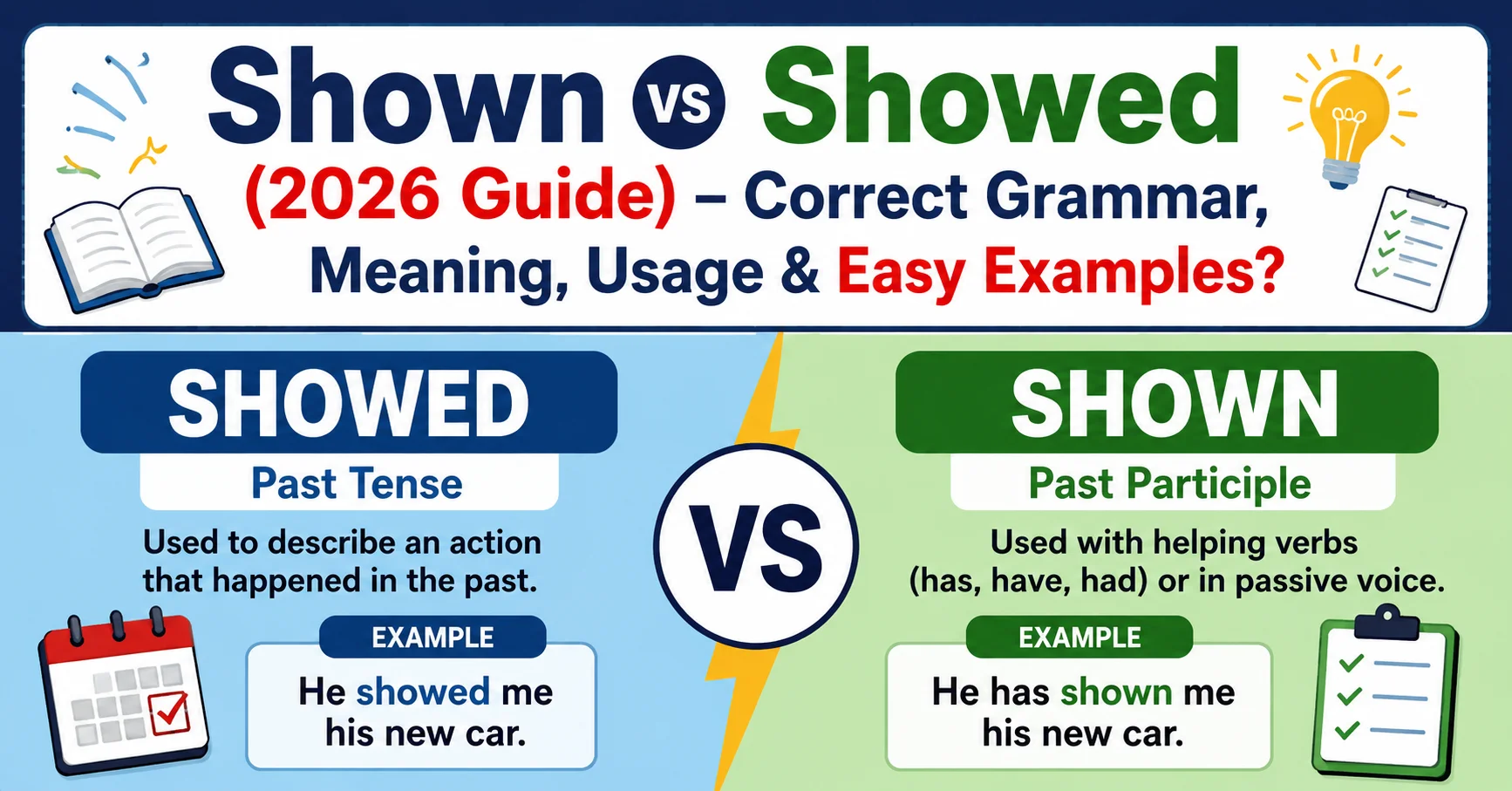
English can feel confusing at times. Some words sound right but are actually incorrect in certain situations. One common example is “shown vs showed.” Many people use both words in speaking and writing, but only one fits properly in some sentences.
If you have ever written “I have showed” or wondered whether “shown” sounds better, you are not alone. Students, bloggers, business writers, and even native speakers mix these words up often.
The good news is that the difference is simple once you understand the grammar rule behind it.
In this complete 2026 guide, you will learn:
- The difference between shown and showed
- Which one is grammatically correct
- When to use each word
- Real-life examples
- Easy grammar rules
- Common mistakes to avoid
- Helpful memory tricks
By the end, you will feel confident using both words correctly in everyday English.
Why People Confuse Shown vs Showed
The confusion happens because both words come from the verb “show.” They are connected, but they do different jobs in a sentence.
Many English verbs change form depending on time. For example:
| Base Verb | Past Tense | Past Participle |
|---|---|---|
| Go | Went | Gone |
| Write | Wrote | Written |
| Show | Showed | Shown |
The problem is that many people do not know what a past participle is. Because of this, they use “showed” everywhere.
In casual speech, you may hear sentences like:
- “I have showed you already.”
- “She had showed me the photo.”
These sound natural to some people, but standard English grammar says they are incorrect.
Understanding the difference between simple past tense and past participle makes everything easier.
What Does “Show” Mean?
The verb show means:
- To let someone see something
- To explain something
- To guide or prove something
Examples:
- “Please show me your homework.”
- “He showed kindness.”
- “The report shows improvement.”
The word changes depending on the tense used in the sentence.
Here are the main forms:
| Verb Form | Word |
|---|---|
| Base Form | Show |
| Present Tense | Show / Shows |
| Past Tense | Showed |
| Past Participle | Shown |
This table is the key to understanding shown vs showed correctly.
What Is “Showed”?
“Showed” is the simple past tense of “show.”
You use it when talking about something that already happened in the past.
Examples of Showed
- “She showed me her new dress.”
- “My teacher showed the class a video.”
- “They showed great courage.”
- “I showed him the way home.”
In all these sentences, the action happened in the past and is finished.
Easy Rule
Use showed when no helping verb appears before it.
Helping verbs include:
- has
- have
- had
- was
- were
- be
Without those helping verbs, “showed” usually works perfectly.
What Is “Shown”?
“Shown” is the past participle of “show.”
Past participles usually work with helping verbs.
Examples of Shown
- “I have shown you this before.”
- “She had shown great patience.”
- “The movie was shown last night.”
- “He has shown improvement.”
Notice something important here:
Every sentence uses a helping verb.
That is the biggest clue in the shown vs showed debate.
The Main Difference Between Shown vs Showed
The easiest way to remember the difference is this:
| Word | Grammar Role | Example |
|---|---|---|
| Showed | Simple past tense | “He showed me the book.” |
| Shown | Past participle | “He has shown me the book.” |
Here is another simple comparison:
Correct:
- “She showed me her phone.”
- “She has shown me her phone.”
Incorrect:
- “She has showed me her phone.”
This mistake is extremely common online and in casual speech.
A Simple Trick to Remember the Difference
Here is a quick memory trick that helps many learners.
If the sentence has:
- has
- have
- had
Then use shown.
Examples:
- “I have shown you.”
- “They had shown interest.”
- “She has shown progress.”
If there is no helping verb:
Use showed.
Examples:
- “I showed you yesterday.”
- “They showed interest.”
- “She showed progress.”
This simple trick works most of the time.
Shown vs Showed in Everyday Conversation
In real conversations, people sometimes use incorrect grammar casually. You may hear:
- “I have showed him already.”
Even though native speakers say this sometimes, formal English prefers:
- “I have shown him already.”
This matters especially in:
- School writing
- Business emails
- Blog articles
- Professional communication
- Exams
Using “shown” correctly makes your English sound polished and educated.
Common Grammar Patterns With Shown
“Shown” often appears in perfect tenses and passive voice.
Present Perfect
| Sentence | Correct? |
|---|---|
| “I have shown her the photo.” | ✅ |
| “I have showed her the photo.” | ❌ |
Past Perfect
| Sentence | Correct? |
|---|---|
| “They had shown kindness.” | ✅ |
| “They had showed kindness.” | ❌ |
Passive Voice
| Sentence | Correct? |
|---|---|
| “The movie was shown yesterday.” | ✅ |
| “The movie was showed yesterday.” | ❌ |
These grammar patterns appear often in writing.
Examples of Showed in Sentences
Here are more examples using “showed” correctly.
| Sentence | Why It Works |
|---|---|
| “Dad showed me how to ride a bike.” | Simple past |
| “She showed confidence during the speech.” | Past action |
| “The guide showed us the museum.” | Completed event |
| “My friend showed me his new laptop.” | Happened earlier |
Notice that these sentences describe completed past actions without helping verbs.
Examples of Shown in Sentences
Now let’s look at examples using “shown.”
| Sentence | Why It Works |
|---|---|
| “He has shown great leadership.” | Present perfect |
| “The results were shown online.” | Passive voice |
| “She had shown interest before.” | Past perfect |
| “I have shown you the answer twice.” | Helping verb used |
The helping verbs signal the need for “shown.”
Why “Have Showed” Sounds Wrong
Many learners ask why “have showed” sounds strange.
The reason is simple.
English perfect tenses require a past participle, not a simple past verb.
Compare these:
| Incorrect | Correct |
|---|---|
| “I have went.” | “I have gone.” |
| “She has wrote.” | “She has written.” |
| “They have showed.” | “They have shown.” |
Once you see the pattern, the grammar becomes easier.
Is “Showed” Ever Used as a Past Participle?
This question causes a lot of debate online.
Historically, some older English usage accepted “showed” as a past participle in rare situations. However, modern standard English strongly prefers “shown.”
Today, grammar experts, schools, dictionaries, and style guides generally recommend:
- “have shown”
- “has shown”
- “had shown”
So if you want clear and professional English, use “shown” with helping verbs.
Shown vs Showed in American and British English
Both American and British English follow the same main rule.
Standard Usage
| Form | Preferred Usage |
|---|---|
| Showed | Simple past |
| Shown | Past participle |
However, informal speech can differ slightly by region.
Some dialects may still use “showed” casually after “have” or “had,” but it is considered nonstandard in formal writing.
If you are writing for:
- websites
- blogs
- school
- work
- SEO content
Then “shown” is the safer and more professional choice.
Common Mistakes People Make
Here are some mistakes many English learners make.
Mistake 1
❌ “I have showed you already.”
✅ “I have shown you already.”
Mistake 2
❌ “The results were showed online.”
✅ “The results were shown online.”
Mistake 3
❌ “She had showed improvement.”
✅ “She had shown improvement.”
Mistake 4
❌ “They has shown me.”
✅ “They have shown me.”
This last mistake is about subject-verb agreement.
Shown vs Showed in Writing
Good grammar matters more in writing than in casual speaking.
Using the correct form improves:
- Clarity
- Trustworthiness
- Professionalism
- Readability
Imagine reading these two sentences in a job application:
❌ “I have showed leadership skills.”
✅ “I have shown leadership skills.”
The second sentence immediately sounds more polished.
This is why understanding shown vs showed is useful in real life.
Real-Life Examples You Hear Often
Here are examples from daily situations.
At School
- “The teacher showed us a science experiment.”
- “The experiment was shown on video.”
At Work
- “My manager showed me the report.”
- “The report has been shown to clients.”
With Friends
- “She showed me her vacation photos.”
- “I have already shown you those pictures.”
These examples help you hear the grammar naturally.
Easy Formula for Remembering the Rule
Here is a simple formula:
No helping verb = showed
Example:
- “He showed me.”
Helping verb = shown
Example:
- “He has shown me.”
This shortcut helps quickly during writing.
Verb Forms Related to Show
Understanding related verb forms can also help.
| Tense | Example |
|---|---|
| Present | “I show the results.” |
| Present Continuous | “I am showing the results.” |
| Past | “I showed the results.” |
| Present Perfect | “I have shown the results.” |
| Future | “I will show the results.” |
Learning all forms together improves grammar faster.
How Native Speakers Actually Use These Words
Native speakers usually say:
- “I showed him.”
- “I’ve shown him.”
Both sound natural because they follow standard grammar.
However, spoken English sometimes breaks grammar rules casually. You may hear incorrect forms in movies, songs, or social media videos.
That does not make them grammatically correct.
If you want strong English skills, follow standard grammar rules in formal writing.
Helpful Tips for Students and Writers
If you struggle with grammar, these tips can help.
Read Sentences Out Loud
Sometimes incorrect grammar sounds strange when spoken.
Example:
- “I have showed you.”
It feels awkward compared to:
- “I have shown you.”
Look for Helping Verbs
Check for:
- has
- have
- had
- was
- were
If one appears, “shown” is usually correct.
Practice Short Sentences
Simple practice helps memory.
Examples:
- “I showed him.”
- “I have shown him.”
- “She showed kindness.”
- “She has shown kindness.”
Small repetitions improve confidence.
Quick Comparison Table
Here is a final quick comparison.
| Feature | Showed | Shown |
|---|---|---|
| Verb Type | Past tense | Past participle |
| Used Alone | Yes | Usually no |
| Used With Helping Verbs | No | Yes |
| Example | “He showed me.” | “He has shown me.” |
| Formal Standard English | Yes | Yes |
This table summarizes the full grammar rule clearly.
Frequently Asked Questions
Is it correct to say “have showed”?
No. Standard English grammar uses “have shown,” not “have showed.”
Correct example:
- “I have shown you the document.”
Which is correct: shown or showed?
Both are correct, but they are used differently.
- “Showed” is simple past tense.
- “Shown” is the past participle.
Can I use showed in formal writing?
Yes, but only as a simple past tense verb.
Correct:
- “The teacher showed the presentation.”
Incorrect:
- “The presentation has showed improvement.”
Why do people say “have showed”?
Some people learn English through casual conversation instead of grammar rules. In informal speech, mistakes become common and spread naturally.
Is shown always used with has, have, or had?
Most of the time, yes. “Shown” commonly appears with helping verbs or in passive voice structures.
Examples:
- “She has shown progress.”
- “The movie was shown online.”
Conclusion
The difference between shown vs showed becomes simple once you understand verb forms.
Remember this basic rule:
- Use showed for simple past tense.
- Use shown with helping verbs like has, have, and had.
Examples:
- “I showed him the answer.”
- “I have shown him the answer.”
Many people confuse these words, especially in casual conversation. But using them correctly improves your grammar, writing, and confidence.
The next time you write an email, article, essay, or social media post, pause for a second and check the sentence structure. A small grammar choice can make your English sound much stronger and more professional.
Once you practice a few times, choosing between “shown” and “showed” will feel natural every day.
