

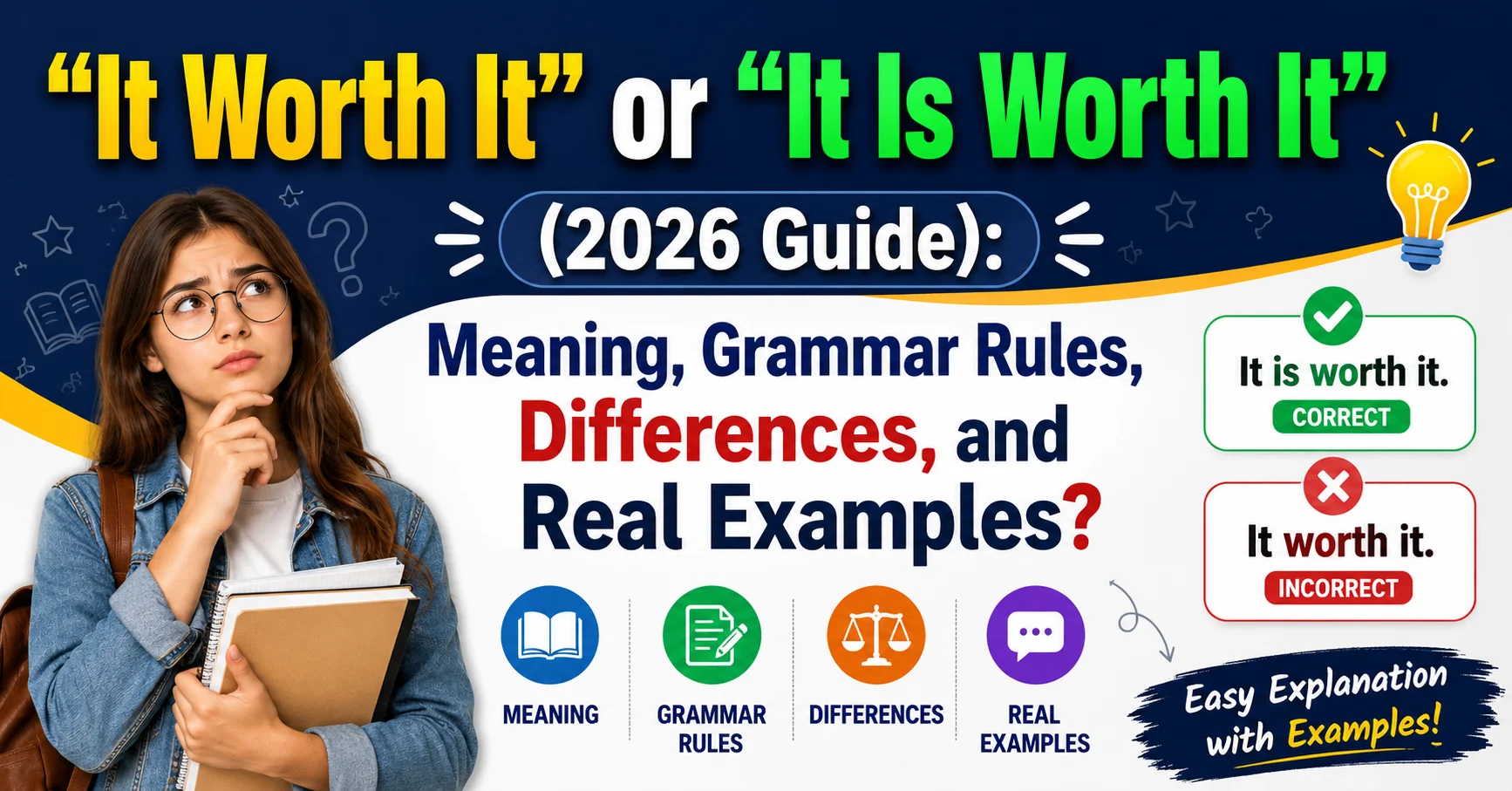
Many English learners get confused between “It Worth It” or “It Is Worth It.” At first glance, both phrases may sound similar. But only one is grammatically correct in standard English.
This small mistake appears in daily conversations, social media captions, text messages, and even professional writing. Many people leave out the word “is” because they hear native speakers talk quickly. Over time, the incorrect version starts sounding normal.
Still, grammar matters. Using the right phrase helps your English sound clearer, smarter, and more natural. Whether you are writing emails, speaking in class, creating content, or preparing for exams, understanding this grammar rule can improve your communication.
In this complete 2026 guide, you will learn:
- The difference between “It Worth It” or “It Is Worth It”
- Which phrase is grammatically correct
- Why people make this mistake
- Real-life examples
- Common grammar rules
- Easy memory tips
- Similar expressions and alternatives
By the end, you will confidently know when and how to use the correct phrase naturally.
Why This Grammar Question Confuses So Many People
English learners often remove helping verbs without noticing. In casual speech, native speakers shorten phrases. For example:
- “It is” becomes “It’s”
- “That is” becomes “That’s”
- “He is” becomes “He’s”
Because of this, learners sometimes think the helping verb is optional. That creates mistakes like:
- “It worth it”
- “She happy”
- “They ready”
However, English grammar usually requires a linking verb before adjectives.
The phrase “worth it” uses the adjective worth, so it needs the verb is before it.
That is why:
❌ It worth it
✅ It is worth it
This grammar pattern is very important in English sentence structure.
Quick Answer: Which One Is Correct?
Here is the simple answer.
| Phrase | Correct or Incorrect | Reason |
|---|---|---|
| It worth it | Incorrect | Missing the verb “is” |
| It is worth it | Correct | Complete grammatical sentence |
The correct phrase is always “It is worth it.”
You can also use the contraction:
- “It’s worth it.”
Both versions are correct and natural.
What Does “It Is Worth It” Mean?
The phrase “It is worth it” means something has enough value, benefit, or importance to justify the effort, cost, or time involved.
People use it when discussing:
- Hard work
- Expensive purchases
- Long trips
- Difficult experiences
- Sacrifices
- Investments
Simple Examples
- The course was difficult, but it is worth it.
- This phone costs more, yet it is worth it.
- Studying every night is worth it for good grades.
In each sentence, the speaker believes the final result justifies the effort or cost.
Understanding the Grammar Behind the Phrase
To fully understand “It Worth It” or “It Is Worth It,” you need to learn a simple grammar rule.
The sentence structure looks like this:
| Subject | Verb | Adjective Phrase |
|---|---|---|
| It | is | worth it |
The word worth acts as an adjective here. Adjectives usually need a linking verb before them.
Examples:
| Correct Sentence | Incorrect Sentence |
|---|---|
| She is happy. | She happy. |
| They are ready. | They ready. |
| It is worth it. | It worth it. |
Without the verb, the sentence becomes incomplete.
This is one of the most common grammar mistakes among English learners.
Why People Say “It Worth It”
Even though it is incorrect, many people still say “It worth it.”
There are several reasons why.
Fast Spoken English
Native speakers often shorten phrases while talking quickly.
“It is worth it” becomes:
- “It’s worth it”
Learners sometimes hear this incorrectly and drop the verb entirely.
Influence From Social Media
Social media captions often ignore grammar rules. Short phrases become popular online because they are faster to type.
For example:
- “This game worth it?”
- “That movie worth it?”
These may appear online, but they are still grammatically incomplete.
Translation From Other Languages
Some languages do not require helping verbs in the same way English does. Learners may directly translate sentence patterns into English.
That creates mistakes like:
- “He tall”
- “It worth it”
Understanding English sentence structure helps avoid these errors.
“It Is Worth It” in Everyday Conversations
This phrase appears often in normal daily communication. Native speakers use it naturally in many situations.
Here are some common examples.
Talking About Money
People often discuss whether something expensive is valuable.
Examples:
- This laptop is expensive, but it is worth it.
- The restaurant costs more, yet it is worth it.
Talking About Hard Work
The phrase also describes effort and rewards.
Examples:
- Learning English takes time, but it is worth it.
- Waking up early for exercise is worth it.
Talking About Experiences
Sometimes experiences are difficult but meaningful.
Examples:
- The long hike was tiring, but it was worth it.
- Traveling alone felt scary, but it was worth it.
The phrase helps express positive value after effort or sacrifice.
Difference Between Formal and Informal Usage
There is also a difference between formal and casual English.
| Version | Usage Style |
|---|---|
| It is worth it | Formal and standard |
| It’s worth it | Casual and natural |
| It worth it | Grammatically incorrect |
In professional writing, essays, and academic work, use:
- “It is worth it.”
In casual conversation, contractions sound more natural:
- “It’s worth it.”
Avoid writing:
- “It worth it.”
unless you are quoting slang or informal dialogue.
Common Situations Where People Use This Phrase
The phrase fits many life situations. Here are some popular examples.
| Situation | Example Sentence |
|---|---|
| Education | Studying abroad is worth it. |
| Fitness | Daily exercise is worth it. |
| Travel | The trip was expensive, but worth it. |
| Career | Working overtime was worth it. |
| Relationships | Honest communication is worth it. |
This phrase is useful because it works in both personal and professional conversations.
Examples of Correct and Incorrect Usage
Learning through examples is one of the best ways to improve grammar.
Correct Examples
- It is worth it to learn new skills.
- The wait was long, but it was worth it.
- Buying quality shoes is worth it.
- It’s worth it in the end.
- The experience is worth it.
Incorrect Examples
- It worth it.
- This worth it.
- The trip worth it.
- Learning English worth it.
Notice how each incorrect sentence is missing a helping verb.
Easy Trick to Remember the Correct Phrase
A simple trick can help you remember the rule forever.
Replace “worth” With Another Adjective
Try using another adjective in the sentence.
For example:
- It happy.
- It beautiful.
- It expensive.
These clearly sound wrong.
Now add the verb:
- It is happy.
- It is beautiful.
- It is expensive.
The same grammar rule applies to:
- It is worth it.
This quick replacement trick makes the sentence structure easier to understand.
Similar Phrases You Can Use Instead
English offers many alternatives to “It is worth it.”
These phrases express similar ideas.
| Phrase | Meaning |
|---|---|
| It pays off | Gives good results |
| It is valuable | Has importance |
| It is worthwhile | Deserving time or effort |
| It makes sense | Reasonable or logical |
| It is beneficial | Helpful or useful |
Examples
- Practicing daily pays off.
- The training is worthwhile.
- Reading books is beneficial.
Using synonyms improves your vocabulary and writing quality.
Is “Worth It” Always Positive?
Usually, yes. The phrase often expresses satisfaction after effort or difficulty.
For example:
- The exam preparation was stressful, but worth it.
However, people sometimes use it sarcastically.
Example of Sarcasm
- I waited three hours for cold food. Totally worth it.
Here, the speaker actually means the opposite.
Tone and context change the meaning.
Grammar Rule: Why “Worth” Needs a Verb
The word worth behaves differently from verbs like “run” or “eat.”
It cannot stand alone as the main action word.
Instead, it works as:
- an adjective
- or part of an adjective phrase
That means it requires a linking verb.
Correct Structures
| Subject | Linking Verb | Complement |
|---|---|---|
| It | is | worth it |
| The book | was | worth reading |
| The class | seems | worth taking |
The verb connects the subject to the description.
Without the verb, the sentence breaks grammatically.
“Worth It” vs “Worthwhile”
These two expressions are similar but not identical.
| Phrase | Meaning |
|---|---|
| Worth it | Valuable enough for the effort |
| Worthwhile | Useful, meaningful, or rewarding |
Examples
- The trip was worth it.
- The project was worthwhile.
“Worthwhile” sounds slightly more formal.
Both are common in English writing.
Real-Life Examples From Daily Situations
Here are practical situations where native speakers commonly use the phrase.
Example 1: College Life
Maria studied every weekend for six months. She felt tired often. But after passing her exam, she said:
“All those late nights were worth it.”
Example 2: Buying Expensive Products
A man buys a costly laptop for work. Later he says:
“It was expensive, but it’s worth it because it saves time.”
Example 3: Fitness Journey
Someone exercises daily for a year. They finally see results and say:
“The hard work is worth it.”
These real-life situations show how naturally the phrase fits into English conversations.
Common Mistakes Related to This Phrase
Learners make several related grammar mistakes.
Missing Verbs
Incorrect:
- She worth it.
- They happy.
- We ready.
Correct:
- She is worth it.
- They are happy.
- We are ready.
Wrong Verb Forms
Incorrect:
- It are worth it.
- They is worth it.
Correct:
- It is worth it.
- They are worth it.
Overusing Informal Grammar
Online slang is not always correct English. Avoid copying incorrect grammar from social media blindly.
How Native Speakers Actually Use the Phrase
Native speakers often shorten the phrase naturally.
Instead of saying:
- “It is worth it.”
They commonly say:
- “It’s worth it.”
This sounds smooth and conversational.
Examples
- Trust me, it’s worth it.
- The upgrade is expensive, but it’s worth it.
- Staying patient is worth it.
Contractions are extremely common in spoken English.
When You Can Omit “It Is”
There are rare cases where English speakers shorten sentences casually.
For example:
- Worth it?
- Definitely worth it.
These are fragments, not full sentences.
People use them in:
- texting
- social media
- informal chats
However, in proper grammar and professional writing, complete sentences are better.
Comparison Table: Correct vs Incorrect Patterns
| Incorrect Pattern | Correct Pattern |
|---|---|
| It worth it | It is worth it |
| She ready | She is ready |
| They happy | They are happy |
| This useful | This is useful |
| He tired | He is tired |
This table shows the same grammar rule across multiple examples.
Why Correct Grammar Matters
Some people believe small grammar mistakes do not matter. But proper grammar improves communication.
Correct grammar helps you:
- Sound professional
- Write clearly
- Avoid confusion
- Build confidence
- Improve academic writing
Imagine sending a business email saying:
- “This investment worth it.”
It sounds incomplete and unprofessional.
Now compare:
- “This investment is worth it.”
The second sentence sounds polished and natural.
Small grammar corrections create a big difference.
Best Tips to Avoid This Mistake
Here are easy ways to remember the correct phrase.
Always Check for a Verb
If your sentence contains an adjective, ask yourself:
“Where is the linking verb?”
Practice Full Sentences
Instead of shortcuts, practice complete grammar structures.
Read Native English Content
Books, articles, and trusted websites help reinforce correct patterns.
Use Contractions Naturally
“It’s worth it” sounds natural while remaining correct.
FAQs About “It Worth It” or “It Is Worth It”
Is “It worth it” grammatically correct?
No. The phrase is grammatically incomplete because it is missing the verb “is.”
Correct version:
- “It is worth it.”
Can I say “It’s worth it” instead?
Yes. “It’s worth it” is the contracted form of “It is worth it.” Both are correct.
Why do people say “It worth it” online?
People often shorten sentences casually on social media or in texting. However, it is still incorrect in standard English grammar.
Is “worth” a verb?
No. In this phrase, “worth” works as an adjective and needs a linking verb like “is.”
Which phrase should I use in formal writing?
Use:
- “It is worth it.”
This version is clear, professional, and grammatically correct.
Conclusion
Understanding the difference between “It Worth It” or “It Is Worth It” is easier once you learn the grammar rule behind it.
The correct phrase is:
✅ “It is worth it.”
✅ “It’s worth it.”
The incorrect version is:
❌ “It worth it.”
The mistake happens because learners often remove helping verbs in casual speech or online writing. But standard English requires the linking verb “is” before the adjective phrase “worth it.”
This small grammar correction can greatly improve your writing and speaking. Whether you are studying English, writing professionally, or simply chatting online, using the correct phrase helps you sound more fluent and confident.
The next time you wonder whether something deserves the effort, time, or cost, you will know exactly how to say it correctly:
