


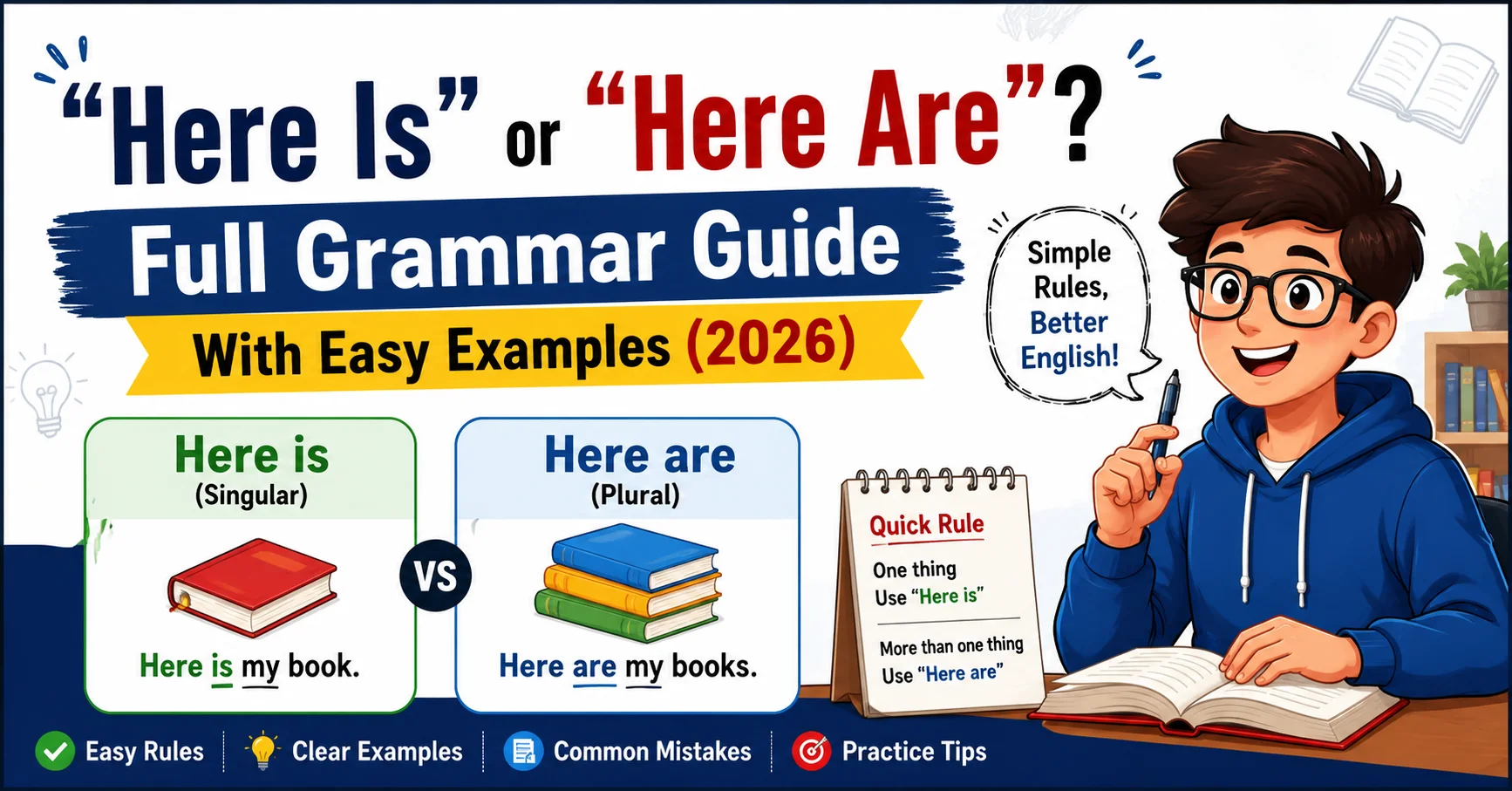
Have you ever stopped while writing and wondered whether to say “Here Is” or “Here Is”? You are not alone. Many English learners and even native speakers get confused by these two small phrases.
The good news is that the rule is simple once you understand it. The trick is knowing whether you are talking about one thing or many things. That is where the difference between “Here Is” or “Here Is” becomes clear.
People use these phrases every day in emails, texts, school work, presentations, and conversations. You may say:
- “Here is your book.”
- “Here are your keys.”
Both are correct, but they follow different grammar rules.
In this guide, you will learn:
- The difference between “Here is” and “Here are”
- Simple grammar rules
- Common mistakes
- Real-life examples
- Easy memory tricks
- When native speakers shorten the phrases
By the end, you will feel more confident using “Here Is” or “Here Is” correctly in daily English.
What Does “Here Is” Mean?
“Here is” is used when you talk about one person, object, or idea. It introduces a singular noun.
For example:
- Here is my phone.
- Here is the answer.
- Here is your coffee.
In each sentence, only one thing is being shown or presented.
The phrase combines:
- “Here” = this place
- “Is” = singular form of the verb “to be”
So, when you point to one thing, you usually use “Here is.”
Quick Examples
| Sentence | Correct? | Reason |
|---|---|---|
| Here is my bag. | Yes | One bag |
| Here is the books. | No | “Books” is plural |
| Here is your ticket. | Yes | One ticket |
Many people learn this rule early, but they still mix it up during fast conversations. That happens because spoken English often sounds different from written grammar.
What Does “Here Are” Mean?
“Here are” is used when you talk about more than one thing. It introduces plural nouns.
Examples:
- Here are your shoes.
- Here are the documents.
- Here are my friends.
In these sentences, multiple things or people are being presented.
The word “are” is the plural form of “to be.” That is why it matches plural nouns.
Simple Rule
- Use “Here is” for singular nouns
- Use “Here are” for plural nouns
This rule makes choosing between “Here Is” or “Here Is” much easier.
The Main Difference Between “Here Is” or “Here Is”
The biggest difference is the noun that follows the phrase.
Easy Comparison Table
| Phrase | Used For | Example |
|---|---|---|
| Here is | Singular noun | Here is your pencil. |
| Here are | Plural noun | Here are your pencils. |
Think of it this way:
- One item = is
- Many items = are
This grammar rule is small, but it matters a lot in clear communication.
Why People Get Confused
Many English speakers use shortcuts while talking. In casual speech, people often say “Here’s” for almost everything.
For example:
- “Here’s your keys.”
- “Here’s the books.”
Technically, these are grammatically incorrect because “keys” and “books” are plural. Still, native speakers say them often in casual conversation.
That creates confusion for learners trying to understand “Here Is” or “Here Are.”
Spoken vs Written English
| Situation | Preferred Form |
|---|---|
| Formal writing | Correct grammar |
| Casual speech | Shortened forms are common |
| School assignments | Use proper grammar |
| Business emails | Use correct structure |
If you are writing professionally, always follow the grammar rule carefully.
When to Use “Here Is”
Use “Here is” when:
- The noun is singular
- You mention one object
- You present one idea
- You refer to one person
Examples in Daily Life
- Here is your receipt.
- Here is my brother.
- Here is the homework.
- Here is the restaurant menu.
Workplace Examples
- Here is the final report.
- Here is your meeting schedule.
- Here is the project update.
School Examples
- Here is my assignment.
- Here is the correct answer.
- Here is the science book.
These examples show how often we use “Here is” in normal communication.
When to Use “Here Are”
Use “Here are” when:
- The noun is plural
- More than one thing is presented
- Multiple people are mentioned
Everyday Examples
- Here are your socks.
- Here are my photos.
- Here are the cookies.
Office Examples
- Here are the files you requested.
- Here are the meeting notes.
- Here are the customer details.
Classroom Examples
- Here are the answers.
- Here are the students’ projects.
- Here are the test papers.
Once you notice the plural noun, choosing between “Here Is” or “Here Is” becomes simple.
Common Mistakes People Make
Even advanced English learners make mistakes with these phrases. The most common problem happens when people focus on the first noun they think about instead of the actual subject.
Wrong vs Correct Examples
| Wrong Sentence | Correct Sentence |
|---|---|
| Here is my shoes. | Here are my shoes. |
| Here are my phone. | Here is my phone. |
| Here is the documents. | Here are the documents. |
| Here are the answer. | Here is the answer. |
A simple trick is to look at the noun:
- Singular noun → use “is”
- Plural noun → use “are”
Why Native Speakers Often Say “Here’s”
One interesting thing about English is that spoken language is not always grammatically perfect.
Native speakers love contractions because they sound faster and smoother.
Common Contractions
| Full Form | Contraction |
|---|---|
| Here is | Here’s |
| There is | There’s |
People often say:
- “Here’s your shoes.”
- “Here’s the papers.”
In formal grammar, this is incorrect. But in real conversations, it sounds natural to many speakers.
Should You Use It?
That depends on the situation.
| Situation | Recommended? |
|---|---|
| Casual chat | Usually okay |
| Academic writing | Avoid |
| Business communication | Avoid |
| Professional presentations | Use correct grammar |
If you want strong English skills, learn the proper version first.
“Here Is” or “Here Are” in Questions
These phrases also appear in question forms.
Examples
- Here is your package.
- Is here your package? ❌
That second sentence sounds unnatural because English usually changes the structure differently.
Instead, people ask:
- “Where is your package?”
- “Are these your books?”
So, “Here is” and “Here are” mostly introduce or present things rather than ask questions.
Using “Here Is” or “Here Are” in Emails
Professional writing requires correct grammar. Small mistakes can make your message look careless.
Professional Email Examples
Correct
- Here is the report you requested.
- Here are the updated documents.
Incorrect
- Here is the documents.
- Here are the report.
Sample Business Situations
| Situation | Correct Sentence |
|---|---|
| Sending one file | Here is the file. |
| Sending many files | Here are the files. |
| Sharing one link | Here is the link. |
| Sharing several links | Here are the links. |
These tiny details improve professionalism.
“Here Is” or “Here Is” in Text Messages
Texting is more relaxed. People often ignore grammar rules in casual chats.
Examples:
- “Here’s the pics.”
- “Here’s your shoes lol”
Even though these are common, proper grammar still matters in many situations.
If you are writing:
- Work messages
- School assignments
- Client emails
- Social media captions for business
Then using the correct form is safer.
Easy Memory Tricks
Grammar becomes easier when you use memory tricks.
Trick #1: Count the Noun
Ask yourself:
- One thing?
- More than one thing?
If one → use “is”
If many → use “are”
Trick #2: Replace the Noun
Example:
- Here is the cat.
- Here are the cats.
Changing the noun makes the answer clearer.
Trick #3: Listen Carefully
Read the sentence out loud:
- “Here are my notebook.”
It sounds strange because “notebook” is singular.
Examples From Real Conversations
Here are examples people use every day.
At Home
- Here is your dinner.
- Here are your clothes.
At School
- Here is your grade.
- Here are your assignments.
At Work
- Here is the contract.
- Here are the invoices.
At a Store
- Here is your receipt.
- Here are your bags.
The more examples you see, the easier this grammar becomes.
British vs American English Usage
Both British and American English follow the same grammar rules for “Here Is” or “Here Are.”
However, casual speech differs slightly.
In both styles, people commonly say:
- “Here’s your tickets.”
Even though it breaks grammar rules, it is widely accepted in spoken English.
Formal writing stays the same everywhere:
- Singular noun → “Here is”
- Plural noun → “Here are”
Grammar Experts’ Advice
Language experts usually recommend learning the formal grammar first. Once you understand the rule, you can recognize informal speech naturally.
This matters because:
- Exams require correct grammar
- Professional writing needs accuracy
- Clear communication builds trust
Strong grammar also improves confidence while speaking English.
“Here Is” or “Here Are” With Lists
Lists can make things tricky.
Example 1
- Here is the pen and notebook.
This sounds strange because there are two items.
Better:
- Here are the pen and notebook.
Example 2
- Here is a list of names.
This is correct because “list” is singular.
The key is identifying the real subject.
Helpful Table
| Sentence | Correct? |
|---|---|
| Here is a box of apples. | Yes |
| Here are a box of apples. | No |
| Here are the apples. | Yes |
Why This Grammar Rule Matters
Some people think small grammar details do not matter. But correct grammar helps in many ways.
Benefits of Proper Grammar
- Makes writing clearer
- Improves professionalism
- Builds confidence
- Helps avoid misunderstandings
- Creates better first impressions
When people understand “Here Is” or “Here Is” they sound more fluent and polished.
Fun Practice Exercise
Choose the correct option.
| Sentence | Correct Answer |
|---|---|
| Here ___ my jacket. | is |
| Here ___ the books. | are |
| Here ___ your lunch. | is |
| Here ___ the students. | are |
Answers
- Here is my jacket.
- Here are the books.
- Here is your lunch.
- Here are the students.
Simple practice helps you remember faster.
Quick Summary Table
| Use | Phrase |
|---|---|
| One thing | Here is |
| Multiple things | Here are |
| Casual contraction | Here’s |
| Formal plural writing | Here are |
This small table can help you remember the difference quickly.
Frequently Asked Questions
1. Is “Here’s” correct for plural nouns?
In formal grammar, no. “Here’s” means “Here is,” so it should match singular nouns. Still, many native speakers use it casually with plural nouns.
2. What is the difference between “Here Is” or “Here Is”?
“Here is” is used for singular nouns, while “Here are” is used for plural nouns.
3. Can I use “Here is” in professional emails?
Yes, but only with singular nouns. Example:
- “Here is the document.”
4. Why do native speakers break this rule?
Spoken English is often more relaxed than written English. Contractions sound faster and smoother during conversation.
5. How can I remember when to use each phrase?
Look at the noun after the phrase:
- One item → “Here is”
- Multiple items → “Here are”
Conclusion
Learning the difference between “Here Is” or “Here Are” is easier than many people think. The rule is simple:
- Use “Here is” for one thing
- Use “Here are” for more than one thing
Even though native speakers sometimes break this rule in casual speech, proper grammar still matters in writing, school, business, and professional communication.
The best way to improve is through practice. Read examples, listen carefully, and use the phrases in your own conversations. Soon, choosing between “Here Is” or “Here Is” will feel natural and automatic.
Good grammar may seem small, but it creates clearer communication and stronger confidence in English every day.
