


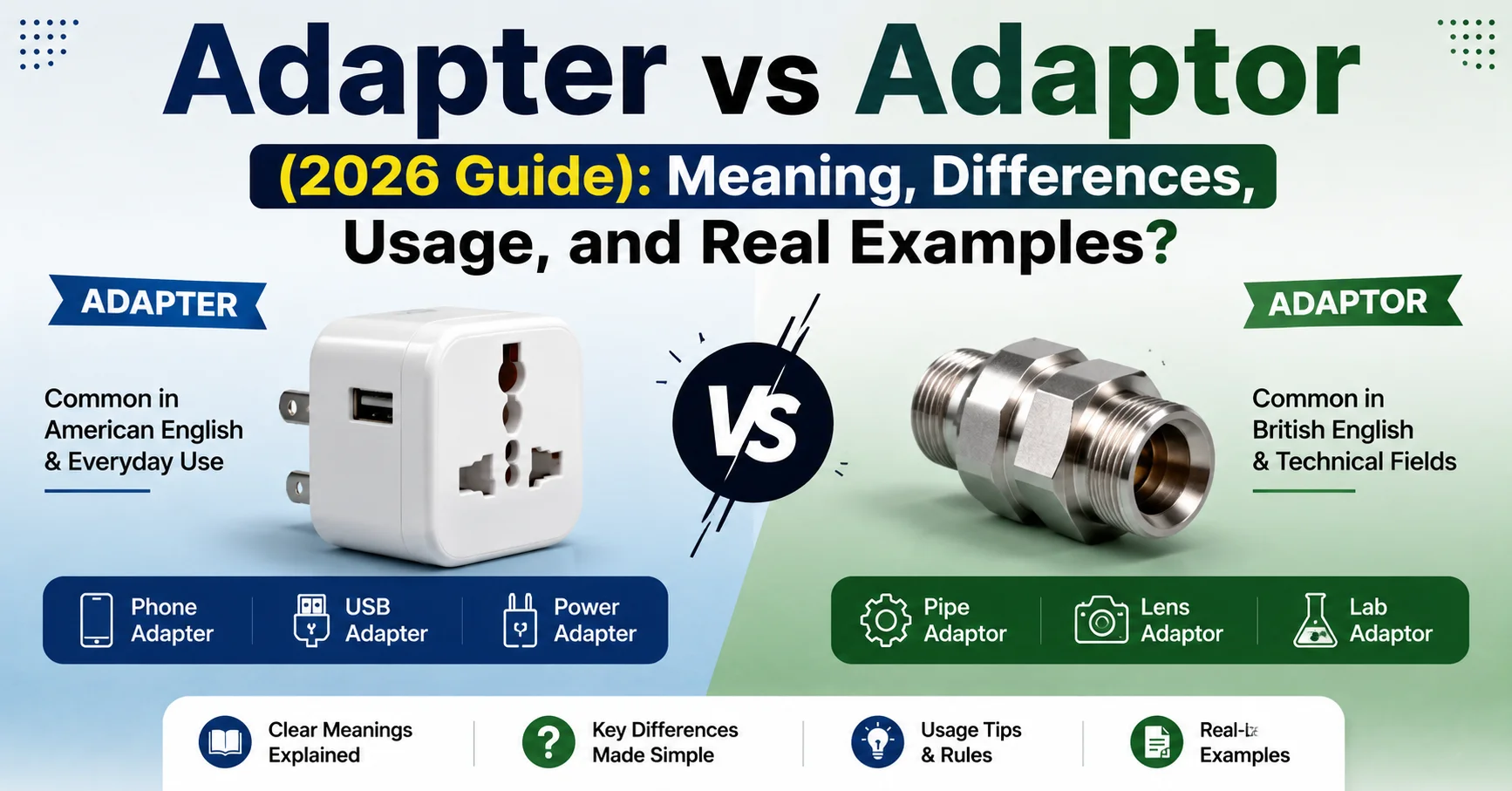
Many English words confuse people because they look almost the same. One great example is Adapter vs Adaptor. At first glance, both spellings seem correct. You may even see both used online, in stores, and in technical manuals.
So which spelling should you use?
The short answer is simple: both words are correct. However, they are often used in slightly different ways depending on the country, industry, and context.
This guide explains everything in easy language. You will learn the meanings, spelling differences, grammar rules, technical uses, and real-life examples of Adapter vs Adaptor. By the end, you will know exactly when to use each term with confidence.
What Do “Adapter” and “Adaptor” Mean?
Both words refer to something that helps two different things work together. In simple terms, an adapter or adaptor connects things that normally do not fit or function together.
For example:
- A phone charger plug
- A USB converter
- A travel plug converter
- A person who adjusts quickly to change
All of these can relate to the idea behind Adapter vs Adaptor.
The words come from the verb “adapt,” which means “to adjust” or “to make suitable.”
Even though the meanings are nearly identical, spelling preferences developed over time. Today, “adapter” is more common in general English, while “adaptor” sometimes appears in technical or specialized industries.
The Main Difference Between Adapter vs Adaptor
The biggest difference is spelling preference and usage style.
Here is a quick overview:
| Word | Common Usage | Popular In | Typical Context |
|---|---|---|---|
| Adapter | Most common spelling | American English | Technology, daily writing |
| Adaptor | Less common spelling | British English and technical fields | Engineering and science |
In modern writing, adapter appears far more often online, in product listings, and in daily communication.
Still, adaptor is not wrong. Some companies and industries continue using it because of tradition or technical standards.
Why Do Two Spellings Exist?
English has many words with multiple spellings. Language changes over time, and regional preferences appear naturally.
The spelling variation in Adapter vs Adaptor happened because people formed nouns from the verb “adapt” differently.
Some writers added “-er” while others used “-or.”
This is similar to words like:
| Version 1 | Version 2 |
|---|---|
| Adviser | Advisor |
| Collector | Collecter (older form) |
| Connector | Connector |
| Instructor | Instructor |
Over time, “adapter” became the dominant everyday spelling. However, “adaptor” stayed active in some industries and regions.
Language often keeps older forms alive, especially in science and engineering.
Which Spelling Is More Common Today?
The clear winner today is adapter.
You will see it more often in:
- Online stores
- Product packaging
- Technology blogs
- School writing
- News articles
- Manuals
- Everyday English
For example, most companies sell products labeled:
- HDMI adapter
- USB adapter
- Wi-Fi adapter
- Power adapter
The spelling “adaptor” still appears, but much less frequently.
If you are unsure which version to use, “adapter” is usually the safest choice.
Adapter vs Adaptor in American English
In American English, adapter is strongly preferred.
Most American dictionaries list “adapter” as the primary spelling. Some dictionaries still include “adaptor,” but often as a secondary variant.
Here are common American examples:
- laptop adapter
- charging adapter
- wireless adapter
- AC adapter
If you write for an American audience, using “adapter” is the best option.
This spelling feels more modern and natural to most readers in the United States.
Adapter vs Adaptor in British English
British English accepts both spellings more comfortably.
However, even in the UK, “adapter” is becoming more popular because of global technology brands and internet influence.
Still, some British engineering companies and technical documents continue using “adaptor.”
For example:
- pipe adaptor
- valve adaptor
- optical adaptor
So while both spellings work in British English, industry tradition sometimes affects the choice.
Technical Uses of Adapter vs Adaptor
This is where things become more interesting.
In technical fields, some professionals prefer adaptor for mechanical devices and adapter for electronic products.
However, this rule is not universal.
Different industries follow different habits.
Here is a simple comparison:
| Industry | Common Preference |
|---|---|
| Consumer electronics | Adapter |
| Engineering | Adaptor |
| Computer hardware | Adapter |
| Plumbing | Adaptor |
| Travel accessories | Adapter |
For example, you may buy a “USB adapter” but read about a “pipe adaptor” in engineering documents.
The meanings stay almost identical. The difference mostly comes from professional tradition.
Common Examples of Adapter in Daily Life
The word “adapter” appears everywhere in modern life.
You probably use several adapters every day without thinking about it.
Here are some common examples:
| Type | Purpose |
|---|---|
| Power adapter | Supplies electricity to devices |
| USB adapter | Connects USB devices |
| Travel adapter | Fits foreign outlets |
| Bluetooth adapter | Adds wireless connection |
| HDMI adapter | Connects video devices |
Technology keeps creating new types of adapters. That is one reason this spelling became so common worldwide.
People see it constantly in electronics stores and online shopping websites.
Common Examples of Adaptor in Technical Fields
Although less common, “adaptor” still appears regularly in specialized industries.
Engineers and mechanics sometimes use this spelling in manuals and diagrams.
Examples include:
- hose adaptor
- pipe adaptor
- lens adaptor
- laboratory adaptor
These industries often keep traditional spellings for consistency.
If you work in a technical field, you may notice company-specific preferences.
Always follow the style guide used by your workplace or publication.
Is One Spelling More Correct Than the Other?
No. Both spellings are correct.
That is the most important thing to remember about Adapter vs Adaptor.
However, one spelling may sound more natural depending on the audience.
Here is a simple guideline:
- Use adapter for general writing
- Use adaptor if your industry or style guide prefers it
Consistency matters more than perfection.
If you choose one spelling, try to use it throughout the entire document.
Switching back and forth can confuse readers.
Adapter vs Adaptor in Grammar
Grammatically, both words function the same way.
They are nouns.
Singular examples:
- I need a new adapter.
- The mechanic installed an adaptor.
Plural examples:
- These adapters are expensive.
- The adaptors arrived yesterday.
The grammar rules do not change based on spelling.
Real-Life Sentences Using Adapter
Seeing real examples makes learning easier.
Here are natural sentences using “adapter”:
- I forgot my laptop adapter at home.
- This travel adapter works in Europe.
- My wireless adapter stopped working yesterday.
- She bought a USB-C adapter online.
- The power adapter became very hot.
These examples reflect modern everyday English.
Real-Life Sentences Using Adaptor
Now let’s look at “adaptor” in sentences:
- The engineer replaced the pipe adaptor.
- This lens adaptor improves camera compatibility.
- The machine requires a special adaptor.
- The technician ordered a metal adaptor.
- The laboratory adaptor was damaged.
These examples sound more technical and specialized.
How Search Engines Treat Adapter vs Adaptor
Search engines understand both spellings.
If you search for either term, you will often see similar results.
Still, “adapter” receives far more online searches because it is more common globally.
That matters for:
- SEO writing
- Product titles
- Blog articles
- Ecommerce listings
If you create online content, using “adapter” may help reach a larger audience.
However, if your audience expects “adaptor,” matching their terminology can improve trust.
Which Spelling Should Students Use?
Students should usually choose adapter unless a teacher or textbook says otherwise.
Why?
Because:
- It is more common
- It appears in most modern materials
- Readers recognize it quickly
- It works well internationally
For school essays and general English writing, “adapter” is the safer option.
Adapter vs Adaptor in Branding
Some companies intentionally choose one spelling for branding reasons.
For example, a business may use “adaptor” to sound technical or traditional.
Others choose “adapter” because it feels modern and simple.
Brand names do not always follow standard language trends.
That is why you may see both spellings on products.
Always respect official brand spellings when writing about products or companies.
Easy Trick to Remember the Difference
Here is a simple memory trick:
- Adapter = everyday technology
- Adaptor = technical or engineering use
This rule is not perfect, but it helps most learners.
If you are still unsure, choose “adapter.” It is the most accepted modern spelling.
Mistakes People Make With Adapter vs Adaptor
Many writers become confused and mix spellings randomly.
Here are common mistakes:
1. Switching Spellings Mid-Article
Wrong:
- adapter in one paragraph
- adaptor in the next paragraph
Better:
Choose one spelling and stay consistent.
2. Assuming One Is Incorrect
Some people think “adaptor” is a typo. It is not.
Both are legitimate English spellings.
3. Ignoring Audience Preferences
Technical readers may expect “adaptor” in some industries.
Always consider who will read your content.
Quick Comparison Table
| Feature | Adapter | Adaptor |
|---|---|---|
| Correct spelling | Yes | Yes |
| More common | Yes | No |
| Popular in American English | Yes | Less common |
| Used in technical industries | Sometimes | Often |
| Best for general writing | Yes | Usually no |
| Seen in electronics | Very often | Less often |
When Should You Use “Adapter”?
Use “adapter” when:
- Writing blogs
- Creating online content
- Talking about electronics
- Writing school assignments
- Selling consumer products
- Writing for global readers
This spelling feels natural to most modern audiences.
When Should You Use “Adaptor”?
Use “adaptor” when:
- Following a technical style guide
- Writing engineering documents
- Matching company terminology
- Using British technical standards
- Referencing specialized equipment
Even then, consistency remains important.
The Evolution of Modern English Spellings
The story behind Adapter vs Adaptor reflects how English changes over time.
Language constantly evolves.
Some spellings become dominant because of:
- Technology
- Global business
- Internet usage
- Popular brands
- Education systems
Today, “adapter” dominates because modern consumers see it everywhere.
Still, older forms like “adaptor” survive in professional environments.
This happens with many English words.
That flexibility is part of what makes English interesting.
Why This Topic Confuses English Learners
English learners often struggle with spelling variations.
Words like Adapter vs Adaptor create confusion because both versions are technically correct.
Learners ask questions like:
- Which spelling is official?
- Which version sounds natural?
- Which one appears on exams?
- Which spelling helps SEO?
The answer depends on context.
But for most situations, “adapter” is the easiest and safest choice.
That is why teachers and modern style guides often recommend it first.
FAQs About Adapter vs Adaptor
Is adapter or adaptor correct?
Both spellings are correct. “Adapter” is more common in modern English, especially in technology and everyday writing.
Which spelling is used in America?
American English strongly prefers “adapter.”
Is adaptor old-fashioned?
Not exactly. It is still used in engineering and technical industries, but it appears less often in daily writing.
Should I use adapter in SEO articles?
Yes. “Adapter” usually performs better because more people search for it online.
Why do companies still use adaptor?
Some industries keep traditional spellings for branding, technical standards, or historical reasons.
Conclusion
Understanding Adapter vs Adaptor is easier once you know the background behind both spellings.
Both words are correct. Both share the same basic meaning. The real difference comes from usage style, region, and industry tradition.
Today, adapter is the dominant spelling in modern English. It appears more often in technology, online content, ecommerce, and daily communication.
Meanwhile, adaptor still survives in engineering, mechanics, and some British technical fields.
If you want the safest general choice, use adapter. It feels natural to most readers worldwide.
Still, if your industry prefers “adaptor,” that spelling remains perfectly acceptable.
The key is simple: know your audience, stay consistent, and choose the version that best fits your context.
