

Have you ever stopped while writing a sentence and wondered whether to say “my wife and I” or “my wife and me”? You are not alone. Many native English speakers make mistakes with these phrases every day. The confusion happens because both sound natural in casual conversation. Yet only one is correct depending on the sentence structure.
The good news is that this grammar rule is easier than it looks. Once you understand a simple trick, you will never struggle with my wife and I or my wife and me again. This guide explains everything in plain English with easy examples, grammar tips, comparison tables, and real-life sentences.
By the end, you will know exactly when to use each phrase confidently in speaking and writing.
Why People Confuse “My Wife and I” or “My Wife and Me”
English grammar can feel tricky because people often learn phrases by hearing them instead of studying grammar rules. Many people believe “my wife and I” always sounds more polite. Because of that, they use it everywhere, even when it is wrong.
For example, someone may say:
- “The teacher gave homework to my wife and I.”
This sentence sounds formal, but it is incorrect. The correct phrase should be:
- “The teacher gave homework to my wife and me.”
The confusion happens because people mix up subject pronouns and object pronouns. Once you understand the difference, choosing between my wife and I or my wife and me becomes simple.
The Simple Grammar Rule You Must Know
The easiest way to understand this topic is by learning two small grammar ideas:
| Phrase | Grammar Type | Used As |
|---|---|---|
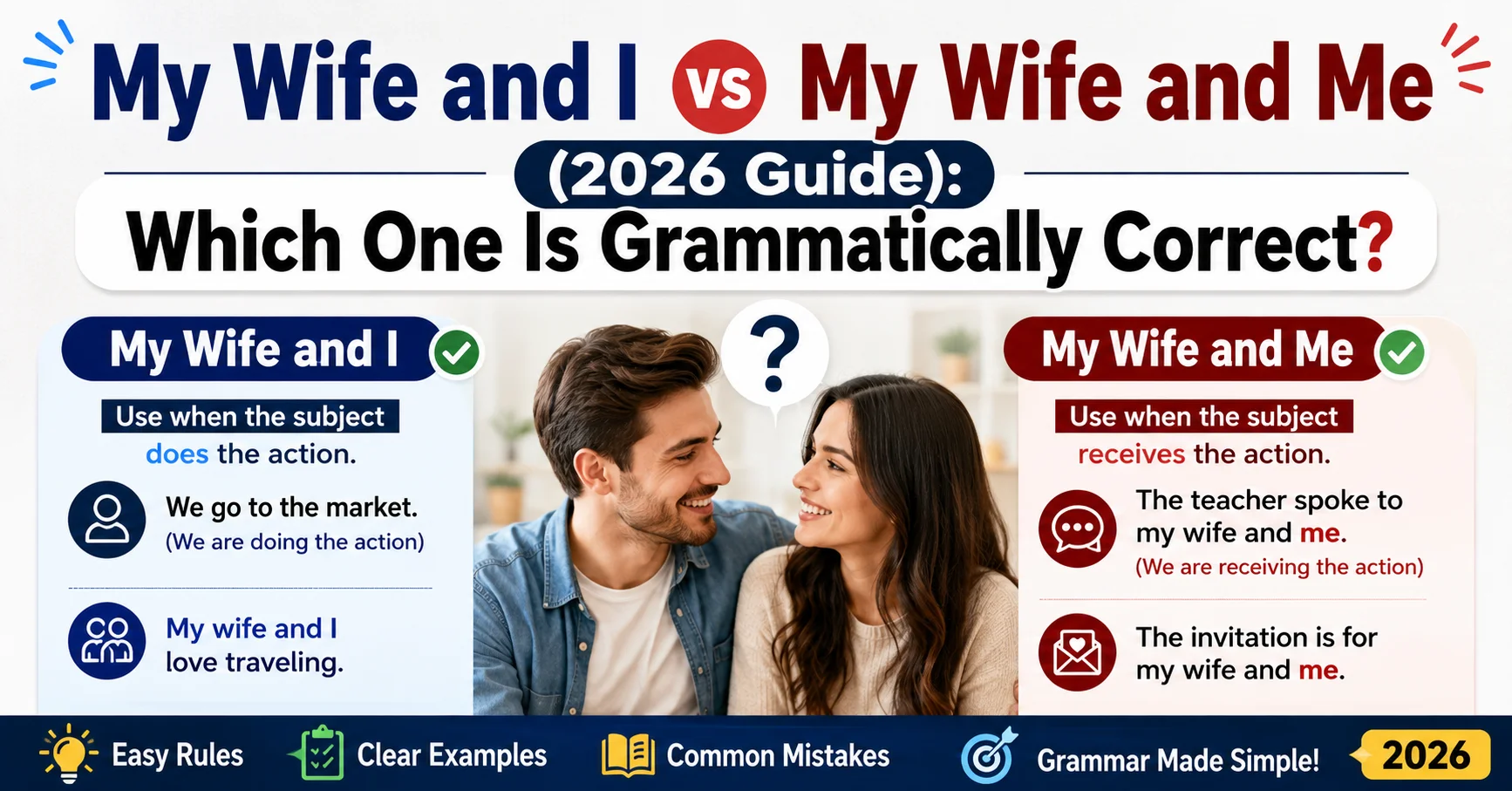
| My wife and I | Subject pronoun | Performs the action |
| My wife and me | Object pronoun | Receives the action |
Think of it this way:
- Use “my wife and I” when the phrase is doing something.
- Use “my wife and me” when something is being done to the phrase.
Correct Examples
| Correct Sentence | Why It Is Correct |
|---|---|
| My wife and I went shopping. | They performed the action |
| The manager spoke to my wife and me. | They received the action |
This is the core difference between my wife and I or my wife and me.
What Does “My Wife and I” Mean?
“My wife and I” is used when both people are the subject of the sentence. That means they are performing the action together.
Examples
- My wife and I love hiking.
- My wife and I watched a movie last night.
- My wife and I are planning a vacation.
In each sentence, the speaker and the wife are doing the action.
A simple trick helps here. Remove “my wife and” from the sentence.
For example:
- “I love hiking” sounds correct.
- “Me love hiking” sounds wrong.
So the correct phrase is “my wife and I.”
This trick works almost every time.
What Does “My Wife and Me” Mean?
“My wife and me” is used when the phrase receives the action in the sentence.
Examples
- The doctor spoke to my wife and me.
- The invitation was sent to my wife and me.
- They asked my wife and me many questions.
Again, remove “my wife and.”
- “The doctor spoke to me” sounds correct.
- “The doctor spoke to I” sounds incorrect.
That is why “my wife and me” is correct here.
Learning this small test makes choosing between my wife and I or my wife and me much easier.
The Remove-the-Other-Person Trick
This is the most useful grammar trick in everyday English.
Step-by-Step Method
- Remove “my wife and”
- Read the sentence again
- Choose the word that sounds correct
Examples Table
| Full Sentence | Remove Extra Person | Correct Choice |
|---|---|---|
| My wife and I went home. | I went home. | I |
| She talked to my wife and me. | She talked to me. | Me |
| My wife and I enjoy cooking. | I enjoy cooking. | I |
| The gift was for my wife and me. | The gift was for me. | Me |
This simple trick helps students, writers, and even professionals avoid grammar mistakes.
Common Mistakes People Make
Many grammar errors happen because people want to sound smarter or more formal. Sadly, that often creates incorrect sentences.
Incorrect Examples
- Between you and I
- She invited my wife and I
- The gift is for my wife and I
These are wrong because the phrases are objects, not subjects.
Correct Versions
- Between you and me
- She invited my wife and me
- The gift is for my wife and me
One reason people misuse these phrases is because teachers often tell children not to say “me and my wife.” Over time, people begin thinking “my wife and I” is always correct. But grammar depends on sentence structure, not politeness alone.
Why “Between You and I” Is Wrong
This mistake is extremely common. You may hear celebrities, news reporters, or even teachers say it incorrectly.
The word “between” is a preposition. Prepositions require object pronouns like:
- me
- him
- her
- us
- them
So the correct sentence is:
- “Between you and me.”
Not:
- “Between you and I.”
The same grammar rule applies to my wife and me.
Examples
| Wrong | Correct |
|---|---|
| Between my wife and I | Between my wife and me |
| For my wife and I | For my wife and me |
| To my wife and I | To my wife and me |
Understanding prepositions is a big step toward mastering my wife and I or my wife and me.
Real-Life Examples in Everyday Conversation
Grammar feels easier when you see natural examples.
At a Restaurant
- The waiter served my wife and me quickly.
- My wife and I enjoyed the meal.
At Work
- My wife and I started a small business.
- The client emailed my wife and me yesterday.
During Travel
- My wife and I visited Italy last year.
- The airline upgraded seats for my wife and me.
Notice how the sentence structure changes the correct phrase.
How Native Speakers Actually Use These Phrases
Native speakers often break grammar rules in casual speech. Some people overcorrect themselves because they think “I” always sounds smarter.
For example, someone might say:
- “He gave tickets to my wife and I.”
Even though this is common in conversation, it is still grammatically incorrect.
In professional writing, business emails, school assignments, and formal communication, correct grammar matters more. That is why understanding my wife and I or my wife and me is important.
Good grammar helps writing feel clearer and more trustworthy.
Polite Word Order Matters Too
In English, it is considered polite to mention yourself second.
Preferred Style
- My wife and I
- My wife and me
Less Polite Style
- Me and my wife
- I and my wife
Even if grammar is technically correct, English speakers usually place themselves second out of politeness.
Comparison Table
| Less Natural | More Natural |
|---|---|
| Me and my wife went out. | My wife and I went out. |
| The manager spoke to me and my wife. | The manager spoke to my wife and me. |
This small detail makes sentences sound smoother and more professional.
Easy Memory Tricks for Students
Many learners remember grammar better with shortcuts and patterns.
Memory Trick #1: Action vs Receiver
- Doing the action = I
- Receiving the action = Me
Memory Trick #2: Remove the Other Person
- Remove “my wife and”
- Test the sentence
Memory Trick #3: Prepositions Need “Me”
Words like:
- to
- for
- with
- between
Usually take “me.”
Examples
- With my wife and me
- For my wife and me
- Between my wife and me
These patterns make grammar easier to remember in real conversations.
Formal Writing vs Casual Speaking
Grammar standards change depending on the situation.
Casual Conversation
People often say:
- “Me and my wife went shopping.”
Many listeners accept it in daily speech.
Formal Writing
Professional writing should use:
- “My wife and I went shopping.”
Correct grammar matters more in:
- business emails
- school essays
- articles
- presentations
- interviews
Using proper grammar improves clarity and professionalism.
Examples From Movies, TV, and Social Media
Modern media often contains grammar mistakes because writers want dialogue to sound realistic.
You might hear:
- “Me and my wife are leaving.”
This sounds natural in casual speech, but grammar books would prefer:
- “My wife and I are leaving.”
Social media also encourages fast and informal writing. Because of that, grammar errors spread quickly online.
That does not mean the rules changed. It only means conversational English is more flexible.
Understanding correct grammar helps you choose the best style for each situation.
Why This Grammar Rule Still Matters in 2026
Some people argue grammar rules are becoming less important. Yet strong grammar still matters in many areas of life.
Correct Grammar Helps You:
- Write better emails
- Sound professional
- Avoid confusion
- Build trust
- Improve academic writing
- Speak more confidently
Even in 2026, people judge communication skills. Clear grammar creates a positive impression.
Learning the difference between my wife and I or my wife and me is a small change that improves communication immediately.
Quick Comparison Chart
| Situation | Correct Phrase |
|---|---|
| Subject of sentence | My wife and I |
| Object of sentence | My wife and me |
| After prepositions | My wife and me |
| Formal writing | Use correct grammar |
| Casual conversation | Rules are sometimes relaxed |
Keep this chart in mind whenever you feel unsure.
Practice Sentences
Choose the correct phrase before checking the answers.
Sentences
- My wife and ___ are going camping.
- The teacher spoke to my wife and ___.
- My wife and ___ baked cookies.
- The gift was for my wife and ___.
- My wife and ___ watched a football game.
Answers
| Sentence | Correct Answer |
|---|---|
| 1 | I |
| 2 | me |
| 3 | I |
| 4 | me |
| 5 | I |
Practice helps these grammar patterns become automatic.
How Teachers Explain This Rule
Many teachers introduce pronouns early in school because they appear in almost every sentence.
Subject Pronouns
- I
- he
- she
- we
- they
Object Pronouns
- me
- him
- her
- us
- them
The phrase my wife and I belongs to the subject group.
The phrase my wife and me belongs to the object group.
Once students understand pronouns, sentence choices become much easier.
Common Questions About This Grammar Topic
People often ask whether grammar rules are changing because spoken English sounds more relaxed today. While conversational English keeps evolving, standard grammar still follows the same structure.
Writers, teachers, editors, and employers still expect correct pronoun use in formal communication. That is why grammar guides continue teaching the difference between my wife and I or my wife and me.
The key is understanding context. Informal speech allows more flexibility, but formal writing usually follows traditional grammar rules closely.
FAQs
Is “my wife and me” grammatically correct?
Yes, it is correct when the phrase receives the action in a sentence. Example: “She spoke to my wife and me.”
Is “my wife and I” always correct?
No. It is only correct when the phrase acts as the subject. Example: “My wife and I went shopping.”
Why do people say “my wife and I” too often?
Many people believe it sounds more polite or formal. Because of that, they sometimes use it incorrectly.
How can I quickly test the correct phrase?
Remove “my wife and” from the sentence. Then check whether “I” or “me” sounds correct alone.
Is “me and my wife” wrong?
In formal grammar, it is less preferred. Most grammar experts recommend “my wife and I” or “my wife and me.”
Final Thoughts on “My Wife and I or My Wife and Me”
Understanding my wife and I or my wife and me becomes simple once you learn the subject-versus-object rule. If the phrase performs the action, use “my wife and I.” If it receives the action, use “my wife and me.”
The easiest method is removing the other person from the sentence. This quick test works in most situations and helps you avoid common grammar mistakes instantly.
Even though casual speech sometimes ignores grammar rules, correct usage still matters in professional writing, schoolwork, and formal communication. Clear grammar improves confidence and helps readers trust your writing.
The next time you hesitate between these two phrases, remember the simple trick:
- “I” does the action
- “Me” receives the action
Once you practice a few times, choosing the correct phrase will feel completely natural.
