

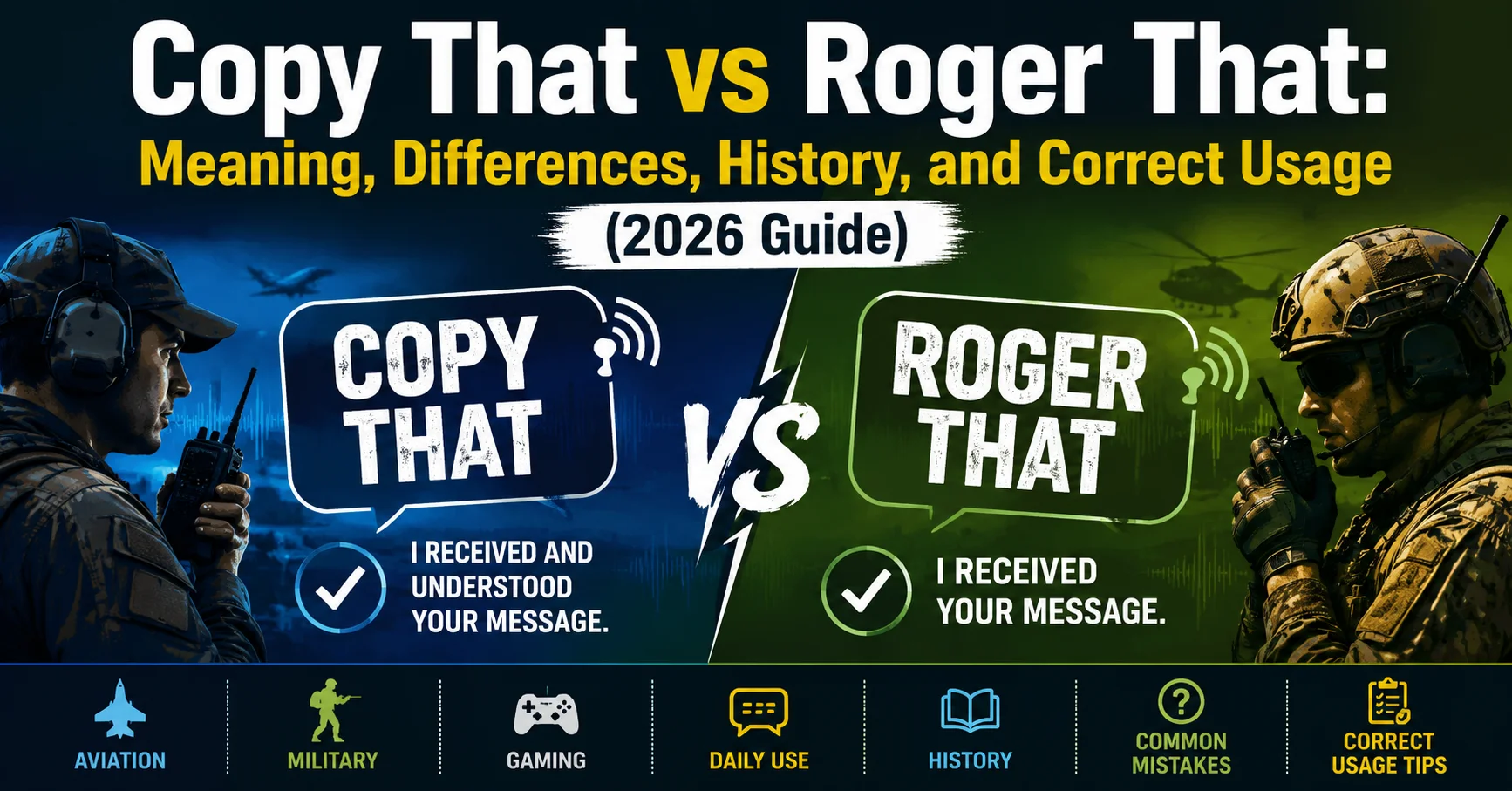
Radio communication has created many famous phrases over the years. Two of the most popular are “Copy That vs Roger That: Meaning, Differences, History, and Correct Usage (2026 Guide).” You may hear them in movies, military shows, online games, aviation videos, or even daily conversations.
But many people still ask an important question:
What is the difference between “Copy That vs Roger That”?
At first, both phrases sound similar. They both show that someone heard a message. However, they are not exactly the same. Each phrase has a different meaning, history, and purpose.
In this complete guide, you will learn:
- The real meaning of “Copy That” and “Roger That”
- The key differences between them
- When to use each phrase
- Which one is more professional
- Examples from military, aviation, gaming, and everyday life
- Common mistakes people make
- Modern alternatives and slang
This article uses simple language and real examples, so anyone can understand the topic easily.
What Does “Copy That” Mean?
“Copy That” means:
“I received and understood your message.”
The word “copy” comes from radio communication. It means you successfully received information from another person.
When someone says “Copy That,” they are confirming that the message was heard clearly and understood correctly.
Simple Example
Person A: “Meet me at the front gate at 5 PM.”
Person B: “Copy That.”
This means Person B understands the instruction.
The phrase became popular in:
- Military communication
- Police radios
- Emergency services
- Aviation
- Gaming communities
Today, people also use it casually in texting and daily speech.
What Does “Roger That” Mean?
“Roger That” also means the speaker received the message. However, its original meaning is slightly different.
The word “Roger” was once used in radio alphabets to represent the letter R. The letter R stood for:
“Received.”
So “Roger That” originally meant:
“I received your message.”
Unlike “Copy That,” it did not always confirm understanding. It mainly confirmed reception.
Simple Example
Pilot: “Turn left heading 270.”
Co-pilot: “Roger That.”
This means the message was received successfully.
Over time, people started using “Roger That” more casually, and many now treat it like “understood.”
Copy That vs Roger That: Main Difference
The biggest difference between Copy That vs Roger That is simple:
| Phrase | Main Meaning | Focus |
|---|---|---|
| Copy That | I received and understood the message | Understanding |
| Roger That | I received the message | Reception |
“Copy That” usually suggests clearer understanding.
“Roger That” mainly confirms hearing the message.
In modern speech, many people use both phrases the same way. Still, professionals in aviation or military settings may notice the difference.
The History Behind “Roger That”
The phrase “Roger That” became famous during World War II.
At that time, pilots and military teams used a phonetic alphabet for radio communication. Before NATO used “Romeo,” the letter R was called “Roger.”
Since R meant “Received,” radio operators started saying:
“Roger.”
This quickly became a standard response in military and aviation communication.
Why It Became Popular
Several reasons helped “Roger That” spread worldwide:
| Reason | Explanation |
|---|---|
| Clear radio language | Easy to understand over weak signals |
| Short response | Fast communication during missions |
| Military movies | Hollywood made it famous |
| Gaming culture | Gamers copied military language |
Today, the phrase feels iconic and professional.
The History Behind “Copy That”
“Copy” also comes from radio operations.
Radio operators needed a quick way to confirm they successfully copied information from a transmission.
The phrase became common in:
- Military units
- Air traffic control
- Police communication
- Emergency rescue teams
Eventually, “Copy That” entered everyday English.
Many people now use it jokingly or casually in conversations.
Example:
Mom: “Take out the trash.”
Teenager: “Copy That.”
Which Phrase Is More Professional?
Both phrases sound professional, but they are used differently depending on the situation.
In Aviation
Pilots usually avoid casual radio phrases unless they match official communication rules.
In aviation:
- “Roger” is still accepted
- “Copy That” is less common in official aviation speech
In Military Communication
Military teams may use both phrases depending on the situation.
“Copy That” often implies clearer understanding.
“Roger” may simply confirm receipt.
In Daily Conversations
Both phrases are casual and friendly today.
However:
| Phrase | Tone |
|---|---|
| Copy That | More modern and direct |
| Roger That | More military-style and dramatic |
Copy That vs Roger That in Gaming
Gamers love military-style communication. That is why both phrases are extremely common in multiplayer games.
You may hear them in:
- Shooter games
- Battle royale games
- Tactical team games
- Military simulators
Example in a Game
Squad Leader: “Enemy near the bridge.”
Player: “Copy That.”
Or:
Player: “Roger That.”
Both work fine in gaming.
Many players use them because they sound cool, fast, and tactical.
When Should You Use “Copy That”?
You should use “Copy That” when:
- You clearly understand instructions
- You want a confident response
- You are confirming details
- You want a professional tone
Good Situations
| Situation | Example |
|---|---|
| Workplace | “Copy That, I’ll send the report.” |
| Gaming | “Copy That, moving now.” |
| Team projects | “Copy That, meeting starts at 2.” |
| Text messages | “Copy That, see you soon.” |
It works best when understanding matters.
When Should You Use “Roger That”?
Use “Roger That” when:
- You simply received information
- You want a military-style tone
- You are responding quickly
- You want a fun or dramatic reply
Good Situations
| Situation | Example |
|---|---|
| Gaming | “Roger That, defending base.” |
| Movies or jokes | “Roger That, captain!” |
| Radio-style communication | “Roger That, message received.” |
| Casual texting | “Roger That 😂” |
It sounds more classic and cinematic.
Are “Copy That” and “Roger That” Interchangeable?
In modern conversation, yes — most people use them interchangeably.
However, technically speaking:
- “Copy That” = received and understood
- “Roger That” = received
Professionals may still care about the difference.
Casual speakers usually do not.
Common Mistakes People Make
Many people misuse these phrases because movies often mix them incorrectly.
Here are common mistakes to avoid.
Mistake 1: Using Them for Questions
Wrong:
“Roger That?”
These phrases are responses, not questions.
Correct:
“Roger That.”
Mistake 2: Using Them in Formal Emails
These phrases sound too casual for professional business emails.
Instead of:
“Roger That, sir.”
Use:
“Understood.”
“I received your message.”
Mistake 3: Overusing Them
Using “Copy That” in every sentence sounds unnatural.
Example:
❌ “Copy That, I’m eating lunch.”
❌ “Copy That, I opened the door.”
Use them naturally and occasionally.
Copy That vs Roger That in Texting
Text messaging has changed how people use these phrases.
Today, people often use them humorously.
Examples
Friend: “Don’t forget snacks.”
Reply:
- “Copy That 🫡”
- “Roger That 😂”
Both create a playful tone.
Younger users often prefer “Copy That” because it sounds cleaner and more modern.
Military Communication and Accuracy
Military communication depends on clarity. Every word matters.
That is why special communication phrases exist.
Here are some examples:
| Phrase | Meaning |
|---|---|
| Copy | Message understood |
| Roger | Message received |
| Wilco | Will comply |
| Over | My transmission finished |
| Out | Conversation ended |
Interestingly, “Roger Wilco” became famous in movies and games.
But technically, it is slightly repetitive because:
- Roger = received
- Wilco = received and will comply
Still, many people say it anyway.
Modern Alternatives to Copy That and Roger That
Many people now use newer phrases instead.
Here are common modern alternatives:
| Alternative | Meaning |
|---|---|
| Got it | I understand |
| Understood | Clear understanding |
| Sounds good | Agreement |
| Okay | Basic confirmation |
| Received | Message accepted |
| Will do | Action confirmed |
These sound more natural in modern workplaces.
Which Phrase Sounds Better?
This depends on the situation.
“Copy That” Sounds:
- Cleaner
- More modern
- More confident
- More direct
“Roger That” Sounds:
- More military-style
- More dramatic
- More classic
- More cinematic
Many younger people now prefer “Copy That.”
Movies and older generations still love “Roger That.”
Real-Life Examples of Copy That vs Roger That
Understanding real examples makes the difference easier.
Workplace Example
Manager: “Send the design before noon.”
Employee:
- “Copy That.” → understood clearly
- “Roger That.” → received message
Gaming Example
Leader: “Push the left side.”
Player:
- “Copy That.” → clear tactical response
- “Roger That.” → military-style confirmation
Family Example
Dad: “Pick up milk.”
Teen:
- “Copy That 😎”
- “Roger That 😂”
Both work casually.
Pop Culture Made These Phrases Famous
Movies, TV shows, and games helped spread these phrases worldwide.
Popular military films often use:
- “Roger That”
- “Copy That”
- “Over and Out”
Games like tactical shooters also made them common online.
Because of pop culture, many people use these phrases without knowing their original meanings.
Is “Roger Roger” Correct?
Yes, but it sounds old-fashioned.
“Roger Roger” simply repeats confirmation.
Some pilots and radio operators used double responses for clarity.
Today, people mostly use it jokingly.
Example:
“Roger Roger, commander.”
It sounds playful and dramatic now.
Why These Phrases Still Matter Today
Even in the age of smartphones and instant messaging, these phrases remain popular.
Why?
Because they are:
- Short
- Clear
- Memorable
- Fun to say
- Easy to understand
They also create a sense of teamwork and professionalism.
That is why people still use them in:
- Work chats
- Online gaming
- Group projects
- Team communication
- Internet memes
Quick Comparison Table
Here is a fast summary of Copy That vs Roger That:
| Feature | Copy That | Roger That |
|---|---|---|
| Main meaning | Understood message | Received message |
| Origin | Radio communication | Military phonetic alphabet |
| Tone | Modern | Military/classic |
| Common today | Very common | Common in media |
| Best use | Clear understanding | Quick acknowledgment |
| Sounds | Direct | Dramatic |
Which One Should You Use?
If you want modern and clear communication:
✅ Use “Copy That.”
If you want a military or cinematic vibe:
✅ Use “Roger That.”
For casual conversations, both are acceptable.
For professional communication, simple phrases like “Understood” often work better.
FAQs About Copy That vs Roger That
Is “Copy That” rude?
No. It is usually polite and professional. Tone matters more than the phrase itself.
Does “Roger That” mean “yes”?
Not exactly. It mainly means the message was received. It does not always mean agreement.
Which is more common today?
“Copy That” is more common in modern texting and casual communication.
Can civilians use these phrases?
Yes. Anyone can use them casually in speech, texting, or gaming.
What is the difference between “Roger” and “Wilco”?
“Roger” means the message was received.
“Wilco” means:
“Will comply.”
So “Wilco” includes future action.
Final Thoughts on Copy That vs Roger That
Understanding Copy That vs Roger That is easier once you know their original meanings.
Both phrases started in radio communication, but they evolved differently over time.
“Copy That” usually means:
“I received and understood your message.”
“Roger That” traditionally means:
“I received your message.”
Today, most people use them interchangeably. Still, knowing the difference helps you communicate more accurately.
If you want a modern and confident response, “Copy That” works great.
If you want a classic military-style phrase, “Roger That” sounds iconic.
