


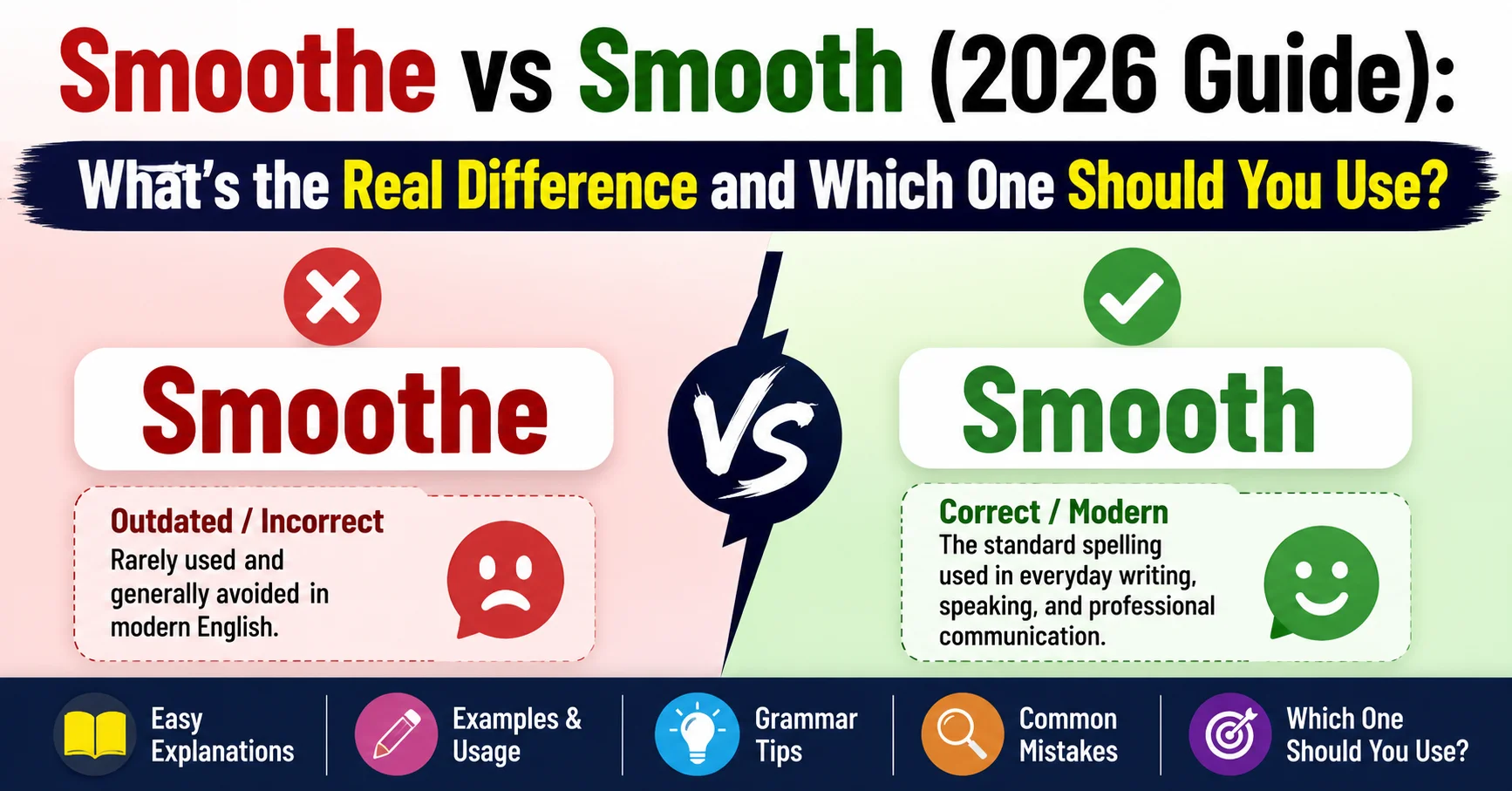
Have you ever typed “smoothe” and wondered if it was correct? You are not alone. Many English learners and even native speakers get confused by Smoothe vs Smooth because the words look almost the same. One extra “e” changes everything.
The good news is simple: in modern English, smooth is the standard and correct spelling in most situations. The word “smoothe” exists, but it is rare and usually considered outdated or incorrect in everyday writing.
This confusion happens because English spelling can be tricky. Some words end with “e,” while others do not. People often guess the spelling based on pronunciation. Since “smooth” sounds like it could end with an “e,” many people accidentally write “smoothe.”
In this detailed guide, you will learn the real difference between Smoothe vs Smooth, how each word works, where mistakes happen, and which version you should use in daily writing. You will also see examples, grammar tips, comparison tables, and common errors people make online.
Why People Confuse Smoothe vs Smooth
The confusion between Smoothe vs Smooth mostly comes from pronunciation. Both words sound nearly identical when spoken quickly. Since many English verbs end with “e,” people assume “smoothe” must also be correct.
Another reason is autocorrect and online writing habits. Social media posts, comments, and casual texting often contain spelling mistakes. When people repeatedly see “smoothe,” they start believing it is standard English.
I have personally noticed this mistake in blog comments, product reviews, and even business emails. Someone might write:
“This lotion makes your skin smoothe.”
The sentence sounds normal when spoken aloud, but the spelling is wrong in modern usage. The correct word is “smooth.”
English learners also struggle because other adjectives sometimes become verbs by adding “e.” That pattern makes “smoothe” look believable even though it is rarely used today.
Understanding the history and grammar behind these words makes the difference much easier to remember.
What Does Smooth Mean?
The word smooth is the correct and commonly accepted spelling in modern English. It usually describes something even, soft, polished, calm, or free from roughness.
It can work as an adjective, verb, or noun depending on the sentence.
Examples of “Smooth” as an Adjective
| Sentence | Meaning |
|---|---|
| The table has a smooth surface. | The surface feels even and soft. |
| Her voice sounded smooth. | Her voice sounded calm and pleasant. |
| The road became smooth after repairs. | The road no longer felt rough. |
Examples of “Smooth” as a Verb
| Sentence | Meaning |
|---|---|
| Smooth the blanket before guests arrive. | Flatten or straighten it. |
| He used oil to smooth his hair. | Make the hair neat and soft. |
| The manager tried to smooth the situation. | Calm the problem down. |
The word appears in everyday English everywhere. You will hear it in beauty products, business conversations, music reviews, and daily speech.
That is why learning the correct usage of “smooth” matters so much.
Is Smoothe a Real Word?
Yes, technically “smoothe” has existed in historical English. However, it is extremely rare today and is generally considered outdated or incorrect in modern writing.
Centuries ago, some writers used “smoothe” as a verb form. Over time, English simplified the spelling, and “smooth” became the accepted version.
Today, dictionaries either mark “smoothe” as obsolete or redirect readers to “smooth.”
Quick Comparison
| Word | Modern Usage | Status |
|---|---|---|
| Smooth | Correct and common | Standard English |
| Smoothe | Rare and outdated | Mostly avoided |
In practical writing, you should almost always choose “smooth.”
If you use “smoothe” in school assignments, business emails, articles, or professional writing, readers may think it is a spelling error.
The Main Difference Between Smoothe vs Smooth
The biggest difference between Smoothe vs Smooth is modern acceptance.
“Smooth” is the correct standard spelling. “Smoothe” is old-fashioned and rarely used.
Here is the simplest way to remember it:
If you are unsure, always choose “smooth.”
That single rule will protect you from nearly every mistake.
Side-by-Side Comparison
| Feature | Smooth | Smoothe |
|---|---|---|
| Common in modern English | Yes | No |
| Accepted in professional writing | Yes | Rarely |
| Found in dictionaries | Yes | Sometimes marked obsolete |
| Safe for school and business | Yes | No |
| Used in everyday speech | Yes | Almost never |
Most people never need to use “smoothe” at all.
How Smooth Is Used in Everyday English
The word “smooth” appears in many types of conversations. That is why it feels familiar to almost everyone.
People use it to describe textures, behavior, communication, and movement.
Common Everyday Uses
| Phrase | Meaning |
|---|---|
| Smooth skin | Soft skin |
| Smooth ride | Comfortable trip |
| Smooth music | Relaxing sound |
| Smooth talker | Charming speaker |
| Smooth process | Easy experience |
One interesting thing about English is how flexible “smooth” can be. It works in both literal and emotional situations.
For example:
- “The cake frosting looks smooth.”
- “She handled the meeting smoothly.”
Both sentences use the same core idea: something calm, even, or polished.
Why “Smoothe” Looks Correct to Many People
Human brains love patterns. English spelling creates many patterns, but not all of them are consistent.
People often compare “smooth” to words like:
- breathe
- soothe
- clothe
Since those words end in “e,” writers naturally think “smoothe” should exist too.
This is one reason spelling mistakes spread online quickly. If a word looks right, people trust it.
I have even seen websites accidentally use “smoothe” in product descriptions. That mistake usually happens because the writer relied on sound instead of checking the dictionary.
The safest approach is remembering this simple fact:
“Smooth” already works as both the adjective and verb.
You do not need to add an “e.”
Grammar Rules Behind Smooth
Understanding grammar makes the difference between Smoothe vs Smooth much easier.
Smooth as an Adjective
An adjective describes a noun.
Examples:
- smooth water
- smooth skin
- smooth fabric
Smooth as a Verb
A verb shows action.
Examples:
- smooth the paper
- smooth your hair
- smooth the edges
Smoothly as an Adverb
The adverb form is “smoothly.”
Examples:
- The event went smoothly.
- The machine runs smoothly.
Grammar Table
| Form | Word | Example |
|---|---|---|
| Adjective | Smooth | Smooth surface |
| Verb | Smooth | Smooth the blanket |
| Adverb | Smoothly | The car moved smoothly |
| Noun | Smoothness | The smoothness felt nice |
Notice something important here: none of these standard forms require “smoothe.”
Common Mistakes People Make
Many spelling mistakes happen because people write quickly. Here are some of the most common errors related to Smoothe vs Smooth.
Incorrect vs Correct Examples
| Incorrect | Correct |
|---|---|
| Your skin looks smoothe. | Your skin looks smooth. |
| Please smoothe the paper. | Please smooth the paper. |
| The ride was very smoothe. | The ride was very smooth. |
| He talks smoothe. | He talks smoothly. |
One especially common mistake is using “smoothe” because spellcheck does not always catch it immediately. Some programs treat it as an old alternative spelling instead of an outright error.
That makes proofreading important.
Smooth in Business and Professional Writing
Professional writing should always use “smooth.”
This matters in:
- resumes
- emails
- articles
- presentations
- product descriptions
- marketing content
Using “smoothe” in professional work may make readers question your credibility.
For example, imagine a skincare brand writing:
“This cream gives smoothe results.”
Customers may think the company lacks professionalism.
On the other hand:
“This cream leaves your skin smooth.”
That sentence sounds polished and trustworthy.
Small spelling details strongly affect how readers judge quality.
Smooth in Pop Culture and Media
The word “smooth” appears everywhere in media and entertainment. Songs, advertisements, movies, and brands use it constantly.
Some famous examples include:
- “Smooth Criminal”
- “Smooth jazz”
- “Smooth operator”
The word creates feelings of elegance, calmness, and style. Marketers love using it because it sounds pleasant and positive.
You will almost never see mainstream companies using “smoothe.” That alone shows which spelling modern English prefers.
Watching real-world usage is often one of the best ways to learn correct English naturally.
How to Remember the Correct Spelling
If you keep forgetting the difference between Smoothe vs Smooth, these memory tricks can help.
Easy Memory Tips
| Trick | Explanation |
|---|---|
| “Smooth” is already complete | No extra “e” needed |
| Think of “smooth skin” ads | They always use “smooth” |
| Remember “smoothly” | The base word is smooth |
| Shorter spelling wins | Modern English prefers simpler forms |
Another trick I personally use is this sentence:
“Smooth moves smoothly.”
Every word follows the correct modern spelling pattern.
Simple memory tools make spelling much easier over time.
Regional Differences and Historical Usage
Some people wonder if “smoothe” is British English while “smooth” is American English. That is not true.
Both American and British English use “smooth” as the standard modern spelling.
Historically, older English texts sometimes included “smoothe.” You may occasionally see it in poetry or very old books. However, modern grammar guides strongly favor “smooth.”
Historical Comparison
| Time Period | Common Form |
|---|---|
| Old English | Various spellings |
| Middle English | Smooth and smoothe both appeared |
| Modern English | Smooth dominates |
Language naturally changes over time. Many old spellings disappear as English becomes simpler and more standardized.
When You Might Still See “Smoothe”
Even though “smoothe” is outdated, you may still encounter it occasionally.
Places Where It Appears
- old literature
- historical documents
- poetry
- stylized branding
- spelling mistakes online
Sometimes companies intentionally use unusual spellings for branding purposes. That does not make the spelling grammatically standard.
For normal writing, schoolwork, and communication, “smooth” remains the safest and smartest choice.
SEO and Online Search Confusion
Interestingly, thousands of people search for Smoothe vs Smooth every year because they are unsure which spelling is correct.
Search engines now understand that many users accidentally type “smoothe.” That is why results still appear even with the wrong spelling.
This teaches an important lesson:
Popular usage does not always equal correct usage.
Just because many people write “smoothe” online does not make it proper modern English.
Always trust reliable dictionaries and grammar sources over random social media posts.
Real-Life Examples of Smooth
Real examples make grammar easier to understand. Here are some natural sentences using “smooth.”
Everyday Sentences
| Sentence | Usage Type |
|---|---|
| The baby’s skin feels smooth. | Adjective |
| Smooth the icing carefully. | Verb |
| The conversation went smoothly. | Adverb |
| He gave a smooth presentation. | Adjective |
These examples sound natural because “smooth” fits modern English perfectly.
If you replace the word with “smoothe,” the sentences suddenly look awkward or incorrect.
FAQs About Smoothe vs Smooth
Is “smoothe” ever correct?
Technically, yes. It existed historically as an older form. However, it is rarely accepted in modern writing. Most people should use “smooth.”
Which spelling should students use?
Students should always use “smooth” in essays, assignments, and exams. Teachers generally consider “smoothe” incorrect today.
Why does “smoothe” appear online?
It often appears because of spelling mistakes, old texts, or outdated writing styles. Many people also confuse it with similar English words ending in “e.”
Is “smooth” a verb or adjective?
It can be both. For example:
- “Smooth skin” → adjective
- “Smooth the paper” → verb
Do British people use “smoothe”?
No. Modern British English also prefers “smooth.” The spelling “smoothe” is considered outdated there as well.
Final Thoughts on Smoothe vs Smooth
The difference between Smoothe vs Smooth is simpler than it first appears. In modern English, “smooth” is the correct, trusted, and widely accepted spelling. The word “smoothe” survives mostly in historical texts or occasional spelling mistakes.
If you remember only one thing from this guide, make it this:
Use “smooth” for almost every situation.
Whether you are writing an email, article, school assignment, social media post, or business document, “smooth” is the spelling readers expect to see.
English can sometimes feel confusing because many words break normal spelling patterns. But with practice, these small differences become easier to spot.
The next time you type the word, you will know exactly which version to choose confidently and correctly.
