


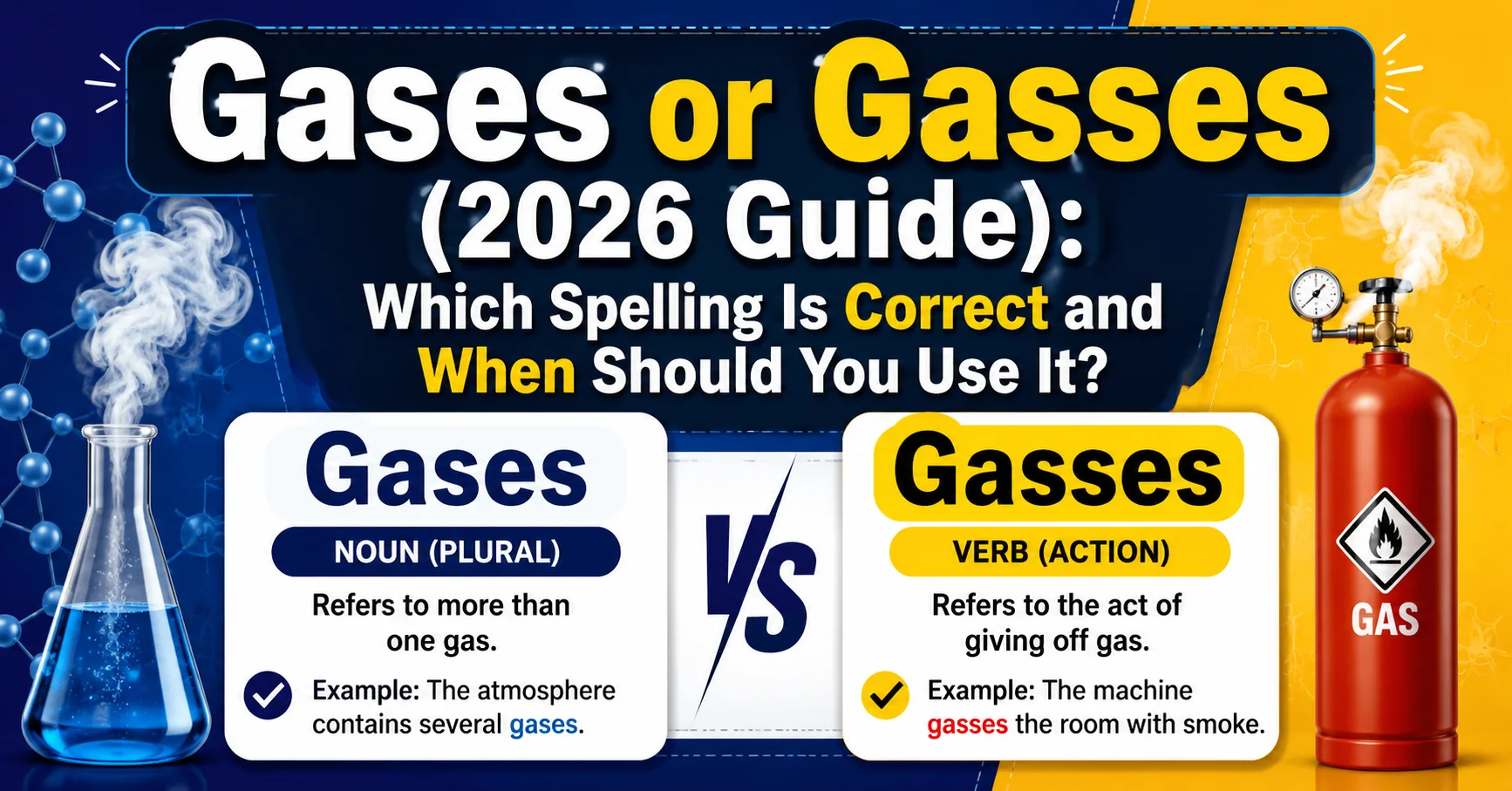
Have you ever typed “gasses” and wondered if your spell checker was broken? You are not alone. Many writers get confused about Gases or Gasses because both words look correct at first glance. They sound similar, but they do not mean the same thing.
English has many tricky plural forms. Some follow simple rules, while others break them completely. That is why words like “gas,” “gases,” and “gasses” often create confusion for students, bloggers, and even professional writers.
The good news is that the difference is actually very easy once you understand it. In most cases, “gases” is the correct plural form of “gas.” The word “gasses,” however, has a different meaning. It is linked to the action of giving off gas or exposing someone to gas.
This guide will explain everything in plain English. You will learn the difference, proper grammar rules, real examples, common mistakes, and simple memory tricks. By the end, you will never struggle with Gases or Gasses again.
Why People Get Confused About Gases or Gasses
English spelling rules are not always predictable. Some nouns become plural by adding “s,” while others add “es.” Then there are words that completely change their spelling.
The confusion around Gases or Gasses happens because both versions exist in English. That makes people think they are interchangeable. But they are not.
For example:
- “The laboratory stores dangerous gases.” ✅
- “The laboratory stores dangerous gasses.” ❌
The second sentence looks strange because “gasses” is not the plural noun. Instead, it is a verb.
People also get confused because many double consonant words exist in English. Examples include:
| Singular | Correct Plural |
|---|---|
| Bus | Buses |
| Class | Classes |
| Gas | Gases |
Since “gas” already ends with “s,” the plural naturally becomes “gases.” Adding another “s” changes the word’s function completely.
Another reason for confusion is autocorrect tools. Some writing apps fail to explain grammar properly. They may highlight a word without teaching why it is wrong.
Understanding the real difference between Gases or Gasses helps you write more clearly and professionally.
What Does “Gases” Mean?
The word “gases” is the plural form of “gas.” It refers to more than one gas.
A gas is a substance like oxygen, helium, or carbon dioxide. It can also refer to fuel used in cars or machines, depending on the country and context.
Examples of “gases”:
- The Earth’s atmosphere contains several gases.
- Scientists tested harmful gases in the factory.
- Greenhouse gases affect climate change.
In every example above, “gases” functions as a noun. It names things.
Here is a simple breakdown:
| Word | Part of Speech | Meaning |
|---|---|---|
| Gas | Noun | One gas |
| Gases | Noun | More than one gas |
This is the version you will use most often when discussing science, chemistry, pollution, cooking fuel, or air.
If you are talking about multiple types of gas, “gases” is almost always correct.
What Does “Gasses” Mean?
“Gasses” is a verb, not a plural noun.
It comes from the verb “to gas.” This can mean:
- To release gas
- To poison with gas
- To chat casually in slang English
Examples:
- The soda gasses quickly after opening.
- The engine gasses the room with smoke.
- He gasses his friends up before games.
Notice something important here. “Gasses” describes an action. It is not naming multiple gases.
That is the biggest difference between Gases or Gasses.
| Word | Part of Speech | Meaning |
|---|---|---|
| Gases | Noun | More than one gas |
| Gasses | Verb | Performs the action of gassing |
Many people accidentally use “gasses” as a plural noun. That is grammatically incorrect.
The Main Grammar Rule Behind Gases or Gasses
The rule is surprisingly simple.
When a noun ends in “s,” “sh,” “ch,” “x,” or “z,” we usually add “es” to make it plural.
Examples:
| Singular | Plural |
|---|---|
| Box | Boxes |
| Dish | Dishes |
| Bus | Buses |
| Gas | Gases |
That is why “gas” becomes “gases.”
Now look at the verb side.
English verbs sometimes double consonants before adding endings.
Example:
| Base Verb | Verb Form |
|---|---|
| Run | Running |
| Stop | Stopped |
| Gas | Gasses |
So “gasses” follows verb spelling rules, not plural noun rules.
This small grammar detail explains the entire debate around Gases or Gasses.
Gases vs Gasses: Side-by-Side Comparison
Sometimes a direct comparison makes everything easier.
| Feature | Gases | Gasses |
|---|---|---|
| Part of Speech | Noun | Verb |
| Meaning | More than one gas | Gives off gas |
| Common Usage | Very common | Less common |
| Example | Toxic gases spread quickly | The machine gasses the room |
| Correct as Plural of Gas? | Yes | No |
This table helps you quickly remember which version belongs in your sentence.
If you can replace the word with “multiple gases,” then use “gases.”
If the word describes an action, then “gasses” may be correct.
Real-Life Examples of Correct Usage
Real examples make grammar easier to remember. Let us look at everyday situations involving Gases or Gasses.
Science Example
Correct:
- Scientists studied greenhouse gases in the atmosphere.
Incorrect:
- Scientists studied greenhouse gasses in the atmosphere.
Why? Because the sentence talks about multiple substances.
Car Example
Correct:
- The car releases harmful gases.
Incorrect:
- The car releases harmful gasses.
Again, we are discussing substances, not actions.
Verb Example
Correct:
- The chemical plant gasses the chamber before testing.
Here, “gasses” is correct because it describes an action.
Casual Slang Example
Modern slang sometimes uses “gas” differently.
Example:
- He gasses his team up before every match.
This means he motivates or praises them.
Although slang exists, “gases” still remains the correct plural noun.
Why “Gases” Is Far More Common
In normal writing, “gases” appears much more often than “gasses.”
That happens because people usually discuss gases as objects or substances. The verb form is less common in daily conversation.
Here are places where “gases” frequently appears:
- Science books
- Chemistry articles
- Environmental reports
- Medical writing
- School textbooks
- News reports about pollution
Meanwhile, “gasses” appears mostly in:
- Technical instructions
- Military history
- Informal slang
- Specialized industrial writing
So if you are unsure which word to use, “gases” is probably the safer choice.
Common Mistakes Writers Make
Even skilled writers sometimes misuse Gases or Gasses.
Here are the most common errors.
| Incorrect Sentence | Correct Sentence |
|---|---|
| The lab studies dangerous gasses. | The lab studies dangerous gases. |
| Greenhouse gasses cause warming. | Greenhouse gases cause warming. |
| The room filled with toxic gasses. | The room filled with toxic gases. |
The mistake usually happens because people think adding another “s” creates the plural.
But remember:
- “Gases” = plural noun
- “Gasses” = verb
That one rule solves most errors instantly.
A Simple Trick to Remember the Difference
Memory tricks help grammar stick in your mind.
Here is an easy one for Gases or Gasses:
“E” for Extra Things
The word “gases” has “es” because it refers to extra gases.
Plural = extra things.
So:
- One gas
- Two gases
Now look at “gasses.” It sounds more like an action word.
Example:
- He gasses the engine.
That action feeling helps separate the meanings.
Another simple trick:
If you can replace the word with “many gases,” then use “gases.”
If you can replace it with “releases gas,” then “gasses” may work.
How Dictionaries Define Gases and Gasses
Most dictionaries clearly separate the two words.
| Word | Dictionary Meaning |
|---|---|
| Gases | Plural form of gas |
| Gasses | Third-person singular form of “gas” |
Major English dictionaries agree on this distinction.
That means academic writing, professional blogs, and school essays should follow the same rule.
Using the correct spelling also improves credibility. Readers trust content that uses proper grammar consistently.
Gases in Science and Everyday Language
The word “gases” appears in many areas of life.
In Science
Scientists study gases constantly. Examples include:
- Oxygen
- Nitrogen
- Carbon dioxide
- Hydrogen
These substances are important in chemistry, medicine, and environmental studies.
In Cooking
People talk about cooking gases like propane and natural gas.
In Weather
Meteorologists discuss atmospheric gases.
In Environmental Topics
Climate experts mention greenhouse gases almost daily.
Because the word appears so often, knowing the correct spelling matters.
How Professional Writers Handle Gases or Gasses
Professional editors usually check this mistake quickly.
In formal writing:
- “Gases” is preferred almost every time.
- “Gasses” only appears when a verb is truly needed.
For example:
Correct:
- Factories emit dangerous gases.
Correct:
- The machine gasses the container.
Professional writing depends on clarity. Using the wrong form can confuse readers and weaken trust.
That is why journalists, teachers, and SEO writers pay close attention to this detail.
British English vs American English
Some English words differ between British and American spelling. Examples include:
| American English | British English |
|---|---|
| Color | Colour |
| Favorite | Favourite |
But Gases or Gasses is not one of those cases.
Both British and American English follow the same grammar rule:
- “Gases” = plural noun
- “Gasses” = verb
So no matter where you write, the rule stays consistent.
SEO Importance of Correct Grammar
Grammar affects more than school grades today. It also impacts online visibility.
Search engines value clear, trustworthy writing. Incorrect spelling can hurt readability and user trust.
When readers search for Gases or Gasses, they want a simple answer. Confusing explanations or incorrect grammar may increase bounce rates.
Good SEO writing should:
- Answer questions clearly
- Use proper grammar
- Include helpful examples
- Keep readers engaged
That is why understanding small grammar differences matters online.
Quick Practice Quiz
Try these quick examples yourself.
Which sentence is correct?
- The factory releases toxic gases.
- The factory releases toxic gasses.
✅ Correct answer: #1
- The machine gasses the chamber slowly.
- The machine gases the chamber slowly.
✅ Correct answer: #1
- Greenhouse gases affect Earth’s climate.
- Greenhouse gasses affect Earth’s climate.
✅ Correct answer: #1
Simple practice helps these rules become natural.
Frequently Asked Questions About Gases or Gasses
FAQ 1: Is “gases” the correct plural of gas?
Yes. “Gases” is the correct plural noun form of “gas.” It refers to multiple gases or gas substances.
FAQ 2: When should I use “gasses”?
Use “gasses” only as a verb. It describes the action of giving off gas or exposing something to gas.
FAQ 3: Why do people confuse gases and gasses?
People confuse them because both words exist and sound similar. However, they belong to different parts of speech.
FAQ 4: Is “greenhouse gasses” wrong?
Yes. The correct phrase is “greenhouse gases.”
FAQ 5: Do British and American English spell it differently?
No. Both forms follow the same grammar rules in British and American English.
Final Thoughts on Gases or Gasses
The difference between Gases or Gasses becomes simple once you know the grammar rule.
Use “gases” when talking about more than one gas. This is the correct plural noun and the version used most often in science, education, and daily writing.
Use “gasses” only as a verb describing an action involving gas.
Here is the easiest way to remember it:
- Multiple substances = gases
- Action involving gas = gasses
Small grammar mistakes can confuse readers and reduce credibility. But once you learn this distinction, your writing instantly becomes cleaner and more professional.
The next time you type the word, you will know exactly which spelling belongs in your sentence.
