


Introduction
Have you ever looked at a calendar and wondered how many weeks in a year there actually are? It seems like a simple question, but the answer can be a little more interesting than most people expect.
Many people assume every year has exactly 52 weeks. While that is mostly true, a year actually contains a few extra days beyond those 52 weeks. These extra days can affect calendars, work schedules, school terms, payroll calculations, and even project planning.
Understanding how weeks fit into a year can help you manage your time better. Whether you are a student planning your studies, an employee checking payroll schedules, or a business owner organizing yearly goals, knowing the exact number of weeks in a year is useful.
In this guide, you’ll learn the simple answer, how the math works, differences between regular and leap years, and how weeks are used in real life. By the end, you’ll have a complete understanding of this common calendar question.
How Many Weeks in a Year? The Quick Answer
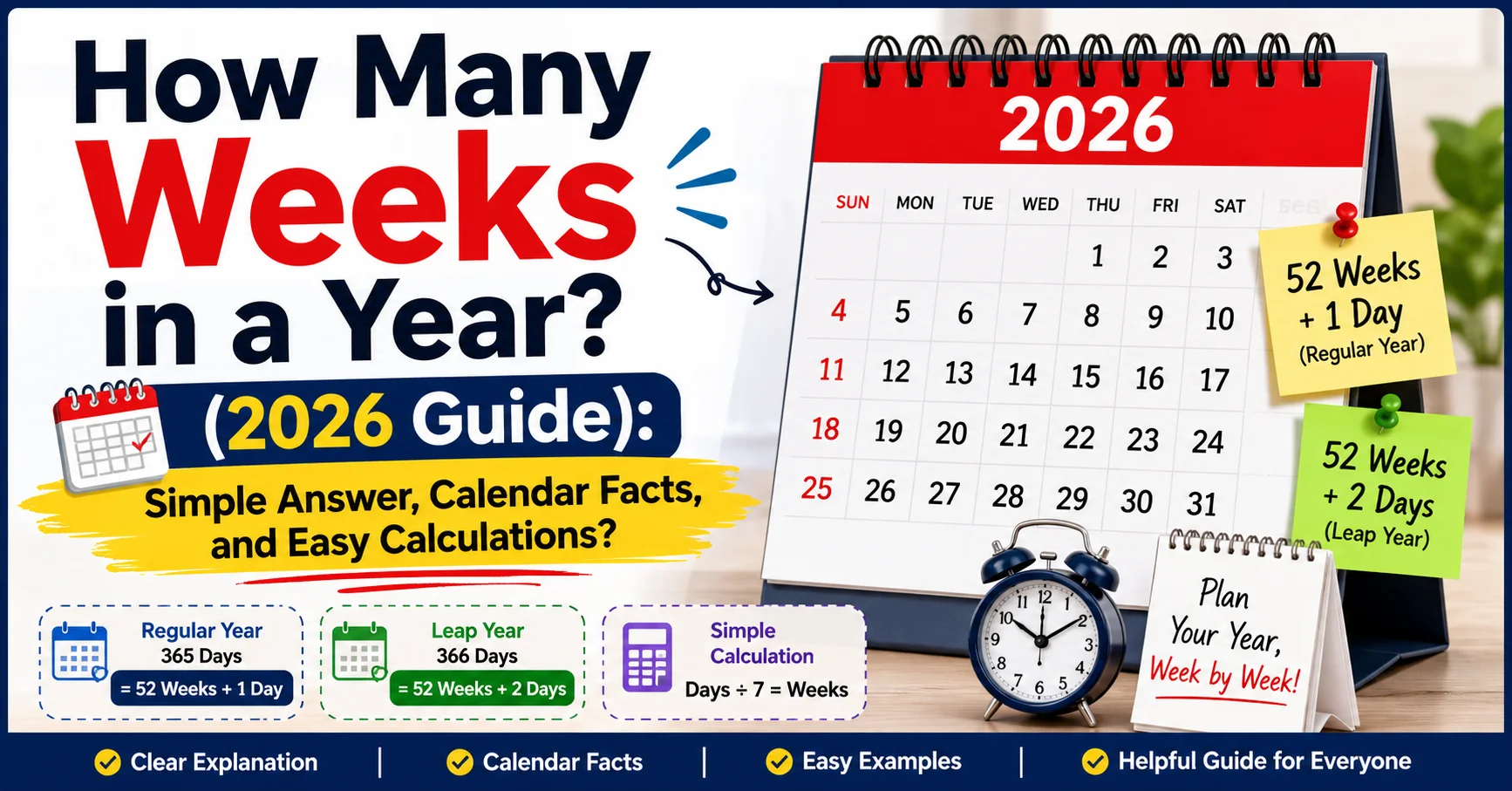
The short answer is that there are 52 weeks in a year.
A standard year has 365 days. Since each week contains 7 days, dividing 365 by 7 gives us:
52 weeks and 1 extra day.
In a leap year, there are 366 days. When divided by 7, that equals:
52 weeks and 2 extra days.
This means a year is never exactly 52 weeks long. Instead, it contains 52 full weeks plus one or two additional days depending on the type of year.
For most everyday purposes, people simply say a year has 52 weeks. This is accurate enough for scheduling, education, work planning, and general discussions. However, understanding those extra days helps explain why certain dates fall on different weekdays each year.
Table: Weeks in Different Types of Years
| Year Type | Total Days | Full Weeks | Extra Days |
|---|---|---|---|
| Regular Year | 365 | 52 | 1 |
| Leap Year | 366 | 52 | 2 |
Why a Year Is Not Exactly 52 Weeks
Many people ask why calendars don’t fit perfectly into weeks.
The answer comes from Earth’s movement around the Sun. A year is based on the time it takes Earth to complete one full orbit. This takes about 365.24 days.
Since weeks are groups of seven days, the math does not divide evenly.
If a year had exactly 52 weeks, it would contain:
52 × 7 = 364 days
But a standard year contains 365 days, leaving one extra day.
This extra day causes weekdays to shift each year. For example, if January 1 falls on a Monday this year, it will likely fall on a different weekday next year.
These small calendar shifts are the reason planners, businesses, and software systems carefully track dates and weeks.
The Math Behind How Many Weeks in a Year
Let’s break the calculation into simple steps.
Standard Year Calculation
365 ÷ 7 = 52.14
This means:
- 52 complete weeks
- 1 remaining day
Leap Year Calculation
366 ÷ 7 = 52.29
This means:
- 52 complete weeks
- 2 remaining days
Table: Week Calculations
| Calculation | Result |
|---|---|
| 365 ÷ 7 | 52 weeks + 1 day |
| 366 ÷ 7 | 52 weeks + 2 days |
| 52 × 7 | 364 days |
Understanding this basic calculation makes it easier to answer questions about yearly schedules, payroll periods, and project timelines.
What Is a Leap Year?
A leap year is a special year that contains 366 days instead of 365.
To keep our calendar aligned with Earth’s orbit, an extra day is added every four years. This extra day appears on February 29.
Without leap years, calendars would slowly drift away from the seasons.
For example, summer could eventually occur during what we currently consider winter months.
Because leap years have one additional day, they contain:
- 52 weeks
- 2 extra days
Leap years help maintain calendar accuracy over long periods. They may seem like a small adjustment, but they play a huge role in keeping dates consistent around the world.
How Many Work Weeks Are in a Year?
Many professionals are more interested in work weeks than total weeks.
A typical work week contains five working days:
- Monday
- Tuesday
- Wednesday
- Thursday
- Friday
Using 52 weeks:
52 × 5 = 260 workdays
However, holidays and vacation time reduce this number.
Example
An employee receives:
- 10 vacation days
- 10 public holidays
That removes 20 working days.
260 − 20 = 240 working days
Table: Typical Work-Year Breakdown
| Category | Days |
|---|---|
| Total Workdays | 260 |
| Vacation Days | 10 |
| Public Holidays | 10 |
| Remaining Workdays | 240 |
This is why businesses often calculate productivity using work weeks rather than calendar weeks.
How Many School Weeks Are in a Year?
Students often wonder whether schools operate all 52 weeks.
The answer is no.
Most schools have long breaks during summer and shorter breaks during holidays.
A typical academic year includes approximately:
- 36 to 40 instructional weeks
- Holiday breaks
- Summer vacation
Table: Typical School Year
| Activity | Approximate Weeks |
|---|---|
| Classroom Learning | 36–40 |
| Summer Break | 8–12 |
| Holiday Breaks | 2–4 |
| Total Calendar Weeks | 52 |
The exact number varies by country, state, and educational system.
How Many Weeks Are in a Month?
People often confuse weeks per month with weeks per year.
A month does not contain exactly four weeks.
Here’s why:
- Four weeks = 28 days
- Most months have 30 or 31 days
As a result, most months contain slightly more than four weeks.
Table: Average Weeks Per Month
| Month Length | Weeks |
|---|---|
| 28 Days | 4 Weeks |
| 30 Days | 4.29 Weeks |
| 31 Days | 4.43 Weeks |
On average:
12 months × 4.33 weeks ≈ 52 weeks annually.
This explains why monthly and weekly schedules don’t always align perfectly.
How Businesses Use Weeks in a Year
Businesses rely heavily on weekly planning.
Instead of thinking in months, many companies organize work into weekly cycles.
Examples include:
- Sales targets
- Marketing campaigns
- Employee schedules
- Inventory management
- Financial forecasting
Using weeks provides a more consistent measurement because every week contains exactly seven days.
Many organizations divide the year into 52 business weeks to simplify planning.
Weekly reporting also allows managers to identify trends more quickly than monthly reports.
This makes week-based systems extremely popular across industries.
How Payroll Uses Weekly Calculations
Payroll departments often use weekly schedules.
Employees may be paid:
- Weekly
- Biweekly
- Semi-monthly
- Monthly
For weekly payroll:
52 pay periods occur during most years.
For biweekly payroll:
52 ÷ 2 = 26 pay periods
However, because of the extra days in the calendar, some years create unusual payroll situations.
Occasionally, companies experience an extra pay cycle during a year. This can affect budgets and financial planning.
Understanding how many weeks in a year helps payroll teams maintain accurate records and forecasts.
Why Some Calendars Show 53 Weeks
You may occasionally hear that a year contains 53 weeks.
This can sound confusing at first.
The reason is that some calendar systems count partial weeks differently.
When a year starts or ends near the beginning or end of a week, a calendar may display:
- Week 1
- Week 2
- …
- Week 53
This does not mean the year contains 53 full weeks.
Instead, it means the remaining extra days create a partial week that receives its own week number.
Businesses that use ISO week numbering often encounter Week 53 in certain years.
How Weeks Help With Goal Setting
Weekly planning is one of the easiest ways to achieve long-term goals.
Thinking about an entire year can feel overwhelming.
Breaking goals into 52 weeks makes them more manageable.
For example:
If you want to read 24 books in a year:
24 ÷ 52 = less than one book every two weeks.
If you want to save $5,200:
$5,200 ÷ 52 = $100 per week.
This weekly approach helps transform large goals into smaller, realistic tasks.
Many productivity experts recommend focusing on weekly progress rather than yearly outcomes.
Common Questions About Weeks and Years
Many people search for answers related to calendar math.
Some common questions include:
- How many weeks in a leap year?
- How many working weeks in a year?
- How many weeks are in 12 months?
- Can a year have 53 weeks?
- Why are there extra days after 52 weeks?
The answer to most of these questions comes back to one simple fact:
A year contains more than 364 days, which is why extra days always remain after 52 complete weeks.
Once you understand this concept, calendar calculations become much easier.
Real-Life Example of Weekly Planning
A few years ago, I started organizing annual goals using weekly milestones instead of monthly ones.
At first, I planned everything by month. But some months felt longer, while others seemed to disappear quickly.
Switching to a weekly system created consistency.
Each week became a fresh opportunity to make progress.
Whether it was fitness goals, writing projects, or budgeting, focusing on one week at a time made large goals feel much more achievable.
This simple change improved productivity and reduced stress because progress became easier to measure.
Many professionals, students, and entrepreneurs find similar benefits when they think in weeks rather than months.
Frequently Asked Questions
1. How many weeks in a year exactly?
A regular year contains 52 weeks and 1 day, while a leap year contains 52 weeks and 2 days.
2. Is a year 52 or 53 weeks?
A year has 52 full weeks. Some calendar systems may show Week 53 because of leftover days.
3. How many work weeks are in a year?
There are approximately 52 work weeks in a year before accounting for vacations and holidays.
4. How many weeks are in 12 months?
Twelve months equal about 52.14 weeks in a regular year and 52.29 weeks in a leap year.
5. Why do leap years have extra days?
Leap years include February 29 to keep the calendar aligned with Earth’s orbit around the Sun.
Conclusion
So, how many weeks in a year?
The simple answer is 52 weeks. However, a standard year actually contains 52 weeks and 1 day, while a leap year contains 52 weeks and 2 days.
Those extra days may seem small, but they play an important role in calendars, scheduling, payroll, education, and long-term planning. Understanding how weeks fit into a year helps you manage time more effectively and make better plans for work, school, and personal goals.
Whether you’re calculating work schedules, setting financial targets, or organizing a project, thinking in weeks can make large tasks feel more manageable. The next time someone asks how many weeks are in a year, you’ll not only know the answer—you’ll understand the math and reasoning behind it as well.
