

Have you ever stopped while writing a sentence and wondered whether to use correct or correctly? You are not alone. Many English learners and even native speakers mix these two words. They look similar, but they work differently in sentences.
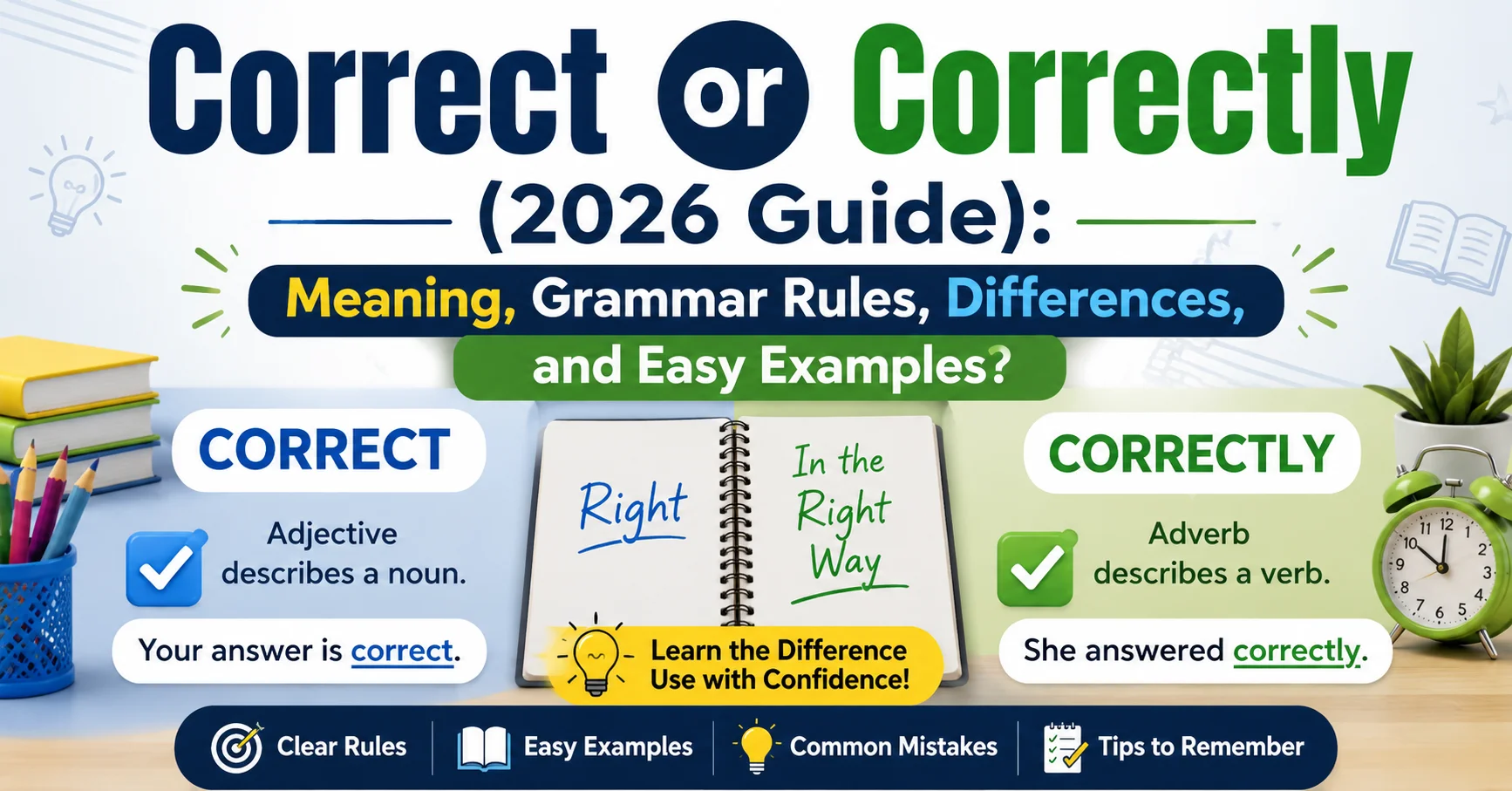
The good news is that the difference is very simple once you understand the basic rule. In most cases, correct is an adjective, while correctly is an adverb. That small change matters because it changes how the word works in grammar.
This guide explains everything in easy language. You will learn when to use each word, common mistakes people make, sentence examples, grammar tips, and easy tricks to remember the difference forever. By the end, using Correct or Correctly will feel natural and simple.
What Does “Correct” Mean?
The word correct usually describes something that is right, accurate, or free from mistakes. It is commonly used as an adjective.
For example:
- Your answer is correct.
- That spelling is correct.
- She gave the correct address.
In these examples, the word describes a noun or pronoun. It tells us something about the answer, spelling, or address.
Sometimes, correct can also work as a verb.
For example:
- The teacher will correct the test.
- Please correct my mistake.
Here, the word means “to fix” or “to make something right.”
Table: Uses of “Correct”
| Use | Example | Meaning |
|---|---|---|
| Adjective | Your answer is correct. | Right or accurate |
| Verb | Please correct this sentence. | Fix a mistake |
| Adjective | That map is correct. | Not wrong |
| Verb | He corrected my grammar. | Improved errors |
Understanding this first meaning makes the Correct or Correctly difference much easier.
What Does “Correctly” Mean?
The word correctly is an adverb. It explains how something happens or how an action is done.
For example:
- She answered the question correctly.
- He spelled the word correctly.
- Please follow the instructions correctly.
Notice something important here. The word correctly describes a verb. It explains how the person answered, spelled, or followed something.
A simple trick is this:
- If you describe a thing, use correct
- If you describe an action, use correctly
That one rule solves most grammar confusion.
The Main Difference Between Correct and Correctly
The biggest difference in Correct or Correctly is grammar function.
- Correct = adjective or verb
- Correctly = adverb
Here is an easy comparison table.
| Word | Part of Speech | Job in Sentence | Example |
|—|—|—|
| Correct | Adjective | Describes a noun | That answer is correct. |
| Correct | Verb | Means fix something | Please correct this paper. |
| Correctly | Adverb | Describes a verb | She answered correctly. |
This small grammar change creates a big meaning difference.
For example:
- “You are correct” sounds natural.
- “You are correctly” sounds wrong.
But:
- “You answered correctly” sounds natural.
- “You answered correct” is informal and often incorrect in formal English.
Why People Confuse Correct or Correctly
Many English learners struggle with adverbs and adjectives. The confusion grows because some casual conversations ignore strict grammar rules.
For example, people may say:
- “You did it correct.”
In everyday speech, many people understand this sentence. However, formal grammar prefers:
- “You did it correctly.”
Social media, texting, and spoken English sometimes blur grammar rules. That is why learners often feel unsure.
Another reason is that some verbs can sound natural with adjectives in casual English. But in professional writing, school assignments, and formal communication, grammar matters more.
Learning the real rule helps you write clearly and confidently.
When to Use “Correct”
Use correct when describing a noun or pronoun.
Examples
- The correct answer is B.
- Your information is correct.
- That sentence looks correct.
- Is this address correct?
In all these examples, correct describes something.
Easy Grammar Trick
Ask yourself:
“What thing is being described?”
If the answer is a noun, use correct.
Table: Correct in Sentences
| Sentence | Why It Uses “Correct” |
|---|---|
| Your math answer is correct. | Describes answer |
| The correct book is on the table. | Describes book |
| Her email address is correct. | Describes address |
| This direction seems correct. | Describes direction |
This rule works in almost every situation.
When to Use “Correctly”
Use correctly when describing how an action happens.
Examples
- She pronounced the word correctly.
- He completed the task correctly.
- They followed the rules correctly.
- Did you answer correctly?
Here, correctly explains the action.
Easy Grammar Trick
Ask yourself:
“How was the action done?”
If it describes the action, use correctly.
Table: Correctly in Sentences
| Sentence | Action Being Described |
|---|---|
| She wrote the answer correctly. | Wrote |
| He explained it correctly. | Explained |
| They solved it correctly. | Solved |
| We followed the steps correctly. | Followed |
This pattern helps avoid grammar mistakes fast.
Common Grammar Mistakes With Correct or Correctly
Many people accidentally mix these words in sentences. Let’s look at common mistakes and fixes.
| Incorrect Sentence | Correct Sentence |
|---|---|
| She sings correct. | She sings correctly. |
| Your answer correctly. | Your answer is correct. |
| He completed the work correct. | He completed the work correctly. |
| That spelling correctly. | That spelling is correct. |
A quick grammar check can save you from these mistakes.
One thing I noticed while teaching beginner English learners is that they often focus only on meaning. They forget grammar structure. But English depends heavily on sentence structure. Once you practice spotting verbs and nouns, choosing between Correct or Correctly becomes easy.
Correct vs Correctly in Spoken English
Spoken English is often less strict than written English. Native speakers sometimes use “correct” informally where “correctly” would be more grammatical.
For example:
- “You did it correct.”
You may hear this in casual conversation. However, formal English still prefers:
- “You did it correctly.”
If you are writing essays, business emails, blog posts, or professional content, using proper grammar is safer.
Informal vs Formal Usage
| Informal Speech | Formal English |
|---|---|
| You said it correct. | You said it correctly. |
| He spelled it correct. | He spelled it correctly. |
| They did it correct. | They did it correctly. |
Understanding this difference improves both writing and speaking skills.
Is “Correctly” Always Necessary?
Not always. Some sentences naturally use only correct.
For example:
- That answer is correct.
- The information is correct.
Adding “correctly” here would sound unnatural because there is no action being described.
At the same time, action verbs usually need correctly.
For example:
- She completed the form correctly.
- He answered correctly.
One useful habit is reading your sentence slowly. Ask yourself whether the word describes a thing or an action.
That small pause can instantly improve grammar accuracy.
Real-Life Examples of Correct or Correctly
Real examples make grammar easier to remember. Let’s explore everyday situations.
In School
- The teacher said my answer was correct.
- I solved the equation correctly.
At Work
- Please enter the password correctly.
- Your report is correct.
In Text Messages
- Did I spell your name correctly?
- Yes, that spelling is correct.
In Online Forms
- Make sure your email is correct.
- Fill out the application correctly.
These simple examples show how naturally the grammar rule works in daily life.
Easy Memory Tricks for Correct or Correctly
Grammar becomes easier when you use memory tricks.
Trick #1: Look for the Verb
If the word explains a verb, use correctly.
Example:
- She danced correctly.
Trick #2: Look for the Noun
If the word describes a noun, use correct.
Example:
- That answer is correct.
Trick #3: LY Words Usually Describe Actions
Many adverbs end in “-ly.”
Examples:
- Quickly
- Slowly
- Carefully
- Correctly
These words explain actions.
This simple pattern helps learners remember grammar faster.
Correct or Correctly in Academic Writing
Academic writing requires proper grammar. Teachers and editors usually expect the correct form.
For example:
❌ The student answered correct.
✅ The student answered correctly.
Formal writing values precision. Using the wrong form may weaken your credibility.
When writing essays or reports, double-check these areas:
- Verbs
- Adverbs
- Adjectives
- Sentence structure
Strong grammar creates stronger communication.
How Native Speakers Use Correct or Correctly
Native speakers often learn grammar naturally through exposure. Still, many casual conversations ignore formal grammar rules.
For example, you may hear:
- “You got it correct.”
This sounds acceptable because “correct” describes “it.”
But you may also hear:
- “You did it correct.”
This is common in speech but less formal.
In professional writing, grammar experts still recommend:
- “You did it correctly.”
That balance between spoken and written English is important to understand.
Sentence Practice for Better Understanding
Practice helps grammar stick in your memory. Try reading these examples carefully.
Fill-in Practice
| Sentence | Correct Answer |
|---|---|
| She answered the teacher _______. | correctly |
| Your homework is _______. | correct |
| He explained the rule _______. | correctly |
| That information seems _______. | correct |
These small exercises improve grammar naturally.
I personally found that writing five practice sentences daily helped me master confusing English words much faster. Repetition trains your brain to notice patterns automatically.
Similar Words That Follow the Same Rule
Many English words follow the same adjective/adverb pattern.
| Adjective | Adverb |
|---|---|
| Quick | Quickly |
| Slow | Slowly |
| Careful | Carefully |
| Happy | Happily |
| Correct | Correctly |
Once you understand this grammar pattern, many other English mistakes become easier to fix.
This is why learning Correct or Correctly can improve your overall grammar skills too.
Why Proper Grammar Matters Online
Good grammar builds trust online. Whether you write blog posts, emails, comments, or social media captions, readers notice mistakes.
Using Correct or Correctly properly helps your writing feel:
- More professional
- Easier to read
- More trustworthy
- More polished
Search engines also reward clear, helpful content. Better grammar improves readability and user experience.
Even small grammar improvements can make a big difference in communication.
Frequently Asked Questions About Correct or Correctly
Is it “You are correct” or “You are correctly”?
“You are correct” is correct grammar because the word describes “you.”
Is “answered correct” wrong?
In formal English, yes. The better version is “answered correctly” because it describes an action.
Can “correct” be a verb?
Yes. Example:
- Please correct my spelling.
Here, the word means to fix something.
Why does correctly end in “-ly”?
The “-ly” ending usually turns adjectives into adverbs. Adverbs describe actions.
Is casual English different from formal grammar?
Yes. Casual speech often bends grammar rules. Formal writing usually follows stricter grammar standards.
Conclusion
Understanding Correct or Correctly is much easier than many people think. The secret is knowing whether the word describes a thing or an action.
Use correct for nouns and pronouns:
- Your answer is correct.
Use correctly for actions and verbs:
- You answered correctly.
That one grammar rule solves most confusion instantly.
The more you practice, the more natural it becomes. Read sentences carefully, notice the verbs, and look for what the word describes. Over time, choosing between Correct or Correctly will feel automatic.
If this guide helped you, try practicing with your own sentences today. Small grammar improvements can make your English stronger, clearer, and more confident.
