


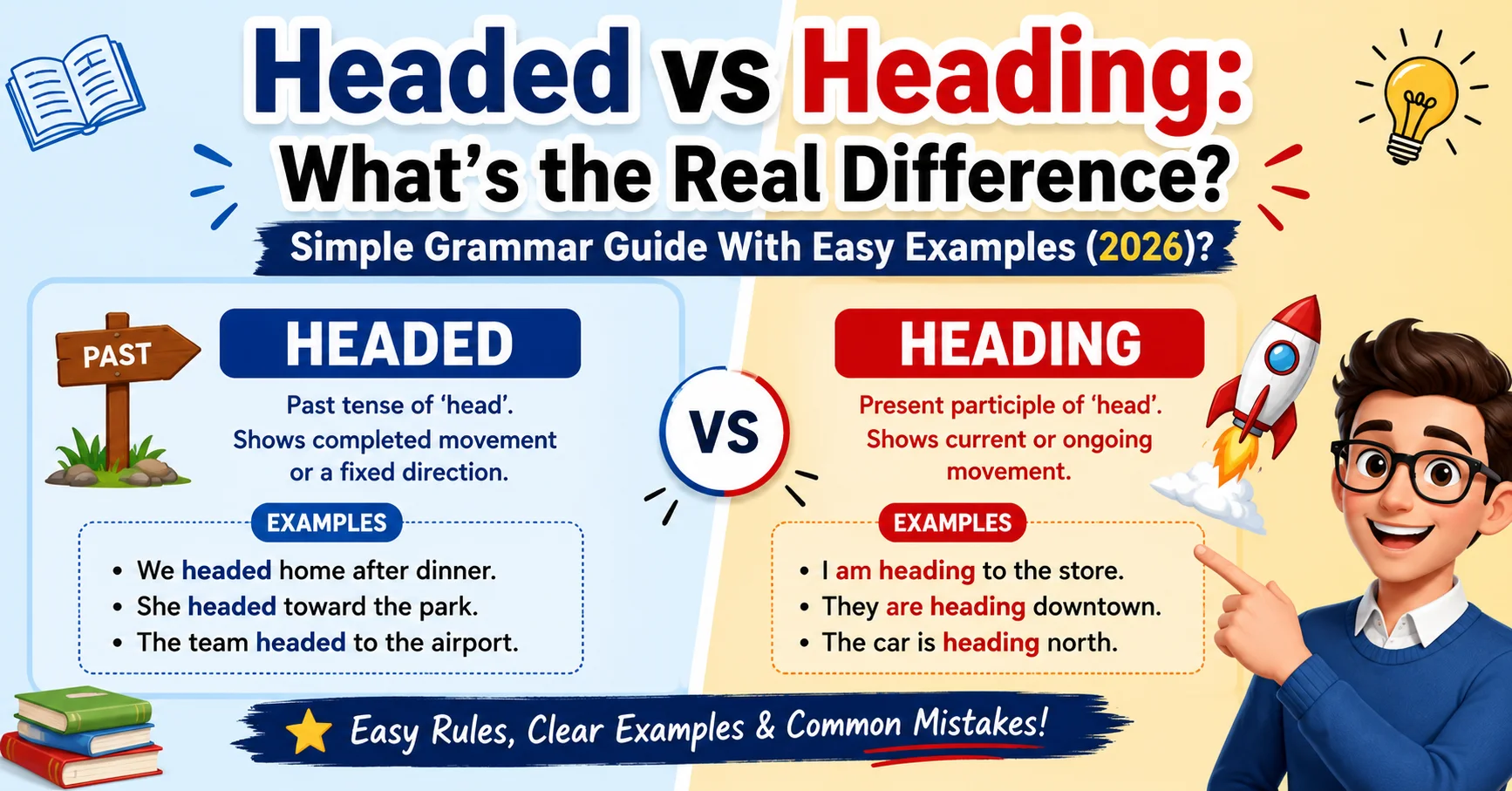
Many English learners confuse Headed vs Heading because both words come from the same root word: “head.” They look similar, sound close, and often appear in everyday conversations. But they are not used in the same way.
The good news is that the difference is actually simple once you understand how each word works in a sentence.
“Headed” usually talks about a completed direction or movement. “Heading” often describes movement happening right now or something that is about to happen. These small grammar differences matter in writing, speaking, schoolwork, and even business communication.
In this guide, you’ll learn:
- The difference between headed and heading
- When to use each word
- Easy grammar rules
- Real-life examples
- Common mistakes to avoid
- Helpful comparison tables
- Memory tricks for faster learning
By the end, you’ll feel confident using both words naturally in daily English.
What Does “Headed” Mean?
“Headed” is the past tense and past participle form of the verb “head.” It usually means someone or something moved toward a place or direction.
People often use “headed” when talking about movement that already started or a planned direction.
Examples:
- We headed home after dinner.
- She headed toward the park.
- The storm headed east overnight.
In many cases, “headed” also works like an adjective.
Example:
- A college-headed student
- A wrong-headed decision
Here, the word describes a type of person or thing.
One easy way to remember this is:
“Headed” often sounds more finished or settled.
That is why you commonly hear phrases like:
- headed to school
- headed home
- headed in the right direction
These phrases describe movement with a clear destination.
What Does “Heading” Mean?
“Heading” is the present participle form of “head.” It describes movement happening now or very soon.
It often appears with helping verbs like:
- is
- am
- are
- was
- were
Examples:
- I am heading to the store.
- They are heading downtown.
- The car is heading north.
“Heading” creates a sense of ongoing action.
It can also mean a title or section name in writing.
Example:
- Add a heading at the top of the page.
This second meaning is common in articles, blogs, books, and school assignments.
So, depending on context, “heading” may describe:
- Movement in progress
- A title or label
That’s why understanding sentence structure matters.
Headed vs Heading: The Main Difference
Here is the easiest way to understand Headed vs Heading.
| Word | Main Use | Time |
|---|---|---|
| Headed | Past movement or fixed direction | Usually completed |
| Heading | Ongoing movement | Happening now |
Quick Examples
| Sentence | Correct Word |
|---|---|
| We are ___ to the beach. | heading |
| They ___ home after school. | headed |
| She is ___ north. | heading |
| The group ___ toward safety. | headed |
Think of it this way:
- Heading = action happening
- Headed = action already set or completed
This simple trick helps many learners avoid confusion.
Why People Confuse Headed and Heading
There are several reasons why these words confuse English learners.
First, both come from the same base verb: “head.”
Second, native speakers often use them casually in speech. Sometimes the difference sounds small in fast conversations.
Third, both words involve movement or direction. That overlap makes them feel interchangeable.
Here’s a confusing example:
- We headed to the mall.
- We are heading to the mall.
Both sentences talk about going somewhere. But the timing changes.
The first sentence talks about movement that already started or happened.
The second sentence describes movement happening now.
Another reason for confusion is informal English. Some speakers shorten phrases or mix grammar casually in text messages.
That’s why learning the proper grammar rule helps you write more clearly and professionally.
How “Headed” Works in Sentences
“Headed” often appears in past tense sentences.
Structure:
Subject + headed + direction/place
Examples:
- We headed south after lunch.
- The kids headed inside.
- She headed straight home.
You can also use “headed” with helping verbs.
Examples:
- We were headed to Texas.
- She had headed upstairs earlier.
- They are headed in the right direction.
Notice something important:
“Are headed” sounds different from “are heading.”
Compare:
- We are heading home. → movement happening now
- We are headed home. → destination already decided
Both are correct, but the feeling changes slightly.
“Headed” often sounds more certain or destination-focused.
How “Heading” Works in Sentences
“Heading” is commonly used in continuous tenses.
Structure:
Subject + helping verb + heading + place
Examples:
- I am heading out now.
- They are heading west.
- She was heading to class.
This form focuses on active movement.
It feels more immediate and current.
Native speakers use “heading” often in casual conversation because it sounds natural and relaxed.
Everyday Examples:
- I’m heading home.
- We’re heading to dinner.
- He’s heading upstairs.
These sentences are very common in spoken English.
Headed vs Heading in Everyday Conversation
In real life, native speakers use both words frequently.
Here are some realistic examples you may hear daily.
| Conversation | Correct Usage |
|---|---|
| “Where are you going?” | “I’m heading home.” |
| “What happened after the game?” | “We headed downtown.” |
| “Is the train moving north?” | “Yes, it’s heading north.” |
| “Where did they go?” | “They headed to the airport.” |
Notice how “heading” feels active and current.
Meanwhile, “headed” sounds more reflective or completed.
This difference becomes easier with practice.
Common Grammar Mistakes to Avoid
Many learners make small grammar mistakes with these words.
Here are the most common ones.
Mistake 1: Using “headed” for present action
❌ I am headed to the store right now.
This sentence is not fully wrong, but “heading” sounds more natural for ongoing movement.
✅ I am heading to the store right now.
Mistake 2: Mixing verb tenses
❌ Yesterday we are heading home.
✅ Yesterday we headed home.
Mistake 3: Forgetting helping verbs
❌ She heading north.
✅ She is heading north.
Mistake 4: Confusing “heading” with titles
Remember that “heading” can also mean a section title.
Example:
- Use a bold heading for each section.
That meaning has nothing to do with movement.
Headed vs Heading in Writing
Professional writing often uses both words differently.
“Headed” in Writing
“Headed” usually appears in reports, news articles, and formal storytelling.
Example:
- The company headed into a difficult year.
It sounds more polished and complete.
“Heading” in Writing
“Heading” appears often in conversational writing, blogs, and active narration.
Example:
- Investors are heading toward safer options.
It feels more current and active.
Writers choose between these words based on tone and timing.
Difference Between “Are Headed” and “Are Heading”
This is one of the biggest grammar questions online.
Both phrases are correct, but they have slightly different meanings.
| Phrase | Meaning |
|---|---|
| Are heading | Currently moving |
| Are headed | Destination already decided |
Example 1
- We are heading to Lahore.
This focuses on the movement happening now.
Example 2
- We are headed to Lahore.
This focuses more on the destination.
Native speakers use both naturally. The difference is subtle.
If you are unsure, either one usually works in casual conversation.
Still, advanced English learners should understand the nuance.
Headed vs Heading: Real-Life Examples
Here are more examples to make things crystal clear.
| Headed | Heading |
|---|---|
| We headed home early. | We are heading home now. |
| She headed toward the exit. | She is heading toward the exit. |
| They headed south yesterday. | They are heading south today. |
| The team headed back after practice. | The team is heading back now. |
Reading these side by side helps you notice the time difference quickly.
Easy Trick to Remember the Difference
Here’s a simple memory trick.
“ING” = happening now
Words ending in “-ing” usually describe ongoing action.
Examples:
- running
- walking
- heading
So if the action is happening now, “heading” is usually correct.
“ED” = already happened or fixed
Words ending in “-ed” often describe completed or settled action.
Examples:
- walked
- played
- headed
This trick works well for beginners.
Can “Headed” Be an Adjective?
Yes, and this surprises many learners.
“Headed” sometimes acts as an adjective instead of a verb.
Examples:
- Strong-headed leader
- Career-headed student
- Level-headed person
In these examples, “headed” describes personality or direction.
One common phrase is:
“Level-headed”
This means calm and sensible.
Example:
- Sara stayed level-headed during the emergency.
This usage is very common in spoken English.
What Does “Heading” Mean in Articles and Books?
Besides movement, “heading” also means a title or section name.
You see headings everywhere online.
Examples:
- Blog headings
- News headings
- Chapter headings
Good headings help readers scan content quickly.
Example:
Benefits of Daily Exercise
That line above is a heading.
This meaning is completely different from movement-related usage.
Context tells you which meaning is correct.
Formal vs Informal Usage
Some English expressions sound more formal than others.
| More Formal | More Casual |
|---|---|
| headed toward | heading toward |
| headed into | heading into |
| headed home | heading home |
“Heading” feels more conversational.
“Headed” sometimes sounds more polished or narrative.
That’s why news articles often use “headed.”
Example:
- The economy headed into recession.
Meanwhile, conversations usually prefer “heading.”
Example:
- I’m heading out now.
How Native Speakers Use These Words
Native English speakers usually choose words based on natural rhythm.
For example:
More Natural in Speech
- I’m heading home.
- We’re heading out.
- She’s heading upstairs.
More Natural in Storytelling
- They headed west.
- He headed back after dinner.
- We headed toward the city.
The more English you hear, the more natural these patterns become.
Watching movies and listening to podcasts can help a lot.
Best Situations to Use “Headed”
Use “headed” when:
- Talking about past movement
- Describing fixed direction
- Writing formally
- Telling stories
- Showing completed action
Examples:
- We headed home late.
- The ship headed north.
- She headed toward success.
Best Situations to Use “Heading”
Use “heading” when:
- Talking about current movement
- Speaking casually
- Describing ongoing action
- Using continuous tenses
Examples:
- I’m heading to work.
- They are heading downtown.
- We’re heading out soon.
FAQs About Headed vs Heading
Is “headed” grammatically correct?
Yes, “headed” is completely correct. It is the past tense and past participle form of “head.” It can also work as an adjective in some sentences.
Is “heading” present tense?
“Heading” is a present participle. It usually appears in continuous verb tenses like “is heading” or “are heading.”
Which is better: “headed” or “heading”?
Neither word is better. The correct choice depends on timing and sentence structure.
Can I say “I am headed home”?
Yes. Native speakers use this phrase often. It focuses more on destination than movement.
What is the difference between “heading” and “heading title”?
“Heading” can mean movement or a title in writing. A heading title is simply a section label in an article or document.
Final Thoughts on Headed vs Heading
Understanding Headed vs Heading becomes much easier once you focus on time and sentence structure.
Use “heading” for actions happening now.
Use “headed” for actions already completed or for fixed direction.
Even though both words are similar, they create slightly different meanings and tones. Learning these small grammar details can improve your speaking, writing, and confidence in English.
The best way to master them is through practice.
Try writing your own examples every day:
- “I’m heading to school.”
- “We headed home early.”
Soon, choosing the correct word will feel natural.
English grammar does not have to feel stressful. Small steps and simple explanations make a big difference.
