


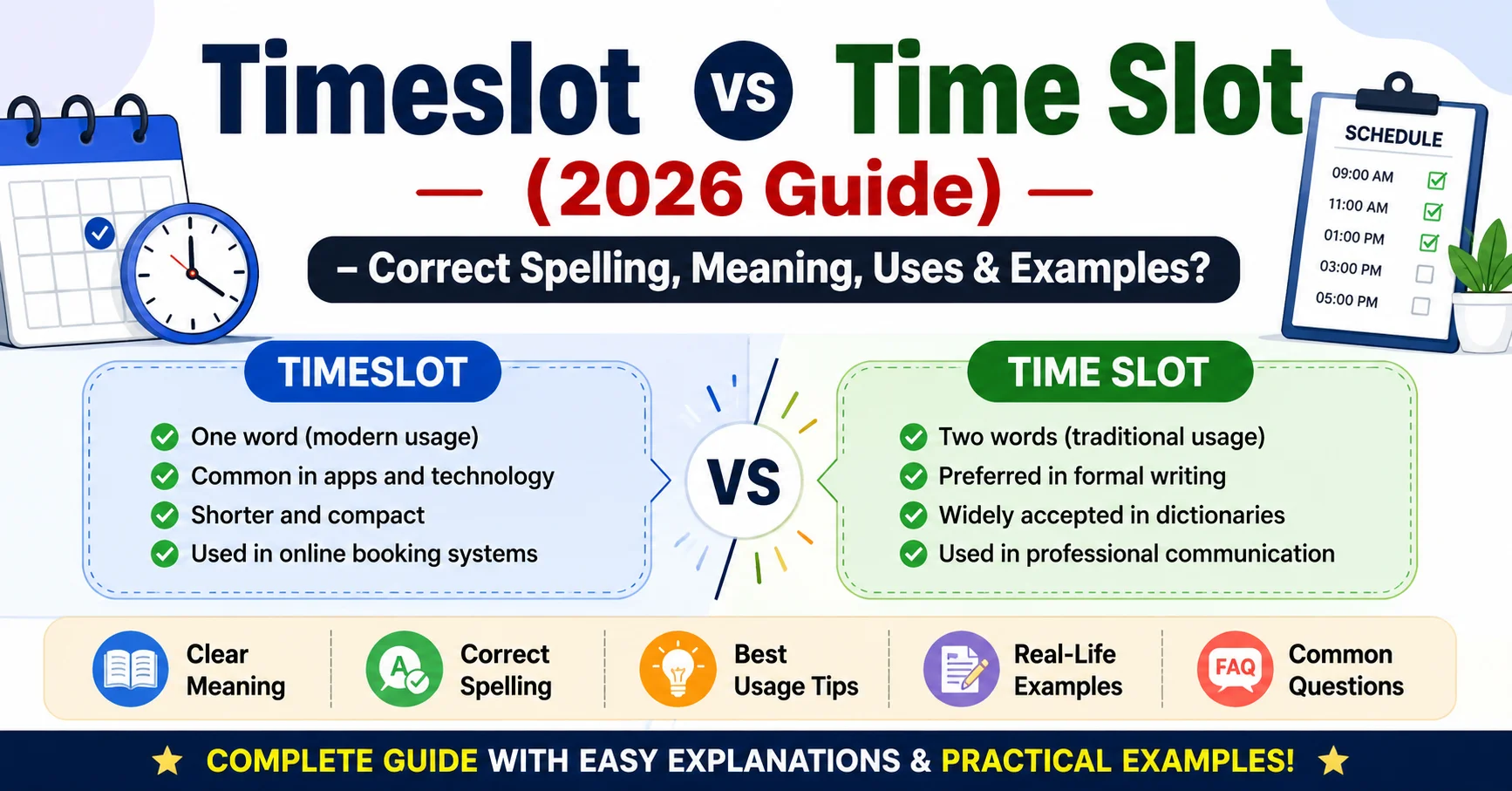
When writing emails, booking meetings, or planning schedules, many people get confused about Timeslot vs Time Slot. Is it one word or two? Which version is correct? And does it matter in professional writing?
The short answer is simple. Both forms appear online, but “time slot” is still the most widely accepted and correct version in formal English. However, “timeslot” is becoming more common in apps, booking systems, and digital platforms.
This guide explains everything in easy language. You will learn the difference between the two spellings, when to use each one, common mistakes, grammar rules, and real examples from daily life. By the end, you will feel confident using the right form in emails, school work, business writing, and casual conversations.
What Does “Time Slot” Mean?
A time slot means a specific period set aside for an activity, meeting, event, or appointment. It usually refers to a fixed block of time during a schedule.
For example:
- A doctor may offer a 10:00 AM appointment time slot.
- A TV channel may reserve a prime evening time slot.
- A teacher may assign a time slot for presentations.
The phrase helps people organize schedules clearly. It avoids confusion because everyone knows exactly when something will happen.
In simple words, a time slot is just a planned time period.
Table: Simple Meaning of Time Slot
| Word | Meaning |
|---|---|
| Time | A measured period |
| Slot | A reserved space or opening |
| Time Slot | A reserved period for an activity |
The phrase is common in schools, offices, healthcare, online bookings, transportation, and entertainment industries.
Timeslot vs Time Slot: What Is the Difference?
The biggest difference between Timeslot vs Time Slot is spelling style.
- Time slot = Traditional and widely accepted spelling
- Timeslot = Modern compound version used in technology and software
Both forms carry the same meaning. The difference mostly depends on context, style guide, and platform usage.
Table: Timeslot vs Time Slot Comparison
| Feature | Time Slot | Timeslot |
|---|---|---|
| Spelling Style | Two words | One word |
| Formal Writing | Preferred | Less common |
| Modern Apps | Sometimes used | Common |
| Dictionaries | Widely accepted | Limited acceptance |
| Business Emails | Recommended | Avoid if unsure |
Most grammar experts still prefer “time slot” in professional writing because it looks cleaner and follows standard English patterns.
Why “Time Slot” Is More Common
English often starts with two separate words before combining them into one over time. Many compound words evolved this way.
For example:
| Older Form | Modern Form |
|---|---|
| Web site | Website |
| Data base | Database |
| Note book | Notebook |
Some experts believe “timeslot” may eventually become fully accepted everywhere. But right now, “time slot” remains the safer choice.
When I worked with scheduling software for a small training company, I noticed something interesting. The app interface used “timeslot,” but official emails to clients used “time slot.” That showed how digital platforms often adopt shorter versions faster than formal writing does.
Is “Timeslot” Grammatically Wrong?
No, “timeslot” is not completely wrong. It is considered an acceptable variation in some industries, especially technology and software systems.
You may see it in:
- Booking apps
- Calendar tools
- Event management software
- Online ticket systems
- Streaming platforms
Still, many editors and teachers prefer “time slot” because it follows standard dictionary style.
If you are writing something important, such as:
- School assignments
- Business proposals
- Professional emails
- Articles
- Academic content
Then using “time slot” is usually the better option.
When Should You Use “Time Slot”?
You should use “time slot” in formal and professional situations. It is the safest spelling because readers immediately recognize it.
Here are common situations where “time slot” works best:
- Office communication
- Academic writing
- Client scheduling
- News articles
- Professional blogs
- Meeting invitations
Examples of Correct Usage
- Please select a convenient time slot for your interview.
- The afternoon time slot is already booked.
- We added another time slot for new students.
- Your presentation time slot starts at 2 PM.
These examples sound natural and professional.
When Is “Timeslot” Acceptable?
“Timeslot” is more common in digital systems and modern branding styles. Many software developers prefer shorter compound words because they look cleaner in menus and buttons.
You may notice “timeslot” in:
- Mobile apps
- Scheduling platforms
- Online gaming
- Streaming services
- Automated booking tools
Examples
- Choose your preferred timeslot online.
- No timeslots are available today.
- The app updates timeslots every hour.
Although these examples are understandable, they may look less polished in formal writing.
Common Mistakes People Make
Many writers confuse the spelling because both versions appear online. Some also mix them within the same article or email, which creates inconsistency.
Table: Common Errors and Corrections
| Incorrect Usage | Better Version |
|---|---|
| Choose your time-slot | Choose your time slot |
| Pick a times lot | Pick a time slot |
| We reserved a timeslote | We reserved a time slot |
| Meeting timeslot confirmed | Meeting time slot confirmed |
One important rule is consistency. If you choose one version, use it throughout the entire document.
Why Consistency Matters in Writing
Consistency improves readability and professionalism. Readers notice spelling changes quickly, especially in business communication.
Imagine reading this:
“Your timeslot is confirmed. Please arrive before your time slot begins.”
Both versions appear in one sentence. That feels messy and unprofessional.
Instead, stick with one style:
“Your time slot is confirmed. Please arrive before your time slot begins.”
This looks cleaner and easier to read.
In SEO writing, consistency also helps search engines understand the main topic clearly.
How Dictionaries Treat These Spellings
Most major dictionaries still list “time slot” as the standard form. Some dictionaries now recognize “timeslot” as a variant, but it is less common.
Language changes constantly. Words evolve based on how people use them. Digital communication speeds up this process.
For now:
- “Time slot” = safer and more professional
- “Timeslot” = modern but less formal
If you are unsure which to use, choose “time slot.”
Timeslot vs Time Slot in Business Communication
Business writing should always prioritize clarity and professionalism. That is why most companies still use “time slot.”
For example:
- Meeting invitations
- Appointment confirmations
- HR scheduling
- Interview emails
- Webinar registrations
Using the traditional form helps avoid criticism from editors or clients.
Professional Example
Dear Sarah,
Please select your preferred time slot for the interview on Thursday.
This sentence feels polished and trustworthy.
Now compare it with:
Please select your preferred timeslot.
The meaning stays the same, but the first version sounds more professional.
Timeslot vs Time Slot in SEO and Online Searches
Interestingly, many people search both versions online. Search engines understand that the terms are related.
Some websites intentionally use both spellings naturally throughout content to match user search behavior.
Relevant SEO keywords include:
- booking time slot
- online timeslot system
- meeting time slot
- available time slots
- appointment scheduling
- calendar booking slot
- interview time slot
Writers should still avoid keyword stuffing. Natural flow matters more than repeating the phrase excessively.
Real-Life Examples of Time Slot Usage
Understanding real situations makes grammar easier.
Example 1: Doctor Appointment
A clinic may say:
“Your appointment time slot is 11:30 AM.”
This helps patients arrive on time and reduces waiting.
Example 2: Online Classes
Teachers often divide students into presentation time slots.
For example:
- Group A: 9 AM slot
- Group B: 10 AM slot
Example 3: TV Scheduling
Television channels compete for prime evening time slots because more viewers watch during those hours.
Example 4: Airport Landing Schedules
Airports assign landing time slots to planes to prevent delays and accidents.
These examples show how useful the phrase is in daily life.
How Compound Words Change Over Time
English grammar is flexible. Many words change from:
- Two words
- Hyphenated words
- Single compound words
For example:
| Stage | Example |
|---|---|
| Two words | Time slot |
| Hyphenated | Time-slot |
| Compound | Timeslot |
Right now, “time slot” is still dominant. But language trends may continue shifting toward “timeslot” in the future.
This happens naturally as people seek faster typing and cleaner design styles online.
Should You Use “Time-Slot” With a Hyphen?
Usually, no.
The hyphenated version “time-slot” is uncommon and unnecessary in modern English.
Most style guides recommend:
- time slot (best choice)
- timeslot (modern variation)
Avoid the hyphen unless a specific company style guide requires it.
Table: Which Version Should You Use?
| Version | Recommendation |
|---|---|
| Time slot | Best overall choice |
| Timeslot | Acceptable in tech contexts |
| Time-slot | Usually avoid |
Tips to Remember the Correct Form
A simple trick can help you remember.
Think about the phrase:
“A slot of time.”
Since “slot” belongs to “time,” writing it as two words feels more natural.
Here are quick memory tips:
- Formal writing → use “time slot”
- Tech apps → “timeslot” may appear
- Avoid mixing both forms
- Skip unnecessary hyphens
When unsure, choose the safer option:
time slot
Why This Small Grammar Choice Matters
At first, the difference may seem tiny. But spelling choices affect how readers view your writing.
Correct grammar:
- Builds trust
- Improves professionalism
- Makes content easier to read
- Helps communication stay clear
Small details often create strong first impressions.
When clients, teachers, or readers notice polished writing, they usually take your message more seriously.
Frequently Asked Questions
Is it “timeslot” or “time slot”?
“Time slot” is the most accepted and professional spelling. “Timeslot” is also used, mainly in digital platforms and software.
Is “timeslot” one word now?
In some industries, yes. Many apps and booking systems use “timeslot” as one word. However, “time slot” remains more common in formal English.
Which spelling should I use in business emails?
You should use “time slot” in business communication because it looks more professional and widely accepted.
Can I use both spellings in one article?
It is better not to mix them. Choose one version and stay consistent throughout the content.
Is “time-slot” correct?
The hyphenated version exists, but it is uncommon today. Most writers prefer either “time slot” or “timeslot.”
Conclusion
Understanding Timeslot vs Time Slot is easier than it first appears. Both spellings mean the same thing, but they fit different situations.
If you want the safest and most professional choice, use “time slot.” It is widely accepted in schools, offices, emails, and formal writing.
“Timeslot” is becoming more popular in technology, apps, and online systems, but it still feels less formal to many readers.
The best approach is simple:
- Use “time slot” for professional writing
- Use “timeslot” only when matching a brand or digital style
- Stay consistent throughout your content
Small grammar details can improve your writing quality more than you think. Choosing the right spelling helps your message look clear, polished, and trustworthy.
If this guide helped you, consider sharing it with someone else who struggles with confusing English word forms.
