


Have you ever stopped while writing a message and wondered whether to say “appreciate it” or “appreciated it”? You are not alone. Many English learners and even native speakers get confused about these two phrases. They look very similar, but they are used in different situations.
The good news is that the difference is simple once you understand the grammar behind it. In daily texting, emails, school work, and office conversations, using the correct phrase can make your English sound more natural and professional.
In this complete 2026 guide, you will learn:
- The meaning of both phrases
- The key grammar difference
- When to use each one
- Common mistakes people make
- Real-life examples
- Easy tips to remember the correct form
By the end of this article, you will confidently know when to say “appreciate it” and when to use “appreciated it.”
What Does “Appreciate It” Mean?
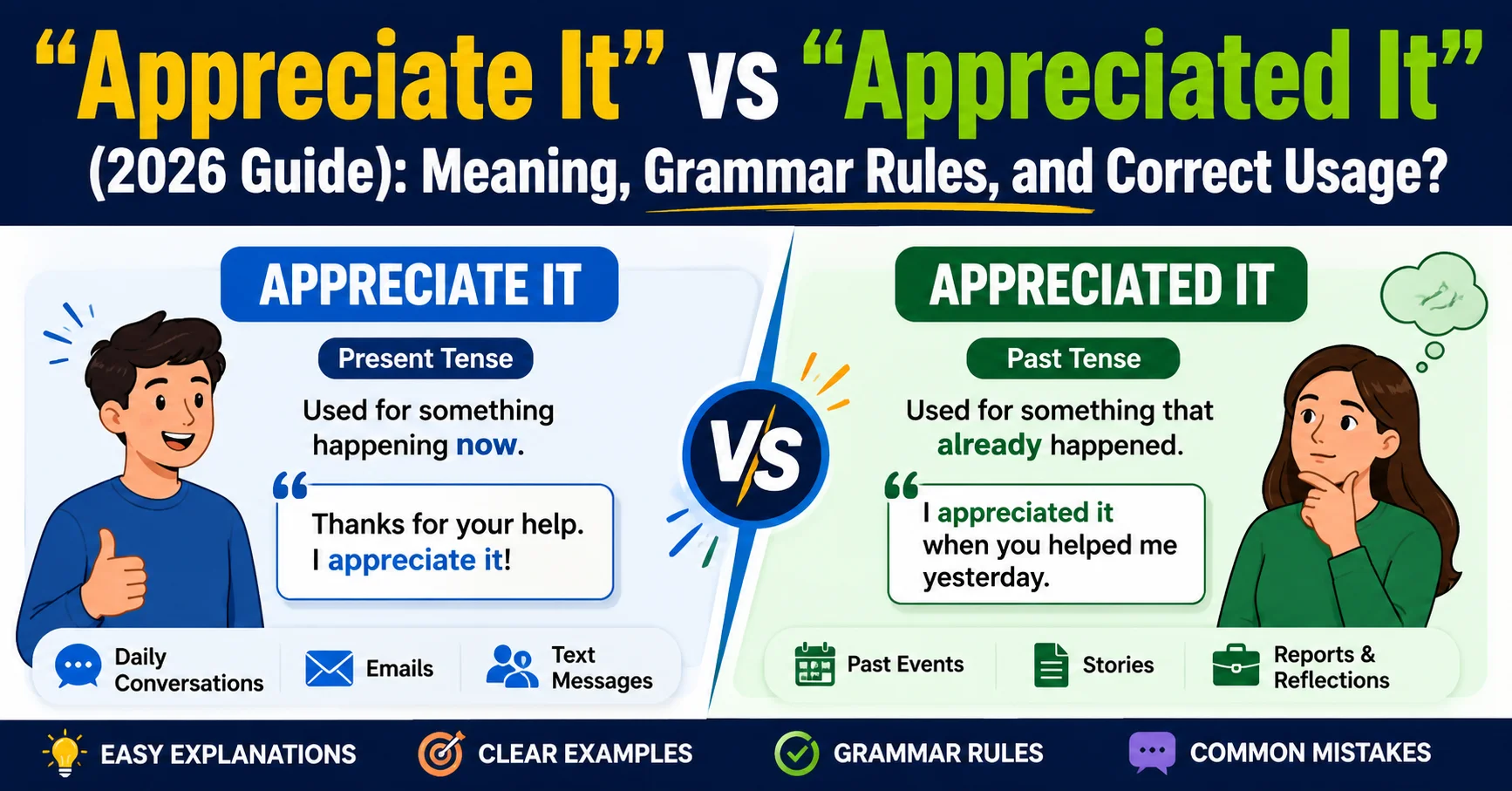
The phrase “appreciate it” is used in the present tense. It means you are thankful or grateful right now.
People often say it in casual conversations. It is short for:
“I appreciate it.”
This phrase is very common in texting, emails, and spoken English.
Examples
- Thanks for helping me. I appreciate it.
- I really appreciate it.
- Appreciate it, buddy!
- I appreciate it more than you know.
When someone does something kind for you in the present moment, this phrase works perfectly.
What Does “Appreciated It” Mean?
The phrase “appreciated it” is in the past tense. It means you were thankful for something in the past.
This phrase talks about an action or feeling that already happened.
Examples
- I appreciated it when you called me yesterday.
- She appreciated it after receiving the gift.
- We appreciated it during difficult times.
The key difference is time. “Appreciated it” refers to something that already happened.
Main Difference Between “Appreciate It” vs “Appreciated It”
Here is the simplest way to understand the difference.
| Phrase | Tense | Meaning | Example |
|---|---|---|---|
| Appreciate it | Present tense | Thankful now | I appreciate it. |
| Appreciated it | Past tense | Thankful before | I appreciated it yesterday. |
Think about the timeline.
- If the gratitude is happening now → use “appreciate it”
- If the gratitude happened before → use “appreciated it”
This small grammar change completely changes the sentence timing.
Why People Confuse These Two Phrases
Many learners mix up these phrases because they both come from the verb “appreciate.” The only visible difference is “-ed.”
But in English grammar, adding “-ed” usually changes a verb into the past tense.
That small change matters a lot.
For example:
| Present | Past |
|---|---|
| Walk | Walked |
| Play | Played |
| Appreciate | Appreciated |
So when you say “appreciated it,” you are talking about the past.
People also get confused because casual texting often removes subjects like “I.”
For example:
- Appreciate it!
- Appreciated it!
The first one sounds natural. The second one usually sounds awkward unless you are talking about the past.
When to Use “Appreciate It”
Use “appreciate it” when someone helps you now or when you want to show present gratitude.
This phrase works in many situations:
- Text messages
- Emails
- Office communication
- Friendly chats
- Social media comments
Common Situations
Someone Gives You Help
- Thanks for fixing my laptop. I appreciate it.
Someone Offers Advice
- I appreciate it, thank you for the suggestion.
Someone Supports You
- Really appreciate it during this hard time.
Someone Sends Information
- Appreciate it. This helped a lot.
The phrase sounds polite, warm, and natural.
When to Use “Appreciated It”
Use “appreciated it” when discussing a past event.
This phrase is often used in storytelling, formal writing, or reflection.
Common Situations
Talking About Yesterday
- I appreciated it when you checked on me yesterday.
Describing a Past Experience
- The team appreciated it during the project.
Writing Formal Messages
- We appreciated it greatly at the time.
Reflecting on Old Memories
- She appreciated it more after understanding the situation.
This phrase sounds more reflective and less immediate.
“I Appreciate It” vs “I Appreciated It”
Adding “I” makes the difference even clearer.
| Sentence | Meaning |
|---|---|
| I appreciate it | I am thankful now |
| I appreciated it | I was thankful before |
Example Comparison
Present Situation
- You helped me today. I appreciate it.
Past Situation
- You helped me last year. I appreciated it.
The tense changes based on when the action happened.
Real-Life Examples of “Appreciate It” vs “Appreciated It”
Understanding real examples helps the grammar stick in your mind.
| Correct Sentence | Why It Works |
|---|---|
| I appreciate it so much. | Present gratitude |
| We appreciated it last week. | Past gratitude |
| Thanks, I appreciate it. | Current thanks |
| She appreciated it after the meeting. | Past event |
| I really appreciate it today. | Happening now |
| They appreciated it during the crisis. | Happened before |
Notice how time words help you choose the right phrase.
Words like:
- today
- now
- currently
usually match “appreciate it.”
Words like:
- yesterday
- last year
- before
- during
usually match “appreciated it.”
Common Grammar Mistakes to Avoid
Many English learners accidentally use the wrong tense.
Here are some common mistakes.
| Incorrect | Correct |
|---|---|
| I appreciated it for your help today. | I appreciate it for your help today. |
| Appreciate it yesterday. | Appreciated it yesterday. |
| I appreciate it last week. | I appreciated it last week. |
| Thanks, appreciated it. | Thanks, I appreciate it. |
The biggest mistake is mixing present tense with past-time words.
Is “Appreciate It” Informal?
Yes, “appreciate it” is slightly informal. But it is still polite and widely accepted.
People use it in:
- Business emails
- Team chats
- Texting
- Daily conversations
Casual Examples
- Appreciate it, man.
- Really appreciate it.
- Appreciate your help.
Professional Examples
- I appreciate your support.
- We appreciate your cooperation.
- I truly appreciate your feedback.
It works in both friendly and professional situations.
Is “Appreciated It” Formal or Informal?
“Appreciated it” sounds more formal and reflective because it talks about past events.
You will often see it in:
- Speeches
- Reports
- Formal writing
- Thank-you letters
- Business communication
Examples
- The company appreciated it greatly.
- We appreciated your contribution during the event.
- She appreciated it more than expected.
This phrase sounds calmer and more thoughtful.
Texting Examples: “Appreciate It” vs “Appreciated It”
Texting makes grammar shorter and faster. That is why confusion happens often.
Here are natural texting examples.
| Text Message | Correct? |
|---|---|
| Thanks bro, appreciate it. | Yes |
| Appreciate it so much! | Yes |
| Appreciated it yesterday. | Yes |
| Thanks, appreciated it. | Usually awkward |
| I appreciated it back then. | Yes |
In texting, “appreciate it” is far more common.
Workplace Examples and Professional Usage
Using the correct phrase at work improves communication.
Correct Professional Examples
Present Gratitude
- I appreciate your quick response.
- We appreciate your patience.
- I truly appreciate your support.
Past Gratitude
- We appreciated your efforts during the project.
- The manager appreciated it at the time.
- I appreciated your honesty in the meeting.
Professional English often depends on correct tense usage.
How Native Speakers Use These Phrases
Native speakers mostly use “appreciate it” in daily life because it sounds natural and direct.
You hear it everywhere:
- “Appreciate it!”
- “Really appreciate it.”
- “I appreciate it, thanks.”
“Appreciated it” appears less often because people usually express gratitude immediately instead of later.
For example:
More Natural
- Thanks for the ride. I appreciate it.
Less Common
- I appreciated the ride yesterday.
Both are correct, but the first sounds more natural in conversation.
Easy Trick to Remember the Difference
Here is a simple memory trick.
Look at the Time
Ask yourself:
“Is this happening now or already finished?”
If It Is Happening Now
Use:
- Appreciate it
If It Already Happened
Use:
- Appreciated it
That is the easiest rule.
Similar Phrases You Should Know
English has many phrases similar to “appreciate it.”
Present Tense Alternatives
| Phrase | Meaning |
|---|---|
| Thank you | General gratitude |
| I appreciate it | Polite gratitude |
| Much appreciated | Strong thanks |
| Thanks a lot | Casual thanks |
Past Tense Alternatives
| Phrase | Meaning |
|---|---|
| I was grateful | Thankful before |
| I valued it | Found importance |
| I appreciated that | Thankful in the past |
Learning similar phrases improves your English naturally.
“Much Appreciated” vs “Appreciate It”
People also compare these two phrases often.
“Much Appreciated”
This phrase is more formal and passive.
Example:
- Your help is much appreciated.
“Appreciate It”
This phrase sounds direct and conversational.
Example:
- I appreciate it.
Both are correct, but the tone changes.
| Phrase | Tone |
|---|---|
| Appreciate it | Friendly |
| Much appreciated | Formal |
How Tone Changes the Meaning
The words may stay the same, but tone changes everything.
Warm Tone
- I really appreciate it.
Sounds sincere and kind.
Cold Tone
- Appreciate it.
Can sound rushed or less emotional.
Deep Gratitude
- I truly appreciated it during that difficult time.
Sounds emotional and reflective.
Tone matters just as much as grammar.
Common Situations Where Each Phrase Fits Best
| Situation | Best Phrase |
|---|---|
| Someone helps you now | Appreciate it |
| Talking about old help | Appreciated it |
| Sending a quick text | Appreciate it |
| Writing a reflection | Appreciated it |
| Business email today | Appreciate it |
| Describing a past project | Appreciated it |
This table makes choosing much easier.
Can You Say “Really Appreciated It”?
Yes, absolutely.
This phrase is correct because “really” modifies the past tense verb.
Examples
- I really appreciated it yesterday.
- She really appreciated your kindness.
- We really appreciated the support.
It sounds natural and emotional.
Can You Say “Really Appreciate It”?
Yes, and it is extremely common.
Examples
- I really appreciate it.
- Really appreciate your help.
- We really appreciate your patience.
This version is more common in daily speech.
Why Correct Tense Matters in English
Tense tells people when something happened.
Using the wrong tense can confuse readers or listeners.
Example
- I appreciate it yesterday. ❌
- I appreciated it yesterday. ✅
The word “yesterday” requires past tense.
Good grammar makes communication smoother and more professional.
Quick Grammar Breakdown
Here is a simple grammar explanation.
| Phrase | Verb Tense |
|---|---|
| Appreciate | Present |
| Appreciated | Past |
The word “it” is the object in both phrases.
So the only thing changing is the tense of the verb.
Mini Quiz: Test Yourself
Choose the correct phrase.
1. Thanks for helping me today. I ___.
Answer: appreciate it
2. I ___ when you supported me last year.
Answer: appreciated it
3. We really ___ your patience during the meeting yesterday.
Answer: appreciated
4. I truly ___ your kindness.
Answer: appreciate
Practice helps you remember faster.
FAQs About “Appreciate It” vs “Appreciated It”
Is “appreciate it” grammatically correct?
Yes. It is a correct and very common phrase used to show present gratitude.
Is “appreciated it” correct English?
Yes. It is the past tense form and talks about gratitude in the past.
Which phrase is more common in texting?
“Appreciate it” is much more common in texts and casual chats.
Can I use “appreciated it” in professional writing?
Yes. It works well when discussing past events or completed projects.
What is the easiest way to remember the difference?
Think about time.
Present moment = appreciate it
Past moment = appreciated it
Final Thoughts on “Appreciate It” vs “Appreciated It”
Understanding the difference between “appreciate it” vs “appreciated it” is easier than it first seems. The main thing to remember is time.
If the gratitude is happening now, use “appreciate it.” If the gratitude happened in the past, use “appreciated it.”
This small grammar detail can make your English sound clearer, more natural, and more professional.
Native speakers use “appreciate it” every day in texts, emails, and conversations. Meanwhile, “appreciated it” appears more often when reflecting on past experiences.
The more examples you read and practice, the faster these phrases will become natural for you.
