


When people talk about factories, products, or businesses, two words appear again and again: manufacture and manufacturer. At first, they may sound almost the same. Many people even use them incorrectly in conversations, emails, and business writing.
But these two words have different meanings and different jobs in a sentence.
Understanding the difference matters more than you may think. If you own a business, write product descriptions, study English, or work in supply chains, using the right word makes your communication clearer and more professional.
In this complete 2026 guide, you will learn the meaning of both words, how they are used, common mistakes, grammar rules, real-life examples, and industry insights. You will also see simple comparison tables that make everything easier to understand.
What Do Manufacture and Manufacturer Mean?
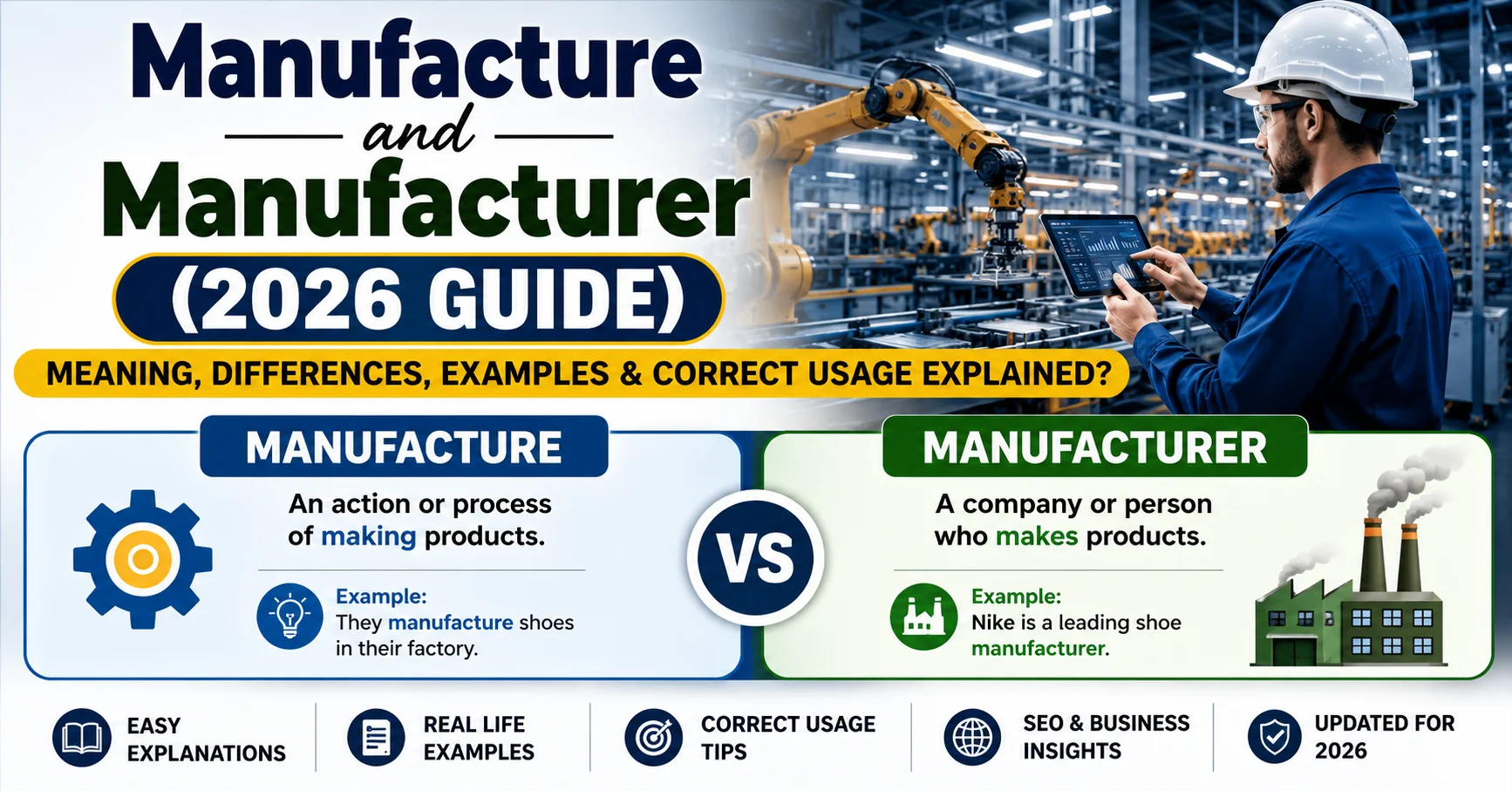
The easiest way to understand manufacture and manufacturer is to remember this simple idea:
- Manufacture is an action.
- Manufacturer is a person or company.
A company can manufacture products, but the company itself is called a manufacturer.
Here is a quick overview:
| Word | Meaning | Part of Speech | Example |
|---|---|---|---|
| Manufacture | To make goods or products | Verb/Noun | They manufacture shoes |
| Manufacturer | A company or person making products | Noun | Nike is a manufacturer |
This small difference changes the whole meaning of a sentence.
For example:
- “They manufacture cars.” ✔️
- “They are a car manufacturer.” ✔️
- “They manufacturer cars.” ❌
Many learners confuse these forms because the spelling looks similar. However, once you understand their roles, using them becomes much easier.
The Meaning of Manufacture Explained Simply
The word manufacture usually means creating products on a large scale. These products are often made in factories using machines, workers, or automated systems.
The word comes from Latin roots meaning “made by hand.” Today, manufacturing includes both hand-made and machine-made production.
Manufacture as a Verb
When used as a verb, it means “to produce.”
Examples:
- The company manufactures mobile phones.
- This factory manufactures furniture.
- They manufacture plastic bottles for export.
In these sentences, the word describes the action of making products.
Manufacture as a Noun
Sometimes, manufacture is also used as a noun.
Examples:
- The manufacture of steel requires high heat.
- Car manufacture creates millions of jobs.
This use is more formal and often appears in business writing or industrial reports.
What Is a Manufacturer?
A manufacturer is the company, business, or person that makes products.
Manufacturers take raw materials and turn them into finished goods. These products are then sold to wholesalers, retailers, or directly to customers.
For example:
| Product | Manufacturer |
|---|---|
| iPhone | Apple |
| Toyota Corolla | Toyota |
| Pepsi | PepsiCo |
| Nike Shoes | Nike |
In each case, the manufacturer is the company producing the item.
Many industries depend heavily on manufacturers. Without them, stores would have nothing to sell.
Main Difference Between Manufacture and Manufacturer
One of the easiest ways to avoid confusion is to focus on grammar.
Here is the biggest difference:
| Feature | Manufacture | Manufacturer |
|---|---|---|
| Type of Word | Verb or noun | Noun |
| Meaning | The act of making products | The company/person making products |
| Used for Action? | Yes | No |
| Used for People/Companies? | No | Yes |
Think about it this way:
- Manufacture = the process
- Manufacturer = the producer
This rule works almost every time.
For example:
- Samsung manufactures televisions.
- Samsung is a television manufacturer.
Both sentences are correct, but they use different forms.
Why People Confuse Manufacture and Manufacturer
There are several reasons why learners mix up manufacture and manufacturer.
First, the words look very similar. Only a few letters change. Second, both words are connected to factories and production. Third, non-native English speakers often translate directly from their own language.
Another reason is autocorrect and typing habits. Many people accidentally write “manufacturer” when they mean “manufacture.”
Here are some common mistakes:
| Incorrect Sentence | Correct Sentence |
|---|---|
| They manufacturer electronics | They manufacture electronics |
| Apple is a manufacture company | Apple is a manufacturing company |
| The manufacture released a new phone | The manufacturer released a new phone |
These mistakes are common in blogs, online stores, and social media posts.
Manufacture in Everyday Business Language
The word manufacture appears in many business situations. It is especially common in industries like technology, automobiles, textiles, and food production.
Here are some examples of business usage:
- This company manufactures medical equipment.
- We manufacture products for international markets.
- The factory manufactures eco-friendly packaging.
In modern business, manufacturing has become highly advanced. Many factories now use robots, AI systems, and automated machines.
I once visited a packaging factory where only a few workers handled machines producing thousands of boxes every hour. Seeing the process helped me understand why manufacturing is such a major part of the global economy.
Today, manufacturing is not only about production. It also includes design, quality control, shipping, and sustainability.
Different Types of Manufacturers
Not all manufacturers work the same way. Some produce products for their own brands, while others make products for other companies.
Here are the main types:
| Type | Description | Example |
|---|---|---|
| OEM Manufacturer | Makes products for another brand | Foxconn |
| Private Label Manufacturer | Produces items sold under store brands | Cosmetic factories |
| Contract Manufacturer | Hired to make products for businesses | Electronics factories |
| Custom Manufacturer | Creates specialized products | Furniture workshops |
Many people do not realize how many brands outsource production.
For example, a clothing brand may design products but use another manufacturer to create them.
This system helps companies reduce costs and increase efficiency.
Manufacture vs Manufacturing
Another common confusion happens between manufacture and manufacturing.
Here is the difference:
| Word | Meaning |
|---|---|
| Manufacture | The act of producing |
| Manufacturing | The industry or process of production |
Examples:
- They manufacture laptops.
- Manufacturing is growing in Asia.
Manufacturing often refers to the entire industry.
For example:
- Manufacturing jobs are increasing.
- The manufacturing sector drives exports.
You will often see this word in economic reports and business news.
Examples of Manufacture and Manufacturer in Sentences
Real examples make grammar easier to remember.
Sentences Using Manufacture
- This factory manufactures car parts.
- They manufacture organic soap products.
- The company plans to manufacture batteries locally.
- Many countries manufacture electronics cheaply.
Sentences Using Manufacturer
- Toyota is a trusted car manufacturer.
- The manufacturer recalled faulty products.
- Apple became one of the world’s biggest technology manufacturers.
- The furniture manufacturer expanded globally.
Practice reading these examples aloud. It helps your brain remember the difference naturally.
Industries That Depend on Manufacturers
Manufacturers are essential in nearly every industry.
Without manufacturing companies, daily life would stop quickly. Everything from food containers to smartphones depends on production systems.
Here are major industries using manufacturing:
| Industry | Products Manufactured |
|---|---|
| Automotive | Cars, engines, tires |
| Technology | Phones, laptops, chips |
| Food | Packaged foods, drinks |
| Textile | Clothes, fabrics |
| Medical | Medicines, equipment |
| Furniture | Chairs, tables, cabinets |
The manufacturing sector supports millions of jobs worldwide.
In countries like China, Germany, the United States, and Pakistan, manufacturing plays a huge role in economic growth.
The Role of Manufacturers in the Global Economy
Manufacturers are one of the biggest drivers of international trade.
When manufacturers produce goods efficiently, countries can export products globally. This creates jobs, business growth, and stronger economies.
For example:
- China manufactures electronics for global markets.
- Germany manufactures advanced machinery.
- Pakistan manufactures textiles and sports goods.
Many footballs used in international tournaments are manufactured in Pakistan, especially around Sialkot. This is a great real-world example of local manufacturing reaching global markets.
Modern manufacturers also influence innovation. Many companies invest billions into research and product improvement.
Without manufacturers, modern technology would move much slower.
Common Grammar Rules for Manufacture and Manufacturer
Grammar mistakes with these words are easy to fix once you know the patterns.
Rule 1: Use “manufacture” for actions
✔️ They manufacture phones.
❌ They manufacturer phones.
Rule 2: Use “manufacturer” for companies or people
✔️ Samsung is a manufacturer.
❌ Samsung is a manufacture.
Rule 3: Use “manufacturing” as an adjective
✔️ Manufacturing industry
✔️ Manufacturing process
Rule 4: Watch subject-verb agreement
✔️ The company manufactures shoes.
✔️ Companies manufacture shoes.
These small grammar rules improve writing quality instantly.
How Manufacture and Manufacturer Are Used in SEO and Online Stores
If you run a website or eCommerce store, understanding these words matters for SEO.
Many online shoppers search using terms like:
- product manufacturer
- phone manufacturer
- where products are manufactured
- original manufacturer
Using the wrong term can make content sound unprofessional.
For example:
❌ “This manufacturer laptops.”
✔️ “This company manufactures laptops.”
Search engines also prefer clear and accurate language.
That is why many product pages include details like:
| SEO Phrase | Purpose |
|---|---|
| Original Manufacturer | Builds trust |
| Manufactured In | Shows production location |
| Certified Manufacturer | Improves credibility |
| Leading Manufacturer | Highlights authority |
Correct wording improves both readability and rankings.
Real-Life Examples From Famous Companies
Looking at global brands helps make the meaning clearer.
Apple
Apple designs products, but manufacturers like Foxconn assemble many devices.
Nike
Nike is a brand, while independent manufacturers produce many shoes and clothing items.
Toyota
Toyota is both a car brand and a vehicle manufacturer.
PepsiCo
PepsiCo manufactures beverages sold worldwide.
These examples show how manufacturing systems work globally.
Some companies own factories directly. Others hire outside manufacturers.
Manufacture and Manufacturer in International Trade
Global trade depends heavily on manufacturers.
Products are often designed in one country, manufactured in another, and sold worldwide.
For example:
| Stage | Country Example |
|---|---|
| Product Design | United States |
| Manufacturing | China |
| Packaging | Vietnam |
| Retail Sales | Worldwide |
This system reduces production costs and increases efficiency.
Many businesses choose manufacturers based on:
- labor costs
- product quality
- shipping access
- production speed
- certifications
This is why manufacturing hubs become economically important.
How Technology Changed Manufacturing
Modern manufacturing looks very different from factories decades ago.
Today, many manufacturers use:
- robots
- AI systems
- automation
- 3D printing
- smart machines
These tools improve speed and reduce errors.
I recently watched a video showing robotic arms assembling cars almost perfectly. It showed how far manufacturing technology has evolved.
However, humans are still important. Workers handle inspections, management, repairs, and design improvements.
Technology helps manufacturers compete in fast global markets.
Sustainable Manufacturing and Eco-Friendly Production
Consumers now care more about sustainability.
Because of this, manufacturers are changing how products are made.
Many companies now focus on:
| Sustainable Practice | Benefit |
|---|---|
| Recycling materials | Reduces waste |
| Solar-powered factories | Saves energy |
| Eco packaging | Lowers pollution |
| Water-saving systems | Protects resources |
Eco-friendly manufacturing is becoming a major business advantage.
Customers often prefer brands that manufacture responsibly.
This trend will likely grow even more in the future.
Common Synonyms Related to Manufacture and Manufacturer
Understanding related words improves vocabulary and writing skills.
Synonyms for Manufacture
- produce
- create
- make
- assemble
- fabricate
Synonyms for Manufacturer
- producer
- maker
- supplier
- industrial company
- factory owner
Different industries may prefer different terms.
For example, “fabricate” is common in metal industries, while “assemble” is popular in electronics.
Tips to Remember the Difference Easily
Here are simple tricks to remember the meanings forever.
Trick 1: Focus on the ending
- “-er” often means a person or company.
- Teacher teaches.
- Builder builds.
- Manufacturer manufactures.
Trick 2: Think action vs identity
- Manufacture = action
- Manufacturer = identity
Trick 3: Use substitution
Replace the word mentally:
- If “make” fits, use manufacture.
- If “maker” fits, use manufacturer.
These memory tricks work surprisingly well.
FAQs About Manufacture and Manufacturer
1. What is the difference between manufacture and manufacturer?
Manufacture means to produce goods, while a manufacturer is the company or person producing them.
2. Is manufacture a noun or a verb?
Manufacture can be both. It is commonly used as a verb, but sometimes appears as a noun in formal writing.
3. What is an example of a manufacturer?
Apple, Toyota, and Samsung are examples of manufacturers because they produce products.
4. Can manufacture and manufacturer be used interchangeably?
No. They have different grammar roles and meanings.
5. What does manufactured mean?
Manufactured means something has been produced or made, usually in a factory.
Conclusion
Understanding manufacture and manufacturer is easier once you know the core difference.
Manufacture is the act of making products. Manufacturer is the company or person making them.
Although the words look similar, they play very different roles in English grammar and business communication.
Using the correct term improves your writing, boosts professionalism, and helps avoid confusion in emails, websites, and conversations.
As global industries continue to grow, these words will remain important in business, SEO, trade, and everyday communication.
The next time you see a product label or company website, try identifying the manufacturer and thinking about where the product was manufactured. It is a simple habit that makes the meaning stick naturally.
