

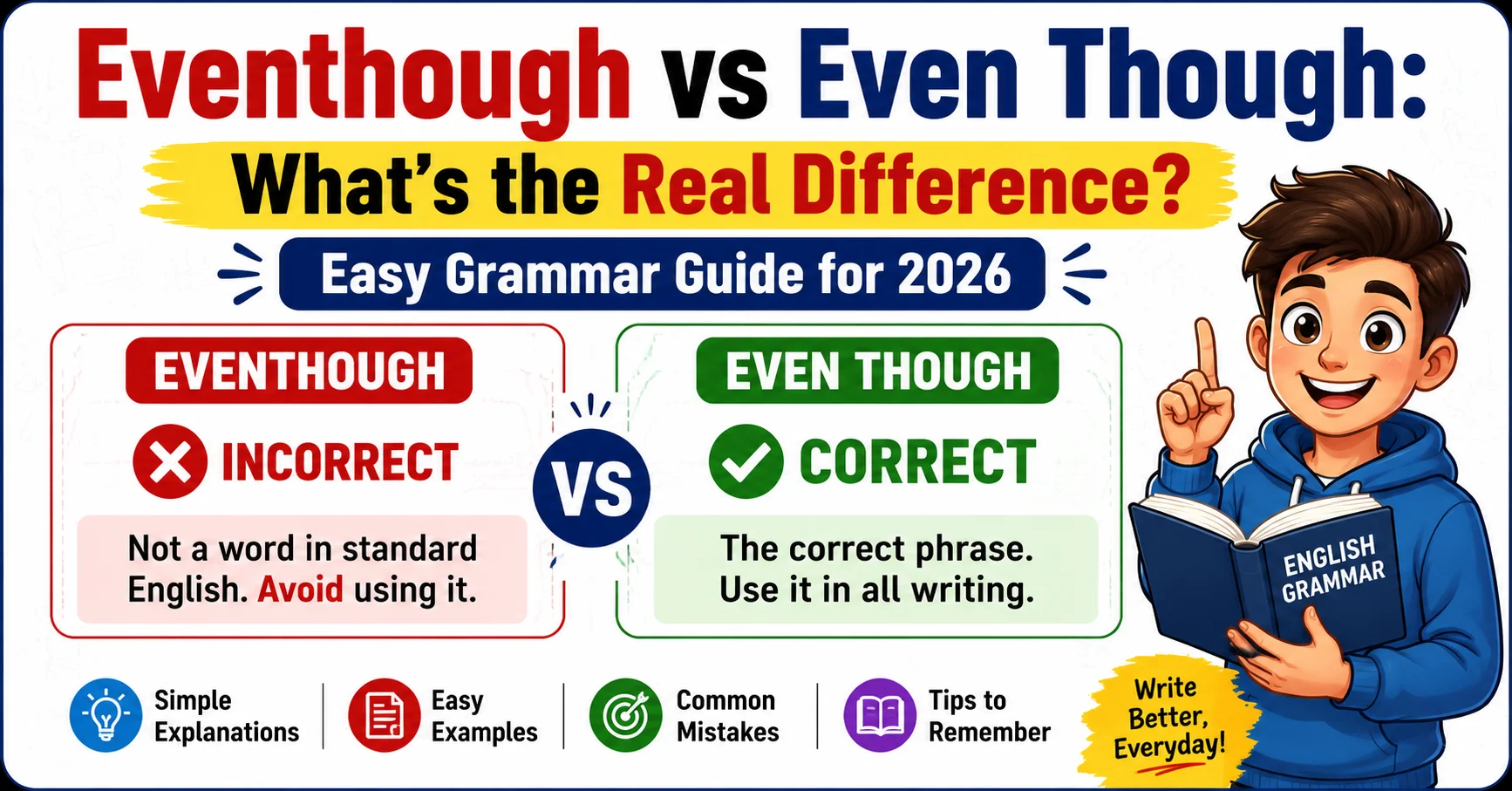
Many people get confused when writing Eventhough vs Even Though. At first glance, both look almost the same. They sound alike, too. Because of this, many writers think they can use them in the same way. But that is not true.
The correct phrase is “even though.” The word “eventhough” is considered incorrect in standard English. You may see it online, in text messages, or on social media, but grammar experts do not accept it as one word.
This small grammar mistake appears in emails, blog posts, homework, and even business writing. The good news is that the rule is simple once you understand it. In this guide, you will learn the exact difference between Eventhough vs Even Though, when to use each one, common mistakes people make, and easy examples that anyone can understand.
Whether you are a student, blogger, content writer, or someone improving English skills, this article will help you write more clearly and confidently.
Why People Confuse Eventhough vs Even Though
The confusion happens because English contains many compound words. Words like “although,” “however,” and “therefore” are written as one word. So, many people assume “eventhough” should also be one word.
But English grammar works differently here. The phrase “even though” must stay separated because it acts as a conjunction phrase. It connects two ideas together.
For example:
- Even though it rained, we played football.
- Even though she was tired, she finished her homework.
In both examples, the phrase introduces contrast. It shows that one thing happened despite another condition.
People often type quickly online. That is why “eventhough” appears on forums, comments, and social media posts. Spellcheck tools sometimes miss it, especially in casual writing. Over time, many writers start believing it is correct.
Still, professional grammar guides agree on one thing: “eventhough” is not standard English.
Quick Answer: Which One Is Correct?
Here is the simple answer:
| Word/Phrase | Correct or Incorrect | Usage |
|---|---|---|
| Eventhough | Incorrect | Avoid using it |
| Even Though | Correct | Use in formal and casual writing |
If you want grammatically correct English, always use “even though.”
What Does “Even Though” Mean?
“Even though” means despite the fact that or although. It introduces an unexpected result or contrast.
Simple Meaning
Something happened, but another thing was surprising or opposite.
Examples
| Sentence | Meaning |
|---|---|
| Even though I was sleepy, I studied. | I studied despite being sleepy |
| Even though he apologized, she stayed upset. | The apology did not change her feelings |
| Even though it was expensive, we bought it. | The high price did not stop the purchase |
The phrase helps sentences sound smoother and more natural.
Is “Eventhough” Ever Correct?
No. “Eventhough” is not accepted in standard English grammar.
You may still see it in:
- Informal texting
- Social media posts
- Online comments
- Fast typing
- Non-native English writing
However, it should not appear in:
- School assignments
- Blog articles
- Professional emails
- Academic writing
- SEO content
- Business communication
Using “eventhough” can make your writing look careless. Search engines and grammar tools also prefer correct grammar usage.
Eventhough vs Even Though: Main Difference Explained
Here is the easiest way to remember the rule.
| Feature | Eventhough | Even Though |
|---|---|---|
| Spelling | Wrong | Correct |
| Grammar acceptance | Not accepted | Accepted |
| Used in professional writing | No | Yes |
| Appears in dictionaries | No | Yes |
| Recommended for SEO writing | No | Yes |
The correct version is always “even though.”
How “Even Though” Works in a Sentence
“Even though” usually connects two ideas with opposite meanings.
Structure
Even though + condition, result
Example:
- Even though the road was busy, we arrived early.
The first part creates expectation. The second part gives the surprising outcome.
More Examples
| Sentence | Contrast |
|---|---|
| Even though she practiced daily, she felt nervous. | Practice vs nervousness |
| Even though the movie was long, everyone enjoyed it. | Long movie vs enjoyment |
| Even though he missed breakfast, he stayed energetic. | Missing food vs energy |
This contrast makes writing more interesting and emotional.
Even Though vs Although
Many people also compare even though and although because both express contrast.
The good news is that their meanings are very similar.
| Phrase | Tone |
|---|---|
| Although | Slightly formal |
| Even Though | Stronger emphasis |
Example Comparison
- Although it was cold, we went outside.
- Even though it was cold, we went outside.
The second sentence feels slightly stronger emotionally.
Even Though vs Though
Another common grammar question involves though.
| Word/Phrase | Usage |
|---|---|
| Though | Informal and flexible |
| Even Though | Stronger contrast |
Examples
- Though I liked the food, it was too spicy.
- Even though I liked the food, it was too spicy.
The second sentence gives stronger emphasis.
Common Mistakes Writers Make
Writers often make small errors with Eventhough vs Even Though. Let’s fix them.
Mistake 1: Writing It as One Word
❌ Eventhough I was tired, I worked.
✅ Even though I was tired, I worked.
Mistake 2: Using Wrong Punctuation
❌ Even though it was late we stayed awake.
✅ Even though it was late, we stayed awake.
A comma is often needed after the introductory phrase.
Mistake 3: Using It Without Contrast
❌ Even though I ate breakfast and drank coffee.
This sentence lacks contrast.
✅ Even though I ate breakfast, I still felt hungry.
Real-Life Examples of Even Though
Understanding grammar becomes easier with real situations.
In School
- Even though the exam was difficult, Sarah passed.
At Work
- Even though the meeting lasted two hours, we solved nothing.
In Relationships
- Even though they argued, they stayed friends.
In Sports
- Even though the team trained hard, they lost the match.
These examples show how natural the phrase sounds in everyday English.
Why Correct Grammar Matters Online
Correct grammar is important for more than school grades.
Today, grammar affects:
- SEO rankings
- Reader trust
- Professional image
- Content quality
- User engagement
Search engines prefer clear, high-quality writing. If readers notice mistakes like “eventhough,” they may leave your page quickly.
For bloggers and website owners, grammar mistakes can reduce authority and trustworthiness.
That is why understanding Eventhough vs Even Though matters more than many people think.
Easy Trick to Remember the Difference
Here is a simple memory trick:
Replace “Even Though” with “Although”
If the sentence still makes sense, you are using it correctly.
Example:
- Even though it rained, we played outside.
- Although it rained, we played outside.
Both sentences work perfectly.
Now test the incorrect version:
- Eventhough it rained, we played outside.
It looks awkward because it is not proper grammar.
Sentences Using Even Though Correctly
Here are more practice examples.
| Correct Sentence | Why It Works |
|---|---|
| Even though he was rich, he lived simply. | Shows contrast |
| Even though I called twice, nobody answered. | Unexpected result |
| Even though the cake burned, we ate it. | Contradicting expectation |
| Even though she felt sick, she attended class. | Opposite outcome |
| Even though traffic was terrible, we arrived on time. | Surprising result |
Practice reading these aloud. It helps the phrase feel natural.
Words Similar to Even Though
Sometimes you may want alternatives to avoid repetition.
Similar Expressions
| Alternative | Example |
|---|---|
| Although | Although it rained, we played. |
| Though | Though he apologized, she stayed upset. |
| Despite the fact that | Despite the fact that it snowed, school opened. |
| While | While I understand your point, I disagree. |
These alternatives help improve sentence variety.
Formal vs Informal Usage
“Even though” works in almost every type of writing.
| Writing Type | Recommended? |
|---|---|
| Essays | Yes |
| Blog posts | Yes |
| Emails | Yes |
| Business writing | Yes |
| Text messages | Yes |
| Academic papers | Yes |
Meanwhile, “eventhough” should stay out of all formal writing.
Why Native Speakers Still Make This Mistake
Even native English speakers sometimes write “eventhough.”
Why?
Reasons Include:
- Fast typing
- Autocorrect habits
- Social media shortcuts
- Confusion with compound words
- Lack of proofreading
This mistake is common online, but common does not mean correct.
Professional writers always separate the two words.
Grammar Experts on Eventhough vs Even Though
Most grammar guides agree completely on this topic.
Standard dictionaries and style guides recognize:
✅ Even though
❌ Eventhough
Professional editors usually correct the one-word version immediately.
This rule has remained consistent for many years.
How to Teach Kids the Difference
Children often learn faster with simple patterns.
Easy Explanation for Kids
“Even though” is like saying:
“This happened, BUT something surprising also happened.”
Example for Children
- Even though Tim was small, he lifted the box.
Kids quickly understand the contrast idea.
SEO Writers and Content Creators Should Avoid “Eventhough”
If you write articles online, grammar matters greatly.
Using incorrect spellings may:
- Hurt credibility
- Reduce readability
- Confuse readers
- Lower engagement
- Make content look unedited
Many SEO professionals carefully proofread phrases like Eventhough vs Even Though because grammar affects user trust.
Clean writing also improves chances of appearing in Google AI Overviews and featured snippets.
Mini Practice Quiz
Choose the correct sentence.
| Question | Correct Answer |
|---|---|
| ___ it was raining, they played soccer. | Even though |
| She smiled ___ she felt sad. | even though |
| I went outside ___ it was cold. | even though |
Correct answer every time: even though
Frequently Asked Questions
Is eventhough one word or two?
The correct form is two words: even though. Writing it as one word is incorrect in standard English.
Why do people write “eventhough”?
People often type quickly online or confuse it with compound words like “although.” However, grammar rules still require two separate words.
Can I use “eventhough” in casual texting?
You can, but it is still technically wrong. Using “even though” is always safer and more professional.
Is “even though” formal or informal?
It works in both formal and informal writing. You can use it in essays, blogs, emails, and conversations.
What is another word for “even though”?
You can use alternatives like:
- although
- though
- despite the fact that
- while
Each one expresses contrast in a slightly different way.
Final Thoughts on Eventhough vs Even Though
The debate around Eventhough vs Even Though is actually very simple once you know the grammar rule.
The correct phrase is always “even though.” The version written as one word is considered incorrect in standard English.
This small grammar fix can improve your writing immediately. Whether you are creating blog posts, homework, social media captions, or professional emails, using the correct phrase helps your writing look polished and trustworthy.
Grammar does not need to feel complicated. Small lessons like this make English easier step by step.
So next time you write the phrase, remember this quick rule:
If you mean “despite the fact that,” always write even though as two separate words.
That tiny space between the words makes all the difference.
