


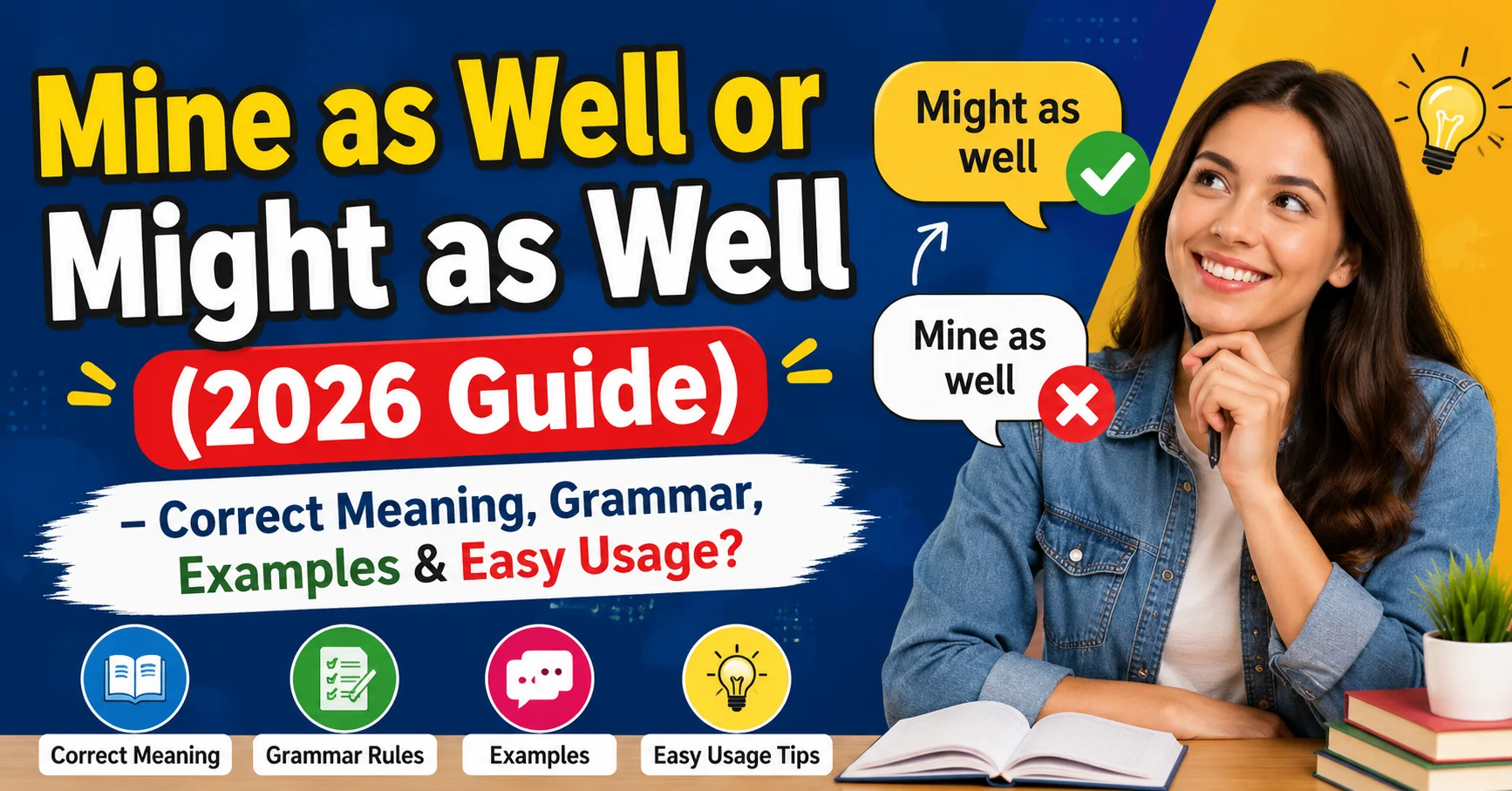
Have you ever heard someone say “mine as well” and wondered if it sounds correct? You are not alone. Many English learners and even native speakers confuse “mine as well” or “might as well.” The phrases sound similar when spoken quickly, which causes many writing mistakes online and in daily conversations.
The truth is simple: “might as well” is the correct phrase in standard English. “Mine as well” is usually a spelling or hearing mistake. Still, thousands of people search for this confusion every month because the pronunciation can sound almost the same.
In this detailed 2026 guide, you will learn the real meaning, grammar rules, common mistakes, examples, pronunciation tips, and easy ways to remember the difference. This article uses simple explanations and real-life examples so anyone can understand the topic easily.
By the end, you will never confuse “mine as well” or “might as well” again.
Why People Confuse “Mine as Well” and “Might as Well”
English has many phrases that sound alike. These are called “misheard expressions.” When people hear a phrase often but never see it written, they sometimes spell it incorrectly.
That is exactly what happens with might as well.
When spoken quickly, “might as well” can sound like:
- mine as well
- mind as well
- mighta well
This confusion is common in casual speech. Many learners write the phrase the way it sounds in their ears.
For example:
- Incorrect: We are already here, so we mine as well stay.
- Correct: We are already here, so we might as well stay.
The second sentence is grammatically correct because “might” is a modal verb used to suggest an option or possibility.
Here is a quick comparison table.
| Phrase | Correct or Incorrect | Meaning |
|---|---|---|
| Might as well | Correct | A reasonable or practical choice |
| Mine as well | Incorrect | No real meaning in this context |
| Mind as well | Incorrect | Grammar mistake |
| Mighta well | Informal spoken slang | Casual pronunciation |
What Does “Might as Well” Mean?
The phrase might as well means:
- doing something because it is the best or easiest option
- accepting a situation
- suggesting an action when other choices are limited
It often shows that one choice makes more sense than another.
Simple Examples
- We missed the bus, so we might as well walk.
- It is raining outside. We might as well stay home.
- You already paid for the ticket, so you might as well watch the movie.
In all these examples, the speaker means the action is practical or reasonable.
Is “Mine as Well” Ever Correct?
Usually, no.
In almost every situation, mine as well is incorrect. It is considered a spelling or hearing mistake of “might as well.”
However, there are rare situations where “mine” and “as well” may appear together naturally.
Example:
- You can bring your bag, and I will bring mine as well.
Here, “mine” is a possessive pronoun, not part of the phrase “might as well.”
This sentence is completely different from the expression “might as well.”
That is why context matters.
The Grammar Behind “Might as Well”
Understanding the grammar makes the phrase easier to remember.
The structure is:
| Structure | Example |
|---|---|
| Might as well + base verb | We might as well leave now. |
| Might as well + action | She might as well try again. |
“Might” is a modal verb. Modal verbs help express possibility, suggestion, or advice.
Other modal verbs include:
- can
- should
- may
- could
- would
The phrase “might as well” works like a soft suggestion.
Example Breakdown
Sentence:
You might as well study tonight.
Meaning:
Studying tonight is probably the smartest or easiest choice.
Common Situations Where People Use “Might as Well”
This phrase appears often in daily English conversations. People use it in relaxed, casual situations.
Here are the most common uses.
1. When There Is No Better Option
- The store is closed. We might as well go home.
2. When Something Is Already Started
- You already cleaned the kitchen. You might as well clean the table too.
3. When Giving Casual Advice
- You might as well ask the teacher for help.
4. When Accepting a Situation
- We are stuck in traffic. We might as well listen to music.
These examples show practical thinking rather than excitement.
“Mine as Well” vs “Might as Well” Table
Here is a detailed comparison table to make the difference crystal clear.
| Feature | Mine as Well | Might as Well |
|---|---|---|
| Correct English phrase | No | Yes |
| Commonly used | As a mistake only | Very common |
| Meaning | Usually none | Practical suggestion |
| Grammar status | Incorrect expression | Correct idiom |
| Used in formal writing | Never | Yes |
| Used in conversations | By mistake | Frequently |
If you want correct English, always choose might as well.
Real-Life Examples of “Might as Well”
Learning through examples helps you remember faster. Here are practical examples from daily life.
At Home
- The power is out, so we might as well sleep early.
- We already cooked dinner. We might as well eat now.
At School
- I finished my homework early, so I might as well study more.
- You are already at the library. You might as well borrow a book.
At Work
- The meeting starts late, so we might as well grab coffee.
- We completed most tasks. We might as well finish everything today.
With Friends
- Everyone is going to the park. I might as well join them.
- We drove this far, so we might as well stay longer.
These examples sound natural because native speakers use this phrase often.
Why “Mine as Well” Became So Popular Online
The internet has increased spelling confusion. Social media, texting, and fast typing create many grammar mistakes.
People often write phrases based on sound instead of grammar.
Some famous examples include:
| Incorrect Phrase | Correct Phrase |
|---|---|
| Mine as well | Might as well |
| Should of | Should have |
| Could of | Could have |
| For all intensive purposes | For all intents and purposes |
Search engines now show these mistakes because many users type them daily.
That does not make them correct.
Easy Trick to Remember the Correct Phrase
A simple memory trick can help forever.
Replace “might” With “may”
Try this sentence:
- We might as well leave now.
Now replace “might” with “may”:
- We may as well leave now.
The sentence still makes sense.
Now test the incorrect version:
- We mine as well leave now.
This sounds wrong immediately.
That quick test helps you choose the correct phrase every time.
Pronunciation Tips for “Might as Well”
Many learners confuse the phrase because of pronunciation.
Native speakers often pronounce it quickly like this:
- mighta-z-well
- might aswell
The “t” sound becomes softer in fast speech.
Slow Pronunciation
- Might
- As
- Well
Fast Natural Pronunciation
- Mightaswell
Because it sounds blended together, some people mistakenly hear “mine as well.”
Listening practice helps fix this issue.
Formal vs Informal Usage
“Might as well” works in both formal and informal English.
Informal Example
- We might as well order pizza tonight.
Formal Example
- Since the project is nearly complete, we might as well finalize it today.
The phrase is flexible and accepted in professional writing too.
However, avoid using slang forms like:
- mighta well
- mine as well
These look unprofessional in formal communication.
Common Mistakes to Avoid
Many learners repeat the same errors with this phrase. Here are the biggest mistakes.
| Mistake | Correct Version |
|---|---|
| Mine as well go | Might as well go |
| Mind as well try | Might as well try |
| Might as good | Might as well |
| Mine as wall | Might as well |
Another common mistake is adding unnecessary words.
Incorrect:
- We might as well to leave.
Correct:
- We might as well leave.
After “might as well,” always use the base form of the verb.
Similar Expressions to “Might as Well”
English has several phrases with similar meanings.
1. May as Well
- We may as well start now.
Very similar meaning but slightly more formal.
2. Could Just
- We could just stay home tonight.
3. No Harm In
- There is no harm in trying.
4. Best Option
- It is probably the best option.
These alternatives help diversify your writing.
“Might as Well” in Movies and Daily Speech
Native speakers use this phrase constantly in movies, TV shows, and conversations.
You may hear:
- “We might as well give up.”
- “You might as well tell the truth.”
- “I might as well go too.”
The phrase sounds natural because it expresses practical thinking.
If you want more natural English, learning phrases like this is very helpful.
Mini Conversation Examples
Here are short conversations using the phrase correctly.
| Conversation | Correct Usage |
|---|---|
| A: The cafe is closed. B: We might as well go home. | ✔ |
| A: Nobody came to the party. B: We might as well leave. | ✔ |
| A: The movie already started. B: We might as well watch it. | ✔ |
Now compare incorrect examples.
| Incorrect Sentence | Why It Is Wrong |
|---|---|
| We mine as well leave. | Wrong phrase |
| I mine as well try. | Grammar error |
| They mind as well go. | Incorrect wording |
Personal Tip for Learning This Phrase
Many English learners improve faster when they connect grammar to real life.
One easy method is to create your own examples daily.
For example:
- I already opened my laptop, so I might as well finish my work.
- I woke up early, so I might as well exercise.
When I practiced English phrases this way, I remembered them much faster. Real situations make grammar feel natural instead of difficult.
Small habits like this improve fluency over time.
When NOT to Use “Might as Well”
Even correct phrases have limits.
Do not use “might as well” when showing excitement or strong preference.
Example:
- Incorrect: I might as well love this cake!
Better:
- I really love this cake!
“Might as well” usually sounds neutral or practical, not emotional.
It works best when discussing reasonable choices.
Quick Rule Summary Table
| Rule | Example |
|---|---|
| Use “might as well” for practical suggestions | We might as well leave. |
| Do not write “mine as well” | Incorrect phrase |
| Use base verb after the phrase | Might as well try |
| Works in formal and casual English | Both accepted |
| Often used in conversations | Very common phrase |
FAQs About “Mine as Well” or “Might as Well”
Is “mine as well” grammatically correct?
No. In most situations, “mine as well” is incorrect. The correct phrase is “might as well.”
Why do people say “mine as well”?
People confuse the phrase because “might as well” sounds similar in fast speech.
What does “might as well” mean?
It means something is a practical, reasonable, or acceptable choice.
Can I use “might as well” in formal writing?
Yes. It is acceptable in both formal and informal English.
What is the easiest way to remember the correct phrase?
Replace “might” with “may.” If the sentence still works, then “might as well” is correct.
Conclusion
Understanding the difference between “mine as well” or “might as well” is easier than it first seems. The correct phrase is almost always might as well, while “mine as well” is usually just a spelling or hearing mistake.
The phrase “might as well” is useful because it helps express practical choices, casual suggestions, and accepted situations. Native speakers use it every day in conversations, movies, workplaces, and schools.
The best way to master this phrase is through practice. Read it often, say it aloud, and create your own examples from daily life. Over time, the correct form will feel natural automatically.
Now that you know the difference, you can write and speak with more confidence in 2026 and beyond.
