


English can feel confusing sometimes. One small word change can make a sentence sound natural or awkward. A common example is “quieter vs more quiet.” Many learners wonder which one is correct and when to use it.
The good news is simple. Both forms are correct in English. Still, native speakers often prefer one over the other depending on the sentence style, tone, and situation.
In this complete 2026 guide, you will learn the difference between quieter vs more quiet, grammar rules, examples, common mistakes, and professional writing tips. You will also discover when each form sounds more natural in everyday speech.
Whether you are a student, blogger, writer, or English learner, this guide will help you use these words correctly and confidently.
What Does “Quiet” Mean?
The word “quiet” describes something with little noise. It can also describe a calm person, peaceful place, or soft sound.
Here are simple examples:
- The library is quiet.
- She has a quiet voice.
- The room became quiet after class started.
“Quiet” works as an adjective. That means it describes nouns like places, people, sounds, or situations.
The confusion begins when people want to compare two things. For example:
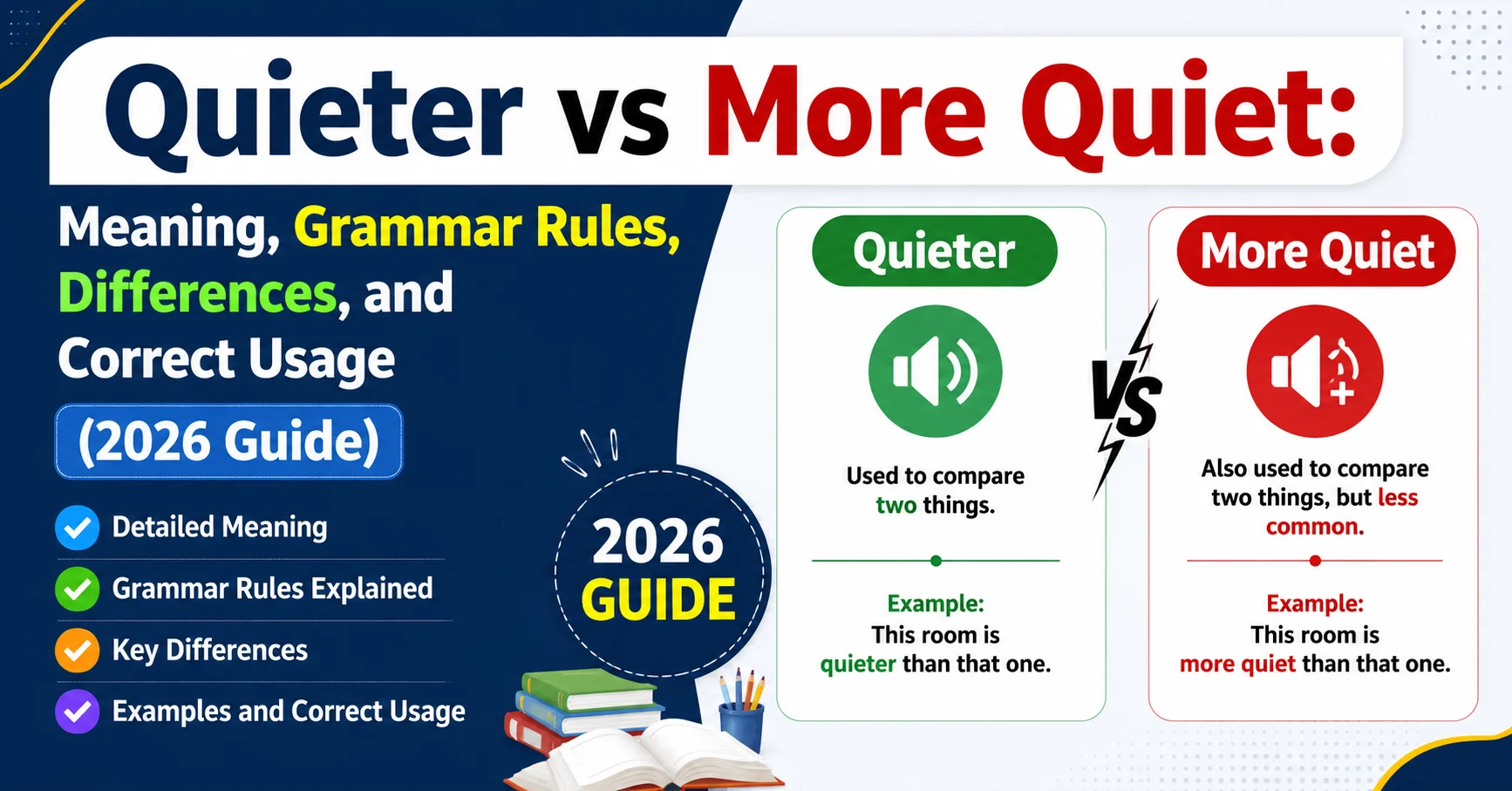
- This room is quieter than that one.
- This room is more quiet than that one.
Both sentences compare noise levels. But one sounds more natural in modern English.
Understanding this comparison rule helps you master quieter vs more quiet correctly.
Quieter vs More Quiet: The Quick Answer
Here is the simple answer:
| Form | Correct? | Common Usage |
|---|---|---|
| Quieter | Yes | More common |
| More quiet | Yes | Less common |
| Quietest | Yes | Superlative form |
| Most quiet | Rare | Sounds unnatural |
In most situations, native speakers prefer quieter instead of more quiet.
Example:
- This café is quieter at night. ✅
- This café is more quiet at night. ✅ (correct but less natural)
English usually adds “-er” to short adjectives. Since “quiet” is short, “quieter” sounds smoother and more natural.
Still, “more quiet” may appear in formal writing, poetry, or situations where a speaker wants extra emphasis.
Why “Quieter” Sounds More Natural
English grammar often follows patterns. One common rule is:
- Short adjectives → add “-er”
- Longer adjectives → use “more”
For example:
| Adjective | Comparative Form |
|---|---|
| Small | Smaller |
| Fast | Faster |
| Quiet | Quieter |
| Beautiful | More beautiful |
| Expensive | More expensive |
Because “quiet” has two syllables, it can technically use both forms. However, native speakers strongly prefer “quieter.”
This preference developed naturally through spoken English over many years.
When I first learned advanced English writing, I noticed books, movies, and conversations almost always used “quieter.” After paying attention, the pattern became very clear.
That is why “quieter” feels smoother and easier in daily communication.
Grammar Rule Behind Quieter vs More Quiet
The grammar rule is based on comparative adjectives.
A comparative adjective compares two things.
Examples:
- louder
- softer
- brighter
- quieter
The word “quiet” becomes “quieter” by adding “-er.”
Here is the grammar structure:
\text{quiet} + er = \text{quieter}
Examples:
- My new apartment is quieter.
- The countryside feels quieter than the city.
- Her voice became quieter after the meeting.
You can also use “more quiet,” but it sounds less direct.
Grammar experts usually recommend shorter comparative forms when possible.
When to Use “Quieter”
Use “quieter” in normal speaking and writing. It works best in casual English, blogs, conversations, schools, and business communication.
Examples of Correct Usage
| Sentence | Correct |
|---|---|
| The park is quieter today. | ✅ |
| Please be quieter in class. | ✅ |
| This engine runs quieter now. | ✅ |
| Nights are quieter here. | ✅ |
“Quieter” feels modern, smooth, and natural.
You will hear it often in:
- movies
- TV shows
- classrooms
- offices
- online articles
- casual conversations
It is usually the safest choice when deciding between quieter vs more quiet.
When to Use “More Quiet”
“More quiet” is less common, but still grammatically correct.
Writers sometimes use it for:
- emphasis
- formal tone
- poetic style
- dramatic effect
Examples:
- After the storm, the town became more quiet.
- She seemed more quiet than usual.
In these cases, the speaker may want slower rhythm or emotional emphasis.
Still, many native speakers would naturally switch to “quieter.”
That is why language experts generally recommend using “quieter” unless you have a special reason not to.
Quieter vs More Quiet in American and British English
Both American and British English prefer “quieter.”
However, formal British writing sometimes accepts “more quiet” more easily than casual American speech.
Here is a comparison table:
| Style | Preferred Form |
|---|---|
| American English | Quieter |
| British English | Quieter |
| Formal Writing | Sometimes “more quiet” |
| Casual Speaking | Quieter |
No matter where you are, “quieter” remains the most natural choice.
If your goal is fluent English, this is the form you should practice most.
Common Mistakes People Make
Many English learners make small mistakes with comparative adjectives.
Here are common errors related to quieter vs more quiet.
| Incorrect | Correct |
|---|---|
| More quieter | Quieter |
| Most quietest | Quietest |
| More quieter than before | Quieter than before |
| The most quieter room | The quietest room |
Never combine “more” with “-er.”
Wrong:
- more quieter ❌
Correct:
- quieter ✅
English uses one comparison form at a time.
Quieter vs More Quiet in Professional Writing
Professional writing values clarity and simplicity.
That is why editors usually prefer “quieter.”
Examples:
Better Business Writing
- Our new machines operate quieter than older models.
Better Marketing Writing
- Enjoy a quieter environment for better sleep.
Better Academic Writing
- Researchers observed quieter behavior after treatment.
“More quiet” can sound wordy in professional settings.
Clear writing often feels stronger and easier to read.
How Native Speakers Actually Use These Words
Real-life English matters more than memorizing grammar rules.
Native speakers overwhelmingly use “quieter” in speech.
Here are natural examples:
- Can you be quieter?
- This area is much quieter now.
- I need a quieter place to work.
- The baby became quieter after feeding.
You rarely hear:
- “Please be more quiet.”
Most people would instead say:
- “Please be quieter.”
- “Please be quiet.”
Listening to native conversations helps you understand which phrases feel natural.
That is one of the fastest ways to improve fluency.
Difference Between Quiet, Quietly, and Quieter
Many learners confuse these forms.
Here is a simple explanation:
| Word | Type | Example |
|---|---|---|
| Quiet | Adjective | The room is quiet. |
| Quietly | Adverb | She spoke quietly. |
| Quieter | Comparative adjective | This room is quieter. |
“Quiet” describes nouns.
“Quietly” describes actions.
“Quieter” compares two things.
Understanding these differences improves both writing and speaking skills.
Everyday Examples of Quieter vs More Quiet
Real examples make grammar easier to remember.
At Home
- The upstairs room is quieter.
- The house feels quieter at night.
At School
- Students became quieter after lunch.
- The library is quieter than the cafeteria.
At Work
- This office is quieter in the morning.
- We moved to a quieter location.
While Traveling
- Small towns are quieter than big cities.
- The beach becomes quieter after sunset.
Notice how naturally “quieter” fits into everyday speech.
Is “More Quiet” Old-Fashioned?
Not exactly. It is still correct English.
However, it sounds more formal or literary today.
Older books sometimes used “more quiet” more often because English style changes over time.
Modern English prefers shorter and smoother comparative forms.
That is why “quieter” became more popular.
You may still see “more quiet” in:
- novels
- poetry
- speeches
- dramatic writing
But for everyday communication, “quieter” remains the better option.
Quieter vs More Quiet in SEO Writing
SEO writing should sound natural to readers.
Google also rewards helpful, people-first content.
That means using the version readers expect most.
In SEO articles, “quieter” usually performs better because it matches normal search behavior and natural language patterns.
Still, using both forms occasionally can help semantic relevance.
For example:
- quieter environment
- more quiet atmosphere
- quieter room
- quiet comparison
- comparative form of quiet
This creates balanced and natural keyword usage.
Best Choice for Students and English Learners
If you are learning English, focus mainly on “quieter.”
It is:
- easier
- more common
- more natural
- widely accepted
You can safely use it in:
- essays
- emails
- exams
- presentations
- conversations
I often suggest learners read their sentence aloud. If it sounds smooth and natural, it is usually correct.
Compare these:
- This classroom is quieter. ✅
- This classroom is more quiet. ⚠️
The first one flows better.
That natural rhythm matters in fluent English.
Quieter vs More Quiet: Side-by-Side Comparison
| Feature | Quieter | More Quiet |
|---|---|---|
| Grammatically correct | Yes | Yes |
| Common in speech | Very common | Rare |
| Preferred in writing | Yes | Sometimes |
| Sounds natural | Yes | Less natural |
| Best for learners | Yes | Not usually |
| Used in poetry/formal tone | Sometimes | More often |
This table makes the difference easier to remember.
How to Remember the Correct Form
A simple memory trick can help.
Rule:
Short adjectives usually take “-er.”
Examples:
| Word | Comparative |
|---|---|
| Tall | Taller |
| Cold | Colder |
| Quiet | Quieter |
So when you think about quieter vs more quiet, remember:
Short words usually become shorter comparisons.
That simple trick works most of the time.
Examples in Sentences
Here are more examples to help you master usage.
Using “Quieter”
- The music became quieter after midnight.
- My new fan is quieter.
- We moved to a quieter neighborhood.
- The classroom stayed quieter today.
Using “More Quiet”
- The forest felt more quiet after the rain.
- He appeared more quiet during the interview.
Notice that “more quiet” often sounds more emotional or descriptive.
Why Context Matters
English is flexible. Sometimes grammar depends on style and context.
For example:
Natural Conversation
- This place is quieter.
Dramatic Writing
- The world suddenly felt more quiet.
The second sentence creates mood and atmosphere.
Writers sometimes break common patterns intentionally to create emotion.
That does not mean the grammar is wrong.
It simply means language can be creative.
Frequently Asked Questions
Is “quieter” grammatically correct?
Yes. “Quieter” is completely correct and is the most common comparative form of “quiet.”
Is “more quiet” wrong?
No. It is grammatically correct, but less common in modern English.
Which sounds more natural: quieter or more quiet?
“Quieter” sounds more natural to most native English speakers.
Can I use “more quieter”?
No. “More quieter” is incorrect because it uses two comparative forms together.
What is the superlative form of quiet?
The correct superlative form is “quietest.”
Example:
- This is the quietest room in the house.
Conclusion
Understanding quieter vs more quiet is easier than many people think. Both forms are technically correct, but “quieter” is clearly the preferred choice in modern English.
It sounds smoother, more natural, and more fluent in everyday conversations and professional writing. That is why native speakers use it far more often.
“More quiet” still has a place in formal, poetic, or emotional writing. However, most learners should focus on using “quieter” confidently.
The next time you compare noise levels, remember this simple rule:
- Short adjective → add “-er”
- Natural English → choose “quieter”
With practice, these grammar choices become automatic. Keep reading, listening, and writing English regularly. Small improvements like this can make your communication sound much more polished and professional in 2026 and beyond.
