

Understanding “That’s or Thats” can feel confusing at first. Many people mix them up every day. The good news is that the rule is simple once you see it clearly. In this guide, I’ll walk you through everything step by step. You’ll learn what each word means, when to use it, and how to avoid mistakes.
I’ve helped many learners fix this exact problem. At first, they guess. Later, they become confident. You can do the same. We will use short sentences, real-life examples, and easy explanations. By the end, you won’t hesitate anymore. You will know exactly which one to choose.
Let’s begin with the basics and build your understanding from there.
What Does “That’s” Mean?
“That’s” is a short form. It is called a contraction. It combines two words into one. The full form is either “that is” or “that has.”
For example:
- That’s my bag → That is my bag
- That’s been done → That has been done
This is the most common use in daily English. People use “that’s” in speech and writing because it sounds natural and smooth. You will hear it in conversations, movies, and messages.
Here is a simple way to test it. Replace “that’s” with “that is.” If the sentence still makes sense, then it is correct. If not, try “that has.”
This small trick can save you from many mistakes. I personally use it when I feel unsure. It works almost every time and builds confidence quickly.
What Does “Thats” Mean?
“Thats” without an apostrophe is usually incorrect. It is not a standard English word. You should avoid using it in formal writing and even casual writing.
Many people type “thats” by mistake. This often happens when typing fast. Sometimes, autocorrect doesn’t fix it. That’s why it shows up in texts, emails, and posts.
Here’s the key idea:
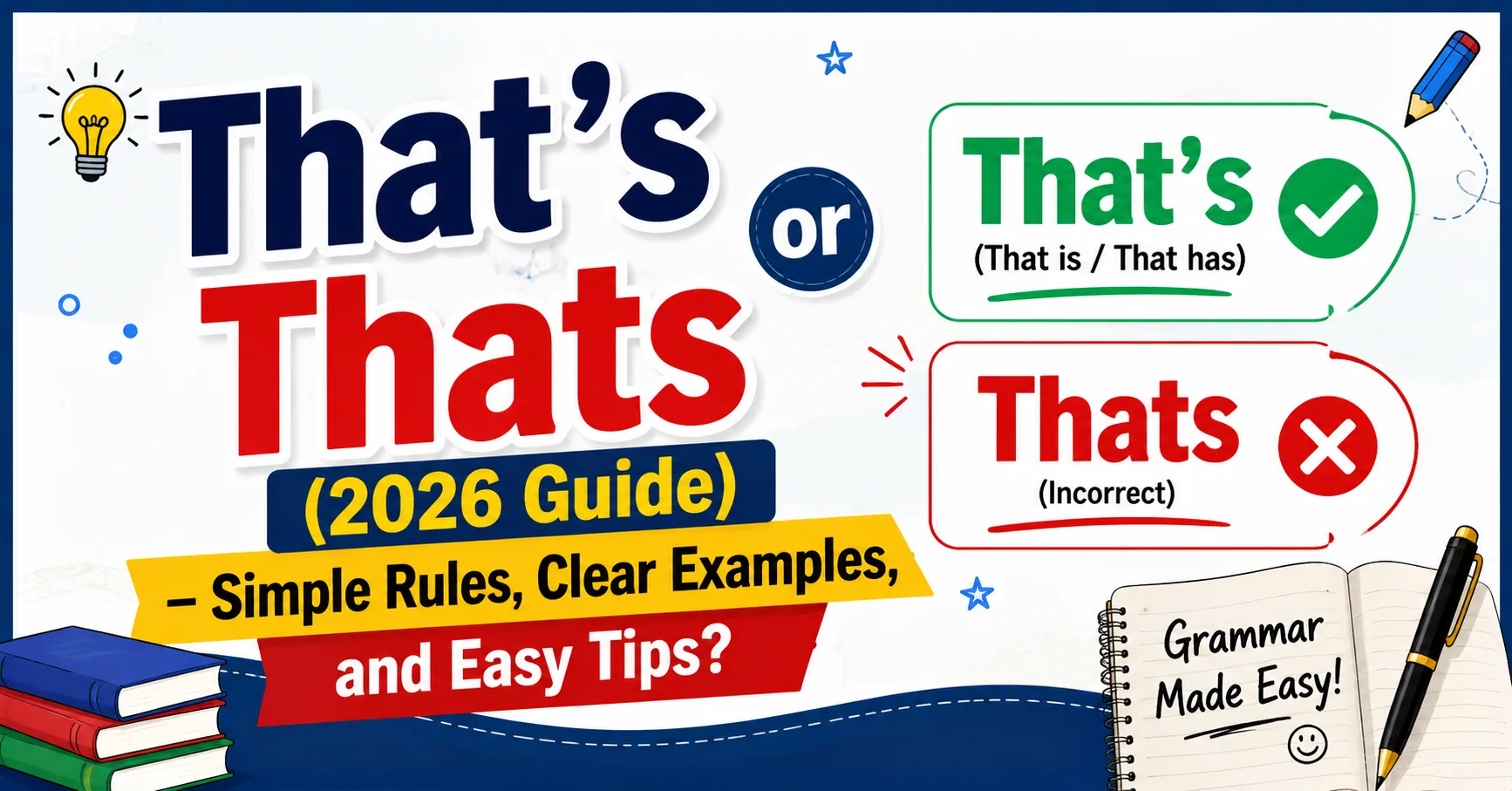
- “That’s” = correct
- “Thats” = incorrect
If you ever see “thats,” it’s best to add the apostrophe. This small mark changes everything. It turns the word into a proper contraction.
Learning this rule early can improve your writing a lot. It makes your sentences look clean and professional.
The Core Difference Between That’s or Thats
The difference between That’s or Thats is simple but important. One is correct, and the other is not.
| Word | Meaning | Correct Usage |
|---|---|---|
| That’s | That is / That has | ✅ Yes |
| Thats | No meaning | ❌ No |
“That’s” always includes an apostrophe. This shows that letters are missing. In this case, the missing letter is “i” from “is” or “ha” from “has.”
“Thats” has no apostrophe. That makes it incomplete. It does not follow English grammar rules.
Think of the apostrophe as a signal. It tells the reader that this is a shortened form. Without it, the word loses its meaning.
Why Do People Confuse That’s or Thats?
Many learners struggle with That’s or Thats because the words look similar. The only difference is a tiny mark. But that small mark matters a lot.
Typing habits also play a role. When people type quickly, they skip the apostrophe. Over time, this becomes a habit. Then it feels normal, even though it’s wrong.
Another reason is lack of grammar awareness. Some learners don’t know what contractions are. So they don’t understand why “that’s” needs an apostrophe.
I’ve seen this happen often with beginners. Once they learn the rule, their mistakes drop quickly. Awareness is the first step to improvement.
Simple Trick to Remember the Rule
Here is an easy trick you can use anytime:
Replace “that’s” with “that is.”
If the sentence still works, then “that’s” is correct.
Example:
- That’s a good idea → That is a good idea ✔️
- Thats a good idea → That is a good idea ❌ (wrong form)
You can also try “that has” in some cases.
This trick is fast and reliable. I suggest practicing it daily. After some time, you won’t need the trick anymore. Your brain will do it automatically.
Common Examples of That’s in Sentences
Let’s look at real-life examples. These will help you understand how to use That’s or Thats correctly.
| Sentence | Expanded Form |
|---|---|
| That’s my friend | That is my friend |
| That’s amazing | That is amazing |
| That’s been fixed | That has been fixed |
| That’s your phone | That is your phone |
Each example shows how “that’s” fits naturally into a sentence. It makes speech smoother and shorter.
When I first learned this, I practiced with simple sentences like these. It helped me build confidence quickly. You can do the same.
When NOT to Use That’s
There are times when you should not use “that’s.” This happens when you need a different structure.
For example:
- That book is mine ✔️
- That’s book is mine ❌
Here, “that’s” cannot replace “that.” The sentence structure is different. “That’s” only works when it replaces “that is” or “that has.”
This is where many learners make mistakes. They try to use “that’s” everywhere. But it only fits in certain situations.
Understanding this limit will improve your writing accuracy.
Real-Life Mistakes and Corrections
Let’s fix some common errors with That’s or Thats:
| Wrong Sentence | Correct Sentence |
|---|---|
| Thats my car | That’s my car |
| Thats a great idea | That’s a great idea |
| Thats been done already | That’s been done already |
| Thats your responsibility | That’s your responsibility |
These mistakes are easy to fix. You just need to add the apostrophe.
I’ve seen students improve quickly by correcting these examples daily. Practice is key. Even five minutes a day can make a big difference.
That’s vs Its: A Related Confusion
Many people who struggle with That’s or Thats also confuse “its” and “it’s.”
Here’s a quick comparison:
| Word | Meaning | Example |
|---|---|---|
| It’s | It is / It has | It’s raining |
| Its | Possession | Its color is blue |
The rule is similar. Apostrophe means contraction. No apostrophe means possession.
Once you understand this pattern, other grammar rules become easier too.
Why Apostrophes Matter in English
Apostrophes may look small, but they carry big meaning. In That’s or Thats, the apostrophe shows missing letters.
Without it, the word becomes unclear or incorrect.
Apostrophes help:
- Show contractions
- Indicate possession
- Improve clarity
Ignoring them can confuse readers. It can also make your writing look careless.
I always tell learners to respect small details. They often make the biggest difference.
Practice Exercises You Can Try
Here are simple exercises to master That’s or Thats:
- Fill in the blank: ___ my house
- Correct the sentence: Thats a nice view
- Expand: That’s going well
- Choose: That’s / Thats amazing
Answers:
- That’s
- That’s a nice view
- That is going well
- That’s amazing
Practice daily for best results. Even short practice builds strong habits.
Tips to Avoid Mistakes in Writing
To avoid errors with That’s or Thats, follow these tips:
- Always check for apostrophes
- Read your sentence aloud
- Use grammar tools if needed
- Practice with simple sentences
I personally review my writing once before sending it. This helps catch small mistakes. It’s a simple habit that improves quality.
How This Rule Helps Your Overall English
Learning That’s or Thats improves more than just one word. It builds your grammar foundation.
You become better at:
- Writing clearly
- Understanding contractions
- Avoiding common mistakes
Confidence grows when you know the rules. You stop guessing and start writing with purpose.
This small lesson can create big improvement in your English skills.
FAQs About That’s or Thats
1. Is “thats” ever correct?
No, “thats” is not correct in standard English. Always use “that’s” with an apostrophe.
2. What does “that’s” stand for?
“That’s” means “that is” or “that has.”
3. Can I use “that’s” in formal writing?
Yes, but in very formal writing, some prefer “that is.” Both are correct.
4. Why do people write “thats”?
Mostly due to fast typing or lack of awareness about apostrophes.
5. How can I remember the correct form?
Use the “that is” test. If it fits, “that’s” is correct.
Final Thoughts: Mastering That’s or Thats
By now, you should feel confident about That’s or Thats. The rule is simple. “That’s” is correct. “Thats” is not.
Always remember the apostrophe. It shows that letters are missing. Without it, the word loses meaning.
Practice a little every day. Use real examples. Check your writing. These small steps build strong habits.
If you found this guide helpful, try applying it in your next message or post. The more you use it, the easier it becomes.
That’s how real learning works—simple steps, repeated often, with clear understanding.
