


If you’ve ever paused while writing and wondered whether to use “run” or “ran,” you’re not alone. This is one of the most common grammar questions in English. The good news? It’s actually very simple once you understand the basic rule.
In this guide, you’ll learn everything about run or ran in a clear and friendly way. We’ll break it down step by step, use real-life examples, and make sure it’s easy enough for anyone to understand—even a beginner. By the end, you’ll never feel confused about this again.
What Is the Difference Between Run or Ran?
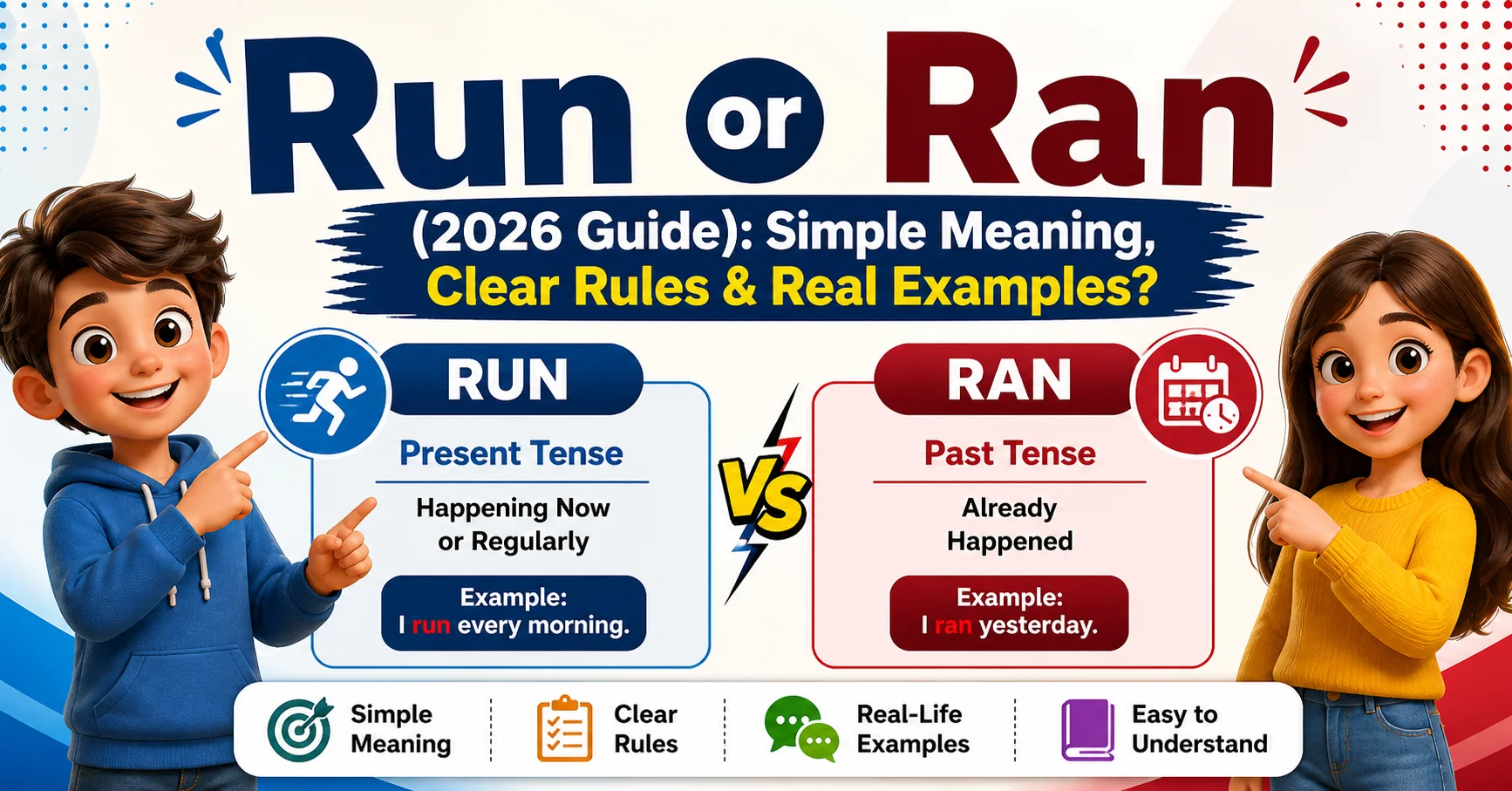
The difference between run or ran is all about time.
- Run = present tense (happening now or regularly)
- Ran = past tense (already happened)
Think of it like this:
- “I run every morning.” (now or habit)
- “I ran yesterday.” (already done)
This simple time rule solves most confusion around run or ran. If the action is happening now or often, use run. If it happened before, use ran.
Why Do People Get Confused About Run or Ran?
Many learners struggle with run or ran because English verbs don’t always follow simple patterns. For example:
- Walk → walked
- Jump → jumped
- But run → ran (not “runned”)
This makes run an irregular verb, which means it changes form in a special way.
Another reason is helping verbs like “has,” “have,” and “had.” These can change how “run” is used. So even though the rule is simple, small details can make it confusing at first.
Understanding “Run” in Simple Words
“Run” is the base form of the verb. It is used in the present tense and sometimes with helping verbs.
Here are common uses of run:
- I run fast.
- They run every day.
- We run a small business.
You can also use “run” after words like:
- Can → I can run
- Will → I will run
- Should → You should run
So whenever you talk about the present or future, run is the correct choice.
Understanding “Ran” in Simple Words
“Ran” is the past tense of “run.” It tells us something already happened.
Examples:
- I ran to school yesterday.
- She ran very fast in the race.
- They ran late last night.
If your sentence talks about yesterday, last week, or any past moment, then ran is correct.
Simple Rule to Remember Run or Ran
Here’s an easy trick you can always use:
| Time | Word to Use | Example |
|---|---|---|
| Present | Run | I run daily |
| Past | Ran | I ran yesterday |
If the sentence includes past time words like:
- Yesterday
- Last night
- Last year
Then you should use ran, not run.
When to Use Run with Helping Verbs
This is where many learners make mistakes with run or ran.
When you use helping verbs like:
- Has
- Have
- Had
You must use run, not ran.
Examples:
- I have run five miles.
- She has run a marathon.
- They had run before the rain started.
Even though these sentences talk about the past, we still use run, not ran.
Common Mistakes with Run or Ran
Let’s look at mistakes people often make:
| Incorrect Sentence | Correct Sentence |
|---|---|
| I have ran fast | I have run fast |
| She has ran away | She has run away |
| They run yesterday | They ran yesterday |
The key takeaway:
- Never use ran after “has,” “have,” or “had.”
- Never use run with past time words unless a helping verb is present.
Run or Ran in Daily Conversations
In real life, people use these words all the time. Here are simple examples you might hear:
- “I run every morning.”
- “He ran late to class.”
- “We have run out of time.”
- “She ran to catch the bus.”
Notice how the tense changes based on time. This is the core idea behind run or ran.
Different Meanings of “Run”
“Run” doesn’t only mean moving fast. It has many meanings:
| Meaning | Example |
|---|---|
| Move fast | I run daily |
| Manage | I run a shop |
| Function | The machine runs well |
| Continue | The show will run tonight |
This makes “run” a very powerful and common verb in English.
Practice Sentences for Run or Ran
Let’s practice choosing the correct word:
- I ___ to school yesterday.
- She ___ every morning.
- They have ___ out of money.
- We ___ late last night.
Answers:
- Ran
- Run
- Run
- Ran
Practicing like this helps you master run or ran quickly.
Easy Trick to Never Forget
Here’s a super simple memory trick:
👉 “Yesterday = ran”
👉 “Now or always = run”
👉 “Has/Have/Had = run”
If you remember this, you will almost never make mistakes again.
Run or Ran in Questions
When asking questions, we usually use “run” with helping verbs.
Examples:
- Did you run yesterday?
- Have you run today?
- Will you run tomorrow?
Even when asking about the past, “did” keeps the verb as run, not ran.
Run or Ran in Negative Sentences
Negative sentences also follow a pattern:
Examples:
- I did not run yesterday.
- She has not run today.
- They did not run fast.
Again, notice we use run, not ran, after “did not.”
Real-Life Example Story
Let’s make it simple with a short story:
“Yesterday, I ran to the market because I was late. Today, I run every morning to stay healthy. Last week, I had run in a race and felt proud.”
This short story shows how run or ran changes with time.
Advanced Tip: Past Participle of Run
“Run” has three forms:
| Form | Word |
|---|---|
| Base | Run |
| Past | Ran |
| Past Participle | Run |
So:
- I run
- I ran
- I have run
This is why we say “have run,” not “have ran.”
How Native Speakers Use Run or Ran
Native speakers don’t think too much about rules. They simply follow patterns they’ve heard.
For example:
- “I ran home.”
- “I have run this before.”
If you listen to English movies, songs, or conversations, you’ll notice these patterns clearly.
FAQs About Run or Ran
1. Is it correct to say “I have ran”?
No, it’s incorrect. You should say “I have run.”
2. When should I use ran?
Use ran when talking about the past without helping verbs.
3. Can I use run for past tense?
Only with helping verbs like “has,” “have,” or “had.”
4. Why is run an irregular verb?
Because it doesn’t follow the “-ed” rule like regular verbs.
5. Is “did you ran” correct?
No. The correct form is “Did you run?”
Final Thoughts on Run or Ran
Understanding run or ran is much easier than it first seems. Once you know the basic rule about time, everything becomes clear. Use run for present or with helping verbs, and use ran for simple past sentences.
The best way to improve is to practice daily. Try writing your own sentences. Speak them out loud. Notice how others use them. Over time, it will feel natural.
If you found this guide helpful, keep learning more simple grammar tips. Small improvements like this can make your English much stronger and more confident.
