


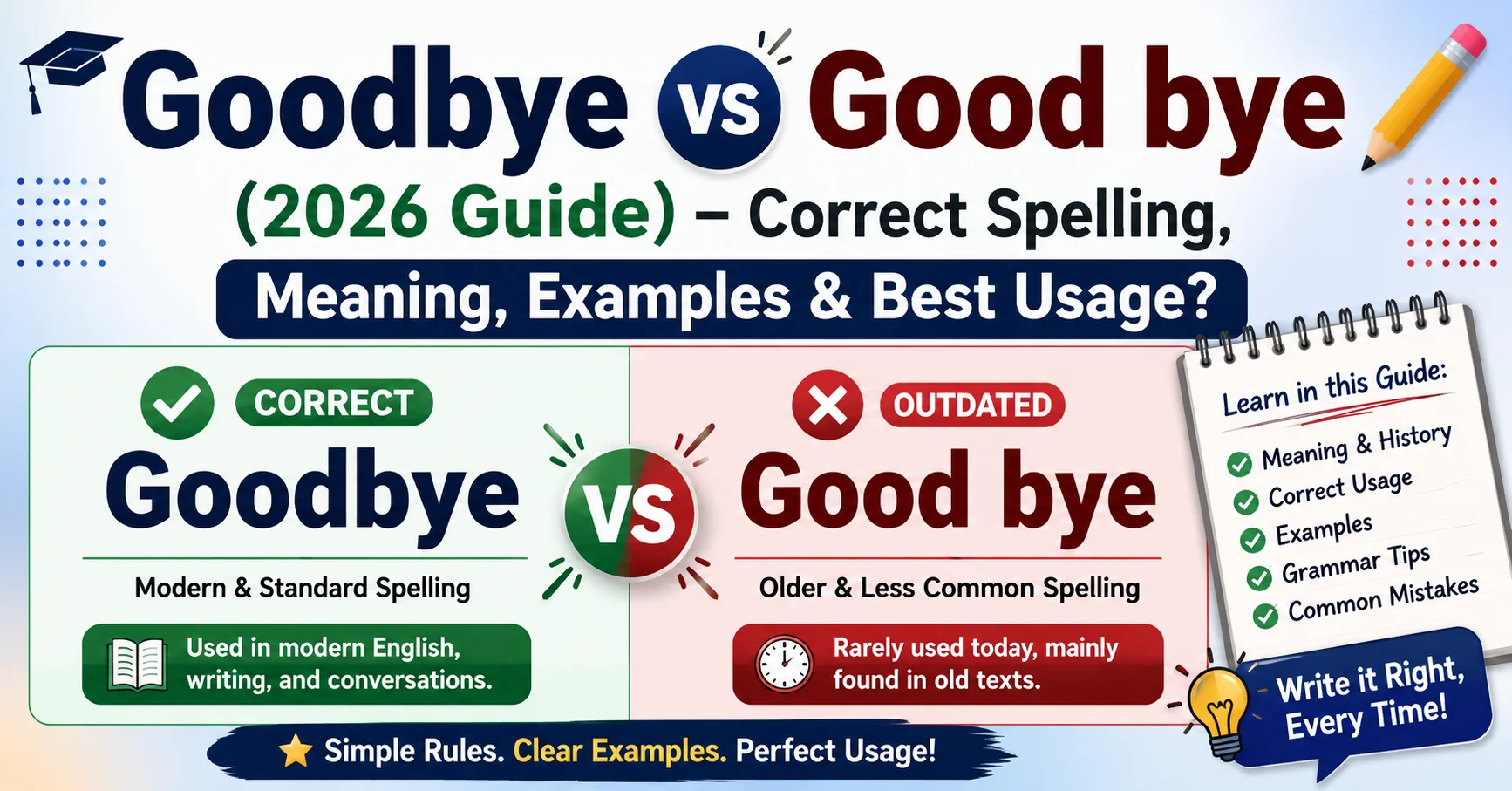
Language changes all the time. Some words that once appeared in two parts later became one word. A great example is “goodbye.” Many people still wonder about Goodbye vs Good bye because both forms appear online, in old books, and even in casual writing.
So, which one is correct today?
The short answer is simple: “goodbye” is the correct modern spelling. “Good bye” is an older version that is now rarely used in formal English. Still, many learners become confused when they see both forms in movies, songs, or older texts.
This guide explains everything in a simple way. You will learn the meaning, history, grammar rules, examples, and common mistakes related to Goodbye vs Good bye. You will also discover when to use each form and why one is preferred today.
By the end, you will never feel confused about this spelling again.
What Does “Goodbye” Mean?
“Goodbye” is a common English expression people use when leaving someone. It is a farewell word. You say it when ending a conversation, phone call, visit, or meeting.
Here are simple examples:
- Goodbye, see you tomorrow.
- She waved goodbye before leaving.
- We said goodbye at the airport.
The word can work in different ways. Sometimes it acts as an interjection. Sometimes it acts like a noun.
For example:
| Sentence | Usage |
|---|---|
| Goodbye! Have a nice day. | Interjection |
| Their goodbye was emotional. | Noun |
Today, dictionaries, schools, and grammar experts accept “goodbye” as the standard spelling. That is why it appears in books, articles, emails, and business writing.
When discussing Goodbye vs Good bye, remember this important rule: modern English strongly prefers the one-word form.
Is “Good bye” Wrong?
Not exactly. “Good bye” is not fully wrong. It is simply outdated.
Long ago, English speakers often wrote the phrase as two separate words. Over time, language evolved, and the words joined together into the modern form “goodbye.”
Today, most grammar experts consider “good bye” old-fashioned. It rarely appears in modern professional writing.
You may still see it in:
- Historical books
- Old letters
- Vintage songs
- Classic literature
- Stylized creative writing
Here is a quick comparison:
| Form | Status Today | Common Use |
|---|---|---|
| Goodbye | Correct modern spelling | Everyday English |
| Good bye | Old-fashioned spelling | Rare or historical |
In normal situations, always choose “goodbye.”
The History Behind Goodbye
The story behind this word is actually very interesting.
The original phrase was:
“God be with ye.”
People used it as a blessing when parting ways. Over many years, pronunciation changed. The phrase slowly became shorter and easier to say.
Here is the language journey:
| Original Phrase | Later Form | Modern Form |
|---|---|---|
| God be with ye | God b’w’ye | Goodbye |
Eventually, English speakers started spelling it in different ways, including:
- Good-bye
- Good bye
- Goodbye
The hyphenated form “good-bye” was common for many years. Later, the simpler one-word spelling became dominant.
This change happens often in English. Many combined words started as separate words first.
Examples include:
| Old Form | Modern Form |
|---|---|
| Any one | Anyone |
| Every day | Everyday |
| Good bye | Goodbye |
Understanding this history makes Goodbye vs Good bye much easier to understand.
Why “Goodbye” Is Preferred Today
Modern English values simplicity and consistency. Since “goodbye” became more common, dictionaries and style guides adopted it as the standard spelling.
Major dictionaries now list “goodbye” as the primary form.
Writers also prefer it because:
- It looks cleaner
- It saves space
- It matches modern usage
- Readers recognize it instantly
In school, business, blogging, and professional communication, “goodbye” is almost always the safest choice.
For example:
✅ Correct:
- Goodbye, everyone.
- I hate saying goodbye.
- She whispered goodbye softly.
❌ Outdated:
- Good bye, everyone.
- I hate saying good bye.
When choosing between Goodbye vs Good bye, modern grammar rules clearly support “goodbye.”
Common Situations Where People Use Goodbye
People use “goodbye” in many daily situations. It appears in speech, writing, texting, and social media.
Here are common examples:
In Daily Conversations
- Goodbye, Mom.
- Goodbye, see you later.
In Emails
- Goodbye and thank you for your support.
- Goodbye for now.
In Text Messages
- Okay, goodbye!
- Goodbye 😂
In Emotional Moments
- Saying goodbye was painful.
- Their final goodbye felt heartbreaking.
The tone can change depending on the situation. Sometimes “goodbye” sounds formal. Sometimes it sounds emotional or friendly.
Goodbye vs Good bye in Formal Writing
Formal writing follows modern grammar standards. Because of that, “goodbye” is the correct choice in almost every professional situation.
Use “goodbye” in:
- Business emails
- Academic writing
- Website articles
- School assignments
- Official letters
Example:
| Formal Sentence | Correct? |
|---|---|
| Goodbye and best wishes. | ✅ |
| Good bye and best wishes. | ❌ |
A few years ago, I edited a client’s business newsletter. The writer used “good bye” throughout the article. While the message sounded warm, the spelling looked outdated. Changing it to “goodbye” instantly made the content feel more polished and modern.
Small spelling choices can affect credibility more than people realize.
Goodbye vs Good bye in Informal Writing
Informal writing allows more creativity. Still, “goodbye” remains the better choice.
Even in casual texting, most native speakers write:
- goodbye
- bye
- cya
- see ya
The two-word version is uncommon today.
However, creative writers sometimes use “good bye” intentionally. They may want the text to sound old-fashioned or poetic.
For example:
“Good bye, my love,” the old sailor whispered.
In this case, the spelling creates a vintage feeling.
Still, in everyday English, “goodbye” is far more natural.
Difference Between Goodbye and Bye
Many learners also confuse “goodbye” and “bye.”
Here is the difference:
| Word | Tone | Formality |
|---|---|---|
| Goodbye | Standard | Neutral/Formal |
| Bye | Casual | Informal |
“Bye” is simply a shorter version.
Examples:
- Goodbye, professor.
- Bye, dude!
In professional settings, “goodbye” usually sounds more respectful.
Meanwhile, “bye” works well with friends and family.
Common Grammar Mistakes With Goodbye
People make several mistakes when using this word. Let’s fix the most common ones.
Mistake 1: Writing “Good bye” in Formal English
❌ Good bye everyone.
✅ Goodbye everyone.
Mistake 2: Using Random Capital Letters
❌ goodBye
✅ goodbye
Mistake 3: Adding Extra Spaces
❌ Good bye
✅ Goodbye
Mistake 4: Confusing “Goodbye” With “Good Night”
These phrases have different meanings.
| Phrase | Meaning |
|---|---|
| Goodbye | Farewell when leaving |
| Good night | Used before sleeping |
Example:
- Goodbye, I’ll see you tomorrow.
- Good night, sleep well.
Avoid mixing them up.
Popular Goodbye Expressions in English
English contains many farewell expressions besides “goodbye.”
Here are some common alternatives:
| Expression | Tone |
|---|---|
| Bye | Casual |
| See you later | Friendly |
| Take care | Warm |
| Farewell | Formal |
| Catch you later | Informal |
| Talk soon | Friendly |
| See ya | Very casual |
Each expression fits different situations.
For example, “farewell” sounds serious and emotional. Meanwhile, “see ya” sounds playful and relaxed.
Knowing these choices improves your communication skills.
How Native Speakers Use Goodbye
Native English speakers usually prefer short and natural expressions. Many people rarely say the full word “goodbye” in casual speech.
Instead, they say:
- Bye
- See you
- Later
- Take care
Still, “goodbye” appears often during emotional or important moments.
For example:
- A child saying goodbye to parents at college
- Friends parting after many years
- Final scenes in movies
- Emotional airport departures
In these moments, “goodbye” feels deeper and more meaningful.
That emotional feeling is one reason the word remains powerful.
Goodbye in Movies, Songs, and Literature
The word “goodbye” appears everywhere in popular culture. Writers and musicians often use it because everyone understands the emotion behind it.
You can find it in:
- Romantic songs
- Sad movies
- Poetry
- Drama novels
Some creators purposely choose “good bye” for artistic reasons. They may want an old-fashioned style.
Still, modern entertainment mostly uses “goodbye.”
This shows how strongly the one-word spelling dominates current English.
Should You Ever Use “Good bye”?
In normal writing, probably not.
Still, there are a few rare situations where someone may intentionally use “good bye”:
| Situation | Reason |
|---|---|
| Historical fiction | Older style |
| Vintage designs | Nostalgia |
| Poetry | Rhythm or appearance |
| Artistic branding | Creative effect |
Outside these cases, “goodbye” is the best option.
If you are a student, blogger, teacher, or business writer, stick with the modern spelling.
Easy Trick to Remember the Correct Form
Here is a simple memory trick:
If you would write “hello” as one word, write “goodbye” as one word too.
This trick helps many learners remember the correct spelling quickly.
Another easy tip:
- Modern English prefers shorter, combined words.
- Therefore, “goodbye” is the modern standard.
Simple habits like this improve spelling confidence over time.
Examples of Goodbye in Sentences
Here are more examples to help you master the word naturally.
Everyday Examples
- Goodbye, I’ll call you tonight.
- She smiled and said goodbye.
- We hugged before saying goodbye.
Emotional Examples
- Their goodbye lasted several minutes.
- Saying goodbye was difficult.
- He never got the chance to say goodbye.
Professional Examples
- Goodbye and thank you for attending.
- The manager said goodbye politely.
- Goodbye for now, and best wishes.
Reading examples helps the correct spelling stay in your memory.
Quick Comparison Table: Goodbye vs Good bye
| Feature | Goodbye | Good bye |
|---|---|---|
| Modern spelling | ✅ Yes | ❌ No |
| Used in formal writing | ✅ Yes | ❌ Rarely |
| Common in speech | ✅ Yes | ❌ Rare |
| Found in old texts | Sometimes | ✅ Yes |
| Recommended today | ✅ Strongly | ❌ Usually not |
This table clearly shows why “goodbye” wins in modern English.
FAQs About Goodbye vs Good bye
Is “goodbye” one word or two?
“Goodbye” is normally written as one word in modern English. This is the accepted spelling today.
Is “good bye” grammatically incorrect?
It is not completely incorrect, but it is outdated. Most writers avoid using it now.
Which spelling should students use?
Students should always use “goodbye” unless a teacher specifically requests historical spelling examples.
Why do some old books use “good bye”?
Older English often separated the words. Language changed over time, creating the modern form “goodbye.”
Can I use “good bye” in creative writing?
Yes. Some writers use it for a vintage or poetic effect. Still, “goodbye” remains more common.
Conclusion
The debate around Goodbye vs Good bye becomes simple once you understand modern English rules.
Today, “goodbye” is the correct and widely accepted spelling. It appears in schools, websites, business writing, books, and everyday communication. Meanwhile, “good bye” survives mostly in historical or artistic contexts.
Language naturally evolves over time. Many words once appeared separately before becoming combined forms. “Goodbye” followed that same path.
If you want your writing to sound modern, polished, and natural, choose “goodbye” every time.
Now that you understand the difference, try using “goodbye” confidently in your emails, messages, and conversations. Small grammar improvements can make your English look much stronger and more professional.
