

Language can feel confusing at times. Many English learners hear phrases like “That’s mean” and “That means” and wonder if they are the same. They sound close, but they have very different meanings. One talks about behavior or attitude. The other explains the meaning of something.
This is why understanding That’s Mean vs That Means is important. A small word change can completely change the sentence. Native speakers use both phrases every day in conversations, texts, schools, offices, and social media posts.
In this guide, you will learn the meaning of each phrase, when to use them, common grammar mistakes, and easy examples. You will also see comparison tables, real-life situations, and simple tips that help you remember the difference forever.
By the end, you will feel more confident using both expressions in daily English.
Why People Confuse “That’s Mean” and “That Means”
Many learners mix up these phrases because they sound similar when spoken quickly. The words “mean” and “means” come from the same root word, but they work differently in grammar.
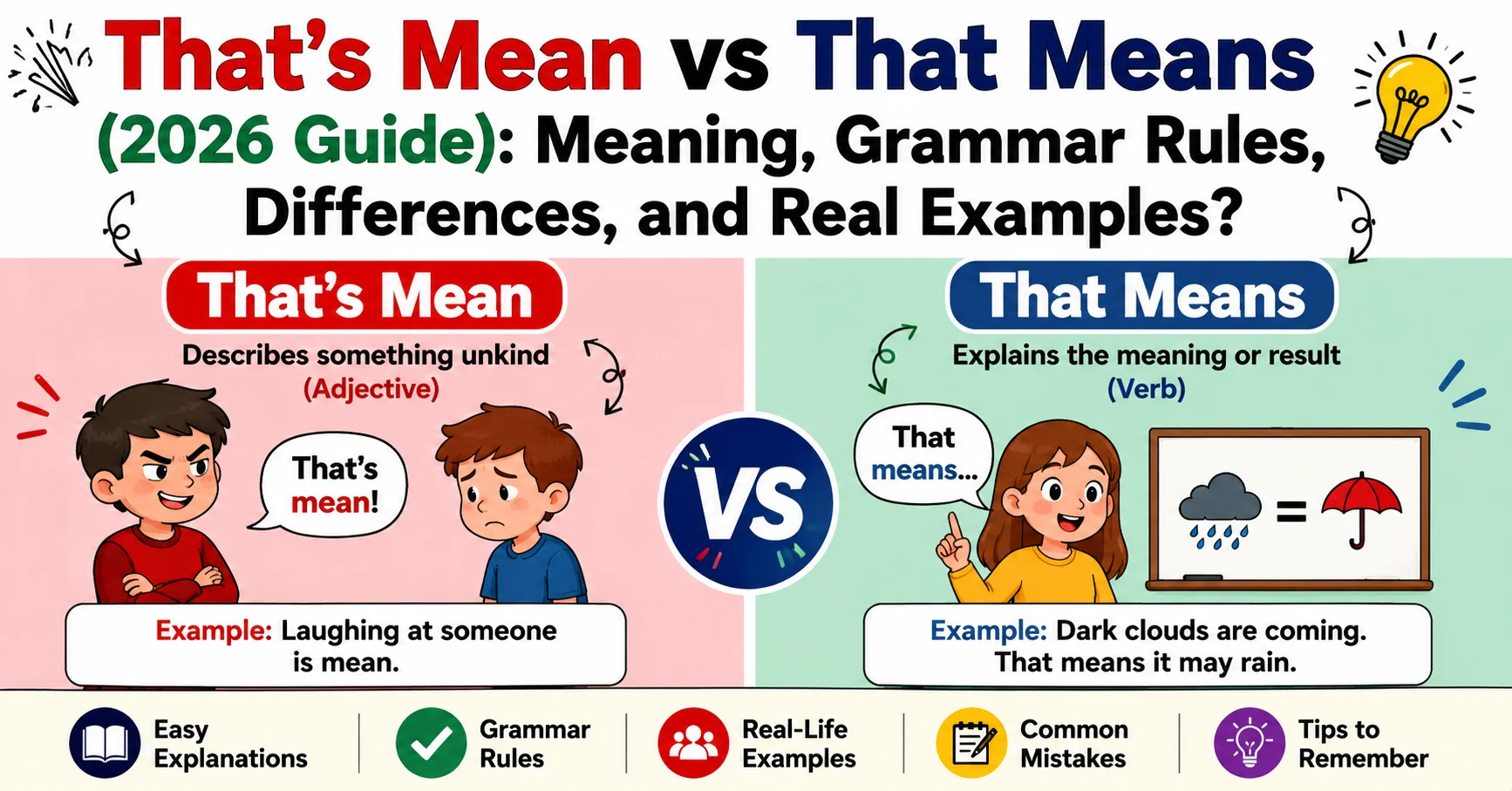
“That’s mean” uses mean as an adjective. It describes a person, action, or behavior that feels unkind or hurtful.
“That means” uses means as a verb. It explains the meaning of something.
Look at these examples:
- “You laughed at him. That’s mean.”
- “The red light is on. That means the machine works.”
The first sentence talks about rude behavior. The second sentence explains information.
This confusion happens often because English has many words that change meaning depending on grammar. Learning sentence patterns helps a lot. Once you understand the role of each word, the difference becomes simple.
What Does “That’s Mean” Mean?
“That’s mean” is used when someone acts in a cruel, rude, or unkind way. The word “mean” here is an adjective.
People usually say this expression after hearing or seeing something hurtful.
Examples:
- “You called her ugly. That’s mean.”
- “Taking his lunch was mean.”
- “Ignoring your friend is mean.”
The phrase often expresses disapproval. Parents, teachers, and friends use it often in conversations.
Here is a simple breakdown:
| Phrase | Grammar Role | Meaning |
|---|---|---|
| That’s mean | Adjective phrase | Something is unkind |
You may hear children use this phrase often because it is easy and direct. Adults also use it in casual speech.
In my experience teaching beginner English learners, this phrase becomes easier when students connect it with emotions. If an action hurts someone emotionally, people often say, “That’s mean.”
What Does “That Means” Mean?
“That means” is completely different. Here, “means” is a verb. It explains the meaning or result of something.
Examples:
- “Dark clouds are coming. That means it may rain.”
- “She smiled. That means she is happy.”
- “The store is closed. That means we must return tomorrow.”
This phrase helps explain ideas, signs, signals, or information.
Here is a simple table:
| Phrase | Grammar Role | Meaning |
|---|---|---|
| That means | Verb phrase | Explains meaning or result |
This phrase is common in schools, lessons, conversations, and instructions. Teachers use it often while explaining concepts.
For example:
- “A triangle has three sides. That means every triangle must have three angles too.”
When discussing That’s Mean vs That Means, remember this easy rule:
- Mean = unkind
- Means = explains
That small difference changes everything.
The Grammar Difference Between the Two Phrases
Understanding grammar makes these phrases much easier.
“That’s Mean”
This phrase is short for:
- “That is mean.”
Sentence structure:
- Subject + be verb + adjective
Example:
- “That is mean.”
The word “mean” describes behavior.
“That Means”
Sentence structure:
- Subject + verb
Example:
- “That means we are late.”
The word “means” shows action because it explains something.
Here is a clearer comparison:
| Phrase | Full Form | Word Type | Purpose |
|---|---|---|---|
| That’s mean | That is mean | Adjective | Describes behavior |
| That means | That means | Verb | Explains meaning |
A quick grammar trick can help:
- If you can replace the word with “unkind,” use “mean.”
- If you can replace it with “explains,” use “means.”
Real-Life Examples of “That’s Mean”
Real examples help language stick in your mind. Below are common situations where people use “That’s mean.”
At School
A student laughs at another student’s mistake.
Friend says:
- “That’s mean.”
At Home
Someone eats another person’s dessert without asking.
Response:
- “That was mean.”
Online
A person leaves rude comments on social media.
Others may reply:
- “That’s really mean.”
Between Friends
A friend shares a secret without permission.
Reaction:
- “That’s mean. You should not do that.”
Here is another useful table:
| Situation | Correct Phrase |
|---|---|
| Bullying someone | That’s mean |
| Saying rude words | That’s mean |
| Hurting feelings | That’s mean |
The phrase often carries emotion. People use it when they feel disappointed or upset.
Real-Life Examples of “That Means”
Now let’s look at situations where “That means” fits naturally.
Weather
- “The sky is dark. That means rain is coming.”
Technology
- “The battery light is red. That means the battery is low.”
School
- “You scored 95%. That means you passed with excellent marks.”
Daily Conversation
- “She did not answer the phone. That means she may be busy.”
Here are more examples:
| Situation | Correct Phrase |
|---|---|
| Explaining signs | That means |
| Giving results | That means |
| Explaining information | That means |
This phrase is extremely useful in daily English because people constantly explain meanings and outcomes.
Common Mistakes English Learners Make
Many learners make small but common mistakes with That’s Mean vs That Means.
Mistake 1: Using “mean” Instead of “means”
❌ “The red light is on. That’s mean the machine works.”
✅ “The red light is on. That means the machine works.”
Mistake 2: Using “means” for rude behavior
❌ “You insulted him. That means.”
✅ “You insulted him. That’s mean.”
Mistake 3: Forgetting Context
Context matters. Ask yourself:
- Am I describing behavior?
- Or am I explaining information?
That question usually gives the answer immediately.
In my experience, students improve faster when they stop memorizing and start focusing on sentence purpose.
Easy Memory Tricks to Remember the Difference
Simple tricks can make learning easier.
Trick 1: Mean = Mean Person
If someone acts badly, use:
- “That’s mean.”
Trick 2: Means = Meaning
If something explains another thing, use:
- “That means.”
Trick 3: Check the Sentence Emotion
- Emotional reaction → “That’s mean”
- Explanation or result → “That means”
Here is a quick cheat sheet:
| If the sentence is about… | Use |
|---|---|
| Rude behavior | That’s mean |
| Explanation | That means |
| Hurt feelings | That’s mean |
| Information | That means |
These memory tricks work well for beginners and children too.
How Native Speakers Use These Phrases
Native speakers use both phrases naturally in casual speech.
Casual Conversation
- “You took her seat? That’s mean.”
- “The bus left already. That means we missed it.”
Parenting
Parents often teach kindness using “That’s mean.”
Example:
- “Do not laugh at your brother. That’s mean.”
Teaching
Teachers explain ideas with “That means.”
Example:
- “Water freezes at zero degrees. That means ice forms at that temperature.”
Native speakers also use tone to change meaning slightly. A serious tone may show anger, while a softer tone may show disappointment.
Listening to movies, podcasts, or YouTube videos can help you hear these phrases naturally.
Similar Phrases You Should Know
English has other phrases connected to these expressions.
Similar to “That’s Mean”
- That’s rude
- That’s cruel
- That’s unkind
- That’s hurtful
Similar to “That Means”
- That explains
- That shows
- That indicates
- That suggests
Knowing related phrases improves vocabulary and fluency.
For example:
- “Ignoring people is rude.”
- “Dark clouds suggest rain.”
Using different words also makes your English sound more natural.
Why Context Matters in English Grammar
English depends heavily on context. The same word can change meaning depending on how it is used.
The word “mean” itself has several meanings:
- Unkind
- Average value in math
- To intend something
- To explain meaning
This is why context is so important.
For example:
- “She is mean.” → unkind
- “What does this word mean?” → definition
- “I mean well.” → intention
When learning That’s Mean vs That Means, always study the whole sentence, not only one word.
I often tell learners to think like detectives. Look for clues around the phrase. The rest of the sentence usually reveals the correct answer.
Mini Conversation Examples
Conversation examples help you understand natural usage better.
Example 1
Anna: “He laughed at my haircut.”
Sara: “That’s mean.”
Example 2
Tom: “The lights are off.”
Jake: “That means the shop is closed.”
Example 3
Mother: “Do not tease your sister.”
Child: “Sorry.”
Example 4
Teacher: “You got all answers correct.”
Student: “That means I passed?”
These small conversations sound natural because they match real English use.
Practice Sentences for Beginners
Try choosing the correct phrase.
| Sentence | Correct Answer |
|---|---|
| “You broke her toy on purpose. ___” | That’s mean |
| “The dog is barking loudly. ___ someone is outside.” | That means |
| “Calling names is rude. ___” | That’s mean |
| “The alarm rang. ___ it is time to leave.” | That means |
Practice helps grammar become automatic.
You can also make your own examples every day. Write five sentences with each phrase. This builds confidence quickly.
How Teachers Explain This Grammar Rule
Teachers usually explain this topic using parts of speech.
Mean as an Adjective
Describes a person or action.
Examples:
- mean person
- mean comment
Means as a Verb
Explains information.
Examples:
- “This sign means danger.”
- “That means stop.”
Understanding word function is more important than memorizing rules. Once learners know whether the word describes or explains, the confusion disappears.
Many students struggle at first, but improvement comes fast with daily reading and listening practice.
The Importance of Tone and Emotion
Tone changes how these phrases feel.
“That’s mean” often sounds emotional. It may show:
- sadness
- anger
- disappointment
“That means” sounds logical and explanatory.
Compare these:
- “That’s mean!” → emotional reaction
- “That means we are late.” → explanation
Learning tone helps your English sound more natural. Native speakers use emotion and voice changes all the time.
Watching real conversations online can improve this skill greatly.
FAQs About That’s Mean vs That Means
Is “That’s mean” grammatically correct?
Yes. It is short for “That is mean.” The word “mean” acts as an adjective.
Is “That means” grammatically correct?
Yes. The word “means” is a verb that explains information or results.
Why do people confuse these phrases?
They sound similar in spoken English. Many learners also confuse “mean” and “means.”
Can “mean” and “means” have different meanings?
Yes. English words often change meaning based on grammar and context.
Which phrase talks about rude behavior?
“That’s mean” talks about rude or unkind actions.
Final Thoughts on That’s Mean vs That Means
Understanding That’s Mean vs That Means becomes easy once you know the grammar difference. One phrase describes behavior, while the other explains meaning or results.
Here is the simplest way to remember:
- That’s mean = unkind behavior
- That means = explanation
Both phrases are common in everyday English. You will hear them in schools, homes, offices, movies, and online conversations.
The best way to master them is through practice. Read English daily, listen to native speakers, and make your own example sentences. Over time, the correct phrase will feel natural automatically.
Small grammar differences can create big meaning changes. Learning these details improves both speaking and writing skills.
If this guide helped you, keep practicing with similar grammar pairs. English becomes much easier when you learn one small rule at a time.
