


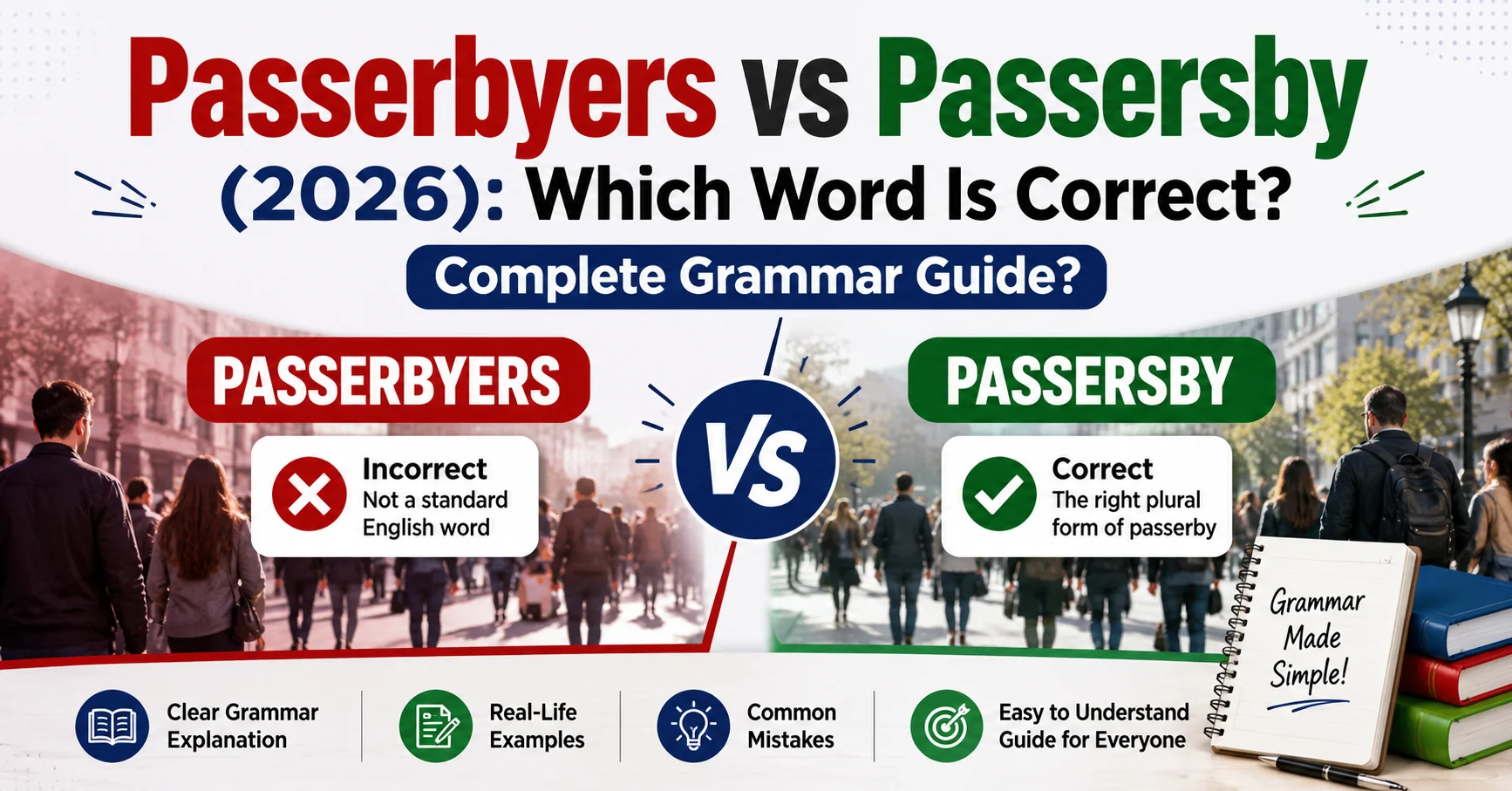
Words can be tricky. Some look right but sound strange. Others sound fine but are not correct at all. One pair that often causes confusion is Passerbyers vs Passersby. Many people type one, say the other, and then stop to wonder which one is correct.
If you have ever paused while writing this word, you are not alone. I remember editing a student essay a few years ago. The sentence said, “Several passerbyers watched the street show.” At first glance, it looked normal. But something felt off. That small moment turned into a fun grammar lesson.
In this guide, we will break down Passerbyers vs Passersby in the simplest way possible. You will learn which word is correct, why people mix them up, where the plural comes from, and how to use it in daily writing. By the end, you will feel confident every time you use it.
Why People Get Confused About Passerbyers vs Passersby
English has many unusual plural forms. Most words become plural by adding -s or -es. For example, dog becomes dogs, and box becomes boxes. That feels easy and natural.
But words like passerby follow a different rule. This is where confusion begins. When people compare Passerbyers vs Passersby, they often assume the ending should take the plural form. That leads them to create passerbyers.
It makes sense at first. Many words work that way. But grammar has exceptions. Compound nouns often follow special patterns.
The good news is this mistake is common. Even strong writers sometimes pause before choosing the correct word. Learning the rule once can save you from making the same mistake again.
The Quick Answer: Which Is Correct?
Let’s make this simple.
Between Passerbyers vs Passersby, the correct word is:
Passersby ✅
The word passerbyers ❌ is not standard English.
That means if you are writing an email, article, essay, or social media post, passersby is the word you should use.
Example:
Correct: Several passersby stopped to watch the artist.
Incorrect: Several passerbyers stopped to watch the artist.
This may feel strange at first. But once you understand how the word is built, it becomes much easier.
What Does Passerby Mean?
Before understanding the plural form, it helps to know what the singular word means.
A passerby is a person who walks past a place. They may stop, look, or keep moving. They are not staying there. They are simply passing by.
Examples:
- A passerby smiled at the child.
- One passerby helped pick up the fallen books.
- The shop owner greeted a passerby.
This word often appears in news stories, books, and daily conversation.
It describes someone who happens to be nearby, often by chance.
Understanding the Structure of the Word
To understand Passerbyers vs Passersby, we need to look at how the word is built.
The word passerby is a compound noun. That means it combines two parts:
| Word Part | Meaning |
|---|---|
| Passer | A person who passes |
| By | Near or past |
Together, the word means a person passing by.
Here’s the important part:
The main noun is passer, not by.
So when we make it plural, we change the noun part.
That gives us:
Passer → Passers
So:
Passerby → Passersby
This is why passersby is correct.
Why Passerbyers Sounds Logical But Is Wrong
When people compare Passerbyers vs Passersby, many choose passerbyers because it feels natural.
Why?
Because most words add -s or -ers at the end.
Examples:
- Teacher → Teachers
- Worker → Workers
- Runner → Runners
So the brain tries to follow the same pattern.
That leads to:
Passerby → Passerbyers
It sounds possible. But grammar does not work that way here.
The word already contains the person marker: passer.
Adding -ers creates an extra ending that English does not use.
So while passerbyers may sound logical, it is not grammatically correct.
Other Compound Nouns That Work the Same Way
The rule behind Passerbyers vs Passersby is not unique.
Many compound nouns follow this same pattern.
Here are some examples:
| Singular | Plural |
|---|---|
| Mother-in-law | Mothers-in-law |
| Attorney general | Attorneys general |
| Runner-up | Runners-up |
| Passerby | Passersby |
Notice something?
The main noun changes, not the final word.
This rule may look strange, but it has been part of English for a long time.
Once you see the pattern, it becomes easier to remember.
Real-Life Examples of Passersby
Sometimes grammar sticks better when we see it in action.
Here are everyday examples using passersby correctly:
In Public Places
A musician played in the park. Several passersby stopped to listen.
During Emergencies
Quick-thinking passersby helped move traffic after the accident.
In Shopping Areas
The bright window display caught the attention of many passersby.
During Community Events
Friendly passersby joined the local street celebration.
I once watched a street painter work in a busy city square. Within minutes, curious passersby formed a circle. Some took photos. Others asked questions. It was a simple but powerful reminder of how often this word appears in real life.
Common Mistakes Writers Make
When discussing Passerbyers vs Passersby, these are the most common errors:
Mistake 1: Adding -ers
❌ Passerbyers
✅ Passersby
Mistake 2: Adding -s at the End
❌ Passerbys
✅ Passersby
Mistake 3: Using the Singular for Groups
❌ Many passerby watched.
✅ Many passersby watched.
Here is a quick guide:
| Incorrect Form | Correct Form |
|---|---|
| Passerbyers | Passersby |
| Passerbys | Passersby |
| Two passerby | Two passersby |
These mistakes happen often. The key is practice.
How to Remember the Correct Form
A simple memory trick can help.
Think of this:
The people are the passers.
The word by only shows direction. It does not represent the people.
So when making it plural, change passer, not by.
You can say this aloud:
One passerby. Many passersby.
Repeat it a few times.
This small trick helps many students remember the difference between Passerbyers vs Passersby.
How Teachers Explain This Rule
In classrooms, teachers often explain this using noun focus.
The rule is simple:
Pluralize the most important noun.
In passerby, the main noun is passer.
So:
Passer + by → Passers + by
Teachers may compare it to other examples:
| Singular | Plural |
|---|---|
| Sister-in-law | Sisters-in-law |
| Commander-in-chief | Commanders-in-chief |
| Passerby | Passersby |
When students see the pattern, they usually understand it quickly.
I’ve noticed that once learners connect grammar to patterns, they remember it longer.
Is Passerbyers Ever Acceptable?
This question comes up often in the Passerbyers vs Passersby debate.
The short answer is:
No.
Passerbyers is not accepted in formal English.
You will not find it in standard dictionaries as the correct plural form.
That means you should avoid using it in:
- School essays
- Blog posts
- News writing
- Business emails
- Academic work
Some people may say it in casual speech. But that does not make it grammatically correct.
Language changes over time, but right now, passersby remains the accepted form.
How Native Speakers Use Passersby
Native speakers naturally use passersby in conversation and writing.
Here are common examples:
- Police asked nearby passersby for information.
- The street magician impressed dozens of passersby.
- Helpful passersby offered water during the race.
Most native speakers may not even know the grammar rule. They simply learned the correct form through exposure.
That’s how language often works.
Reading books, news articles, and magazines helps train your ear for correct word forms.
When to Use Passersby in Writing
You can use passersby in many types of writing.
Journalism
Reporters often mention witnesses or people nearby.
Example:
Several passersby reported hearing loud sounds.
Storytelling
Writers use it to create scenes.
Example:
The old violin player attracted curious passersby.
Business Marketing
Brands use it in street campaigns.
Example:
The free samples caught the attention of passersby.
Personal Writing
It works in blogs and journals too.
Example:
Friendly passersby smiled as we decorated the park.
This makes passersby a useful word in many situations.
Comparing Passerbyers vs Passersby One Last Time
Here is a final side-by-side comparison.
| Feature | Passerbyers | Passersby |
|---|---|---|
| Grammatically Correct | No | Yes |
| Found in Standard English | No | Yes |
| Used in Professional Writing | No | Yes |
| Accepted by Dictionaries | No | Yes |
So when choosing between Passerbyers vs Passersby, the answer is always:
Passersby.
Why Learning Small Grammar Rules Matters
Some people think small grammar choices do not matter.
But they do.
Words shape how others see your writing.
Correct grammar builds trust. It shows care. It shows attention to detail.
Imagine reading two articles. One says passerbyers. The other says passersby.
Which writer seems stronger?
Even tiny grammar choices can affect credibility.
That’s why learning the difference between Passerbyers vs Passersby matters more than many people think.
FAQs
1. Is passersby a real word?
Yes. Passersby is the correct plural form of passerby.
2. Is passerbyers ever correct?
No. Passerbyers is not accepted in standard English.
3. Why is passersby plural?
Because the main noun is passer, and that part becomes plural.
4. Can I say passerbys?
No. The correct plural remains passersby.
5. Do dictionaries include passersby?
Yes. Standard English dictionaries list passersby as the correct plural.
6. Is passersby used in everyday speech?
Yes. Native speakers use passersby in speech, writing, and media.
Conclusion
Grammar can feel confusing at times, especially with unusual plural forms. But once you understand the structure, the answer becomes clear.
In the debate of Passerbyers vs Passersby, the correct choice is always passersby.
The word follows a compound noun rule. The noun passer changes, while by stays the same.
I’ve seen this mistake in essays, online posts, and even professional drafts. That is why learning it now can improve your writing right away.
So next time you describe people walking past, you’ll know exactly what to write:
