


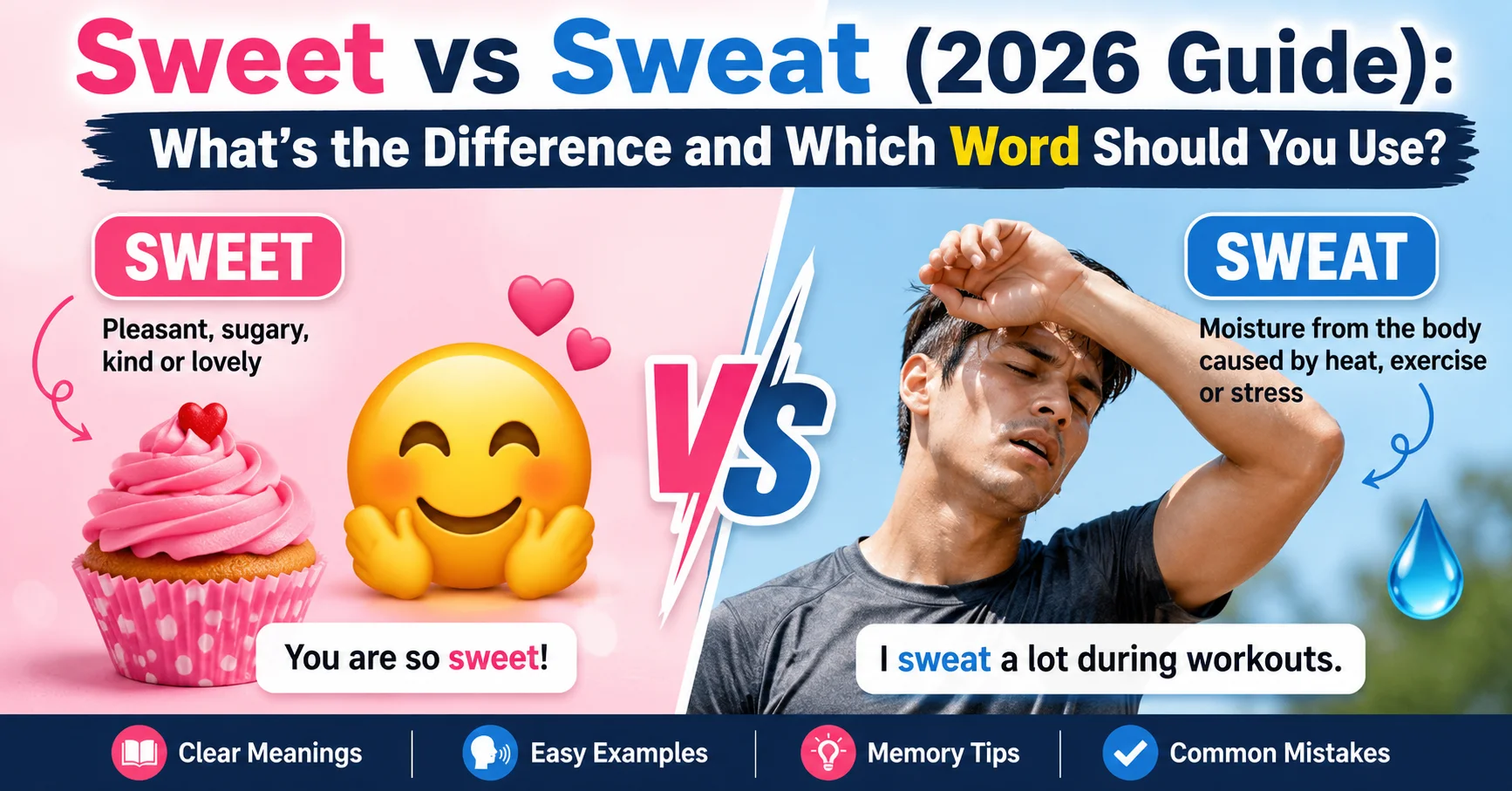
English has many words that sound close but mean very different things. One common example is Sweet vs Sweat. These two words may look similar, but they are used in completely different ways. Many learners, students, and even native speakers sometimes mix them up while writing or speaking.
The confusion usually happens because both words share almost the same spelling. Only one letter changes, yet the meaning becomes completely different. That small change can create funny mistakes in texts, school papers, social media captions, and even professional emails.
Understanding the difference between these words is important for clear communication. If you write “You are sweat” instead of “You are sweet,” the sentence suddenly sounds strange. That is why learning the correct meaning, pronunciation, and usage matters.
In this complete 2026 guide, you will learn everything about Sweet vs Sweat in the easiest way possible. We will explore meanings, grammar, pronunciation, examples, memory tricks, common mistakes, tables, and real-life usage. By the end, you will never confuse these words again.
Why People Confuse Sweet and Sweat
The main reason people confuse these words is spelling similarity. Both begin with “Swe,” and the pronunciation also sounds somewhat close to beginners. When reading quickly, the brain may not notice the difference between “sweet” and “sweat.”
Another reason is autocorrect and typing speed. Many people type quickly on phones. A simple typing mistake can completely change the meaning of a sentence. Imagine texting someone:
- “You look sweat today.”
That sentence feels odd because “sweat” refers to moisture from the body, not something kind or attractive.
Many English learners also struggle because English pronunciation rules are inconsistent. The “ea” sound changes across words. For example:
- Sweet → long “ee” sound
- Sweat → short “e” sound
This difference makes pronunciation harder for new learners.
Social media also adds confusion. People often use slang, shortcuts, or incorrect spelling online. Over time, readers start thinking both forms are acceptable. However, in proper English, each word has its own specific meaning and purpose.
What Does Sweet Mean?
The word “sweet” usually describes something pleasant, kind, sugary, or lovable. It is often connected with positive emotions and enjoyable experiences.
Common meanings of Sweet:
- Sugary taste
- Kind personality
- Pleasant smell
- Romantic behavior
- Cute or lovable actions
Here are some examples:
- The cake tastes sweet.
- She gave me a sweet smile.
- That was a sweet thing to say.
- Mangoes become sweet in summer.
“Sweet” is mainly used as an adjective, though it can also be a noun in British English when talking about candy.
Table: Common Uses of Sweet
| Use | Example Sentence | Meaning |
|---|---|---|
| Taste | The juice is sweet. | Sugary flavor |
| Personality | He is very sweet. | Kind and caring |
| Gesture | That was sweet of you. | Thoughtful action |
| Smell | The flowers smell sweet. | Pleasant scent |
The word often creates warm feelings. That is why it appears frequently in songs, love messages, and compliments.
What Does Sweat Mean?
“Sweat” refers to the moisture produced by the body, especially during heat, exercise, stress, or illness. It is connected to physical activity and body temperature control.
Your body sweats naturally to cool itself down. Sweat comes out through tiny pores in the skin.
Examples of Sweat:
- I sweat a lot during workouts.
- His shirt was covered in sweat.
- The hot weather made everyone sweat.
- Sweat rolled down her face.
“Sweat” can work as both a noun and a verb.
Table: Sweat as a Noun and Verb
| Form | Example | Explanation |
|---|---|---|
| Noun | His sweat soaked the shirt. | Body moisture |
| Verb | I sweat after running. | Producing moisture |
Unlike “sweet,” the word “sweat” usually relates to heat, stress, effort, or physical movement.
Sweet vs Sweat: The Main Difference
The easiest way to understand Sweet vs Sweat is this:
- Sweet = pleasant or sugary
- Sweat = moisture from the body
One word creates positive emotional feelings. The other describes a physical body process.
Quick Comparison Table
| Word | Meaning | Pronunciation | Example |
|---|---|---|---|
| Sweet | Sugary, kind, pleasant | Sweet | She is sweet. |
| Sweat | Body moisture | Swet | I sweat in summer. |
This difference may seem small, but using the wrong word can completely change a sentence’s meaning.
For example:
- “You are sweet.” → compliment
- “You are sweat.” → incorrect and confusing
That is why careful spelling matters.
Pronunciation Difference Between Sweet and Sweat
Pronunciation is another important part of understanding Sweet vs Sweat.
Even though the words look alike, they sound different.
Sweet
- Pronounced as: /swiːt/
- Long “ee” sound
Sweat
- Pronounced as: /swet/
- Short “e” sound
A simple trick is to stretch the sound in “sweet.” It sounds longer and softer.
Examples:
- Sweet = sounds like “sweeeet”
- Sweat = sounds short and quick
Many learners improve pronunciation by listening to native speakers, repeating words aloud, and practicing minimal pairs.
Common Mistakes People Make
Many mistakes happen because of typing fast or misunderstanding pronunciation.
Here are some common errors:
Incorrect:
- You are sweat.
- This candy is sweat.
- I feel sweet after gym class.
Correct:
- You are sweet.
- This candy is sweet.
- I feel sweaty after gym class.
Notice something important here. When describing a person covered in sweat, the correct adjective is often “sweaty,” not “sweat.”
Table: Common Errors and Fixes
| Incorrect Sentence | Correct Sentence |
|---|---|
| The chocolate is sweat. | The chocolate is sweet. |
| I am sweet after running. | I am sweaty after running. |
| She gave me a sweat message. | She gave me a sweet message. |
Small spelling mistakes can create big confusion.
When to Use Sweet in Daily Life
The word “sweet” appears often in daily conversation. People use it to describe food, emotions, behavior, music, smells, and relationships.
Here are common situations:
Food
- Sweet tea
- Sweet chocolate
- Sweet desserts
Personality
- Sweet child
- Sweet grandmother
- Sweet friend
Romantic Situations
- Sweet message
- Sweet kiss
- Sweet compliment
People also use “sweet” casually to show excitement.
Example:
- “Sweet! We won the game!”
In American slang, “sweet” can even mean “awesome” or “cool.”
When to Use Sweat Correctly
“Sweat” is usually connected with physical effort or temperature.
You may use it while talking about:
- Exercise
- Sports
- Summer heat
- Anxiety
- Hard work
Examples:
- Athletes sweat during training.
- I started to sweat in the hot sun.
- Stress can make people sweat.
The word can also appear in idioms.
Common Sweat Idioms
- Sweat it out
- No sweat
- Blood, sweat, and tears
These phrases are common in spoken English and movies.
Sweet vs Sweat in Text Messages and Social Media
Social media has increased spelling mistakes dramatically. Many users type too quickly or rely on autocorrect.
A famous example:
- “Aww, you’re sweat.”
The writer usually means “sweet,” but the typo changes everything.
On platforms like TikTok, Instagram, and Snapchat, these mistakes sometimes become memes or jokes.
Still, correct spelling matters if you want to sound educated, professional, or clear.
Tips for Avoiding Errors Online
- Read messages before sending
- Use spell check
- Practice pronunciation
- Learn word meanings
Correct language improves communication and confidence.
Memory Tricks to Remember the Difference
Simple memory tricks help people remember confusing words faster.
Trick for Sweet
“Sweet” has “ee,” like:
- candy
- treat
- dessert
These are pleasant things.
Trick for Sweat
“Sweat” contains “ea,” like:
- heat
- exercise
Both connect to body moisture.
Another easy memory tip:
- Sweet = smile
- Sweat = gym
These small associations make the words easier to remember.
Real-Life Examples of Sweet vs Sweat
Learning through real examples makes English easier.
Sweet Examples
- Grandma baked sweet cookies.
- He wrote a sweet birthday card.
- The baby has a sweet laugh.
- Pineapple tastes sweet.
Sweat Examples
- Football players sweat a lot.
- Sweat covered his forehead.
- I sweat during summer walks.
- Hard work brings sweat and success.
Real-life examples help your brain connect meaning with context.
Why Correct Word Choice Matters
Using the right word improves communication. It also helps avoid embarrassment.
Imagine writing:
- “Thanks for the sweat gift.”
The reader may laugh because the intended meaning was probably “sweet.”
Correct spelling is especially important in:
- School assignments
- Work emails
- Social media branding
- Professional writing
- Blog content
People often judge writing quality based on grammar and spelling. Strong language skills build trust and confidence.
That is why learning the difference between Sweet vs Sweat is more useful than many people realize.
Sweet and Sweat in Grammar
Grammar also plays a role in understanding these words.
Sweet
Mostly works as an adjective.
Examples:
- sweet fruit
- sweet voice
- sweet person
Sweat
Works as both noun and verb.
Sweat as Noun
- His sweat soaked the shirt.
Sweat as Verb
- I sweat after exercise.
Table: Grammar Breakdown
| Word | Part of Speech | Example |
|---|---|---|
| Sweet | Adjective | Sweet candy |
| Sweat | Noun | Sweat dripped down |
| Sweat | Verb | They sweat in heat |
Understanding grammar helps you use words naturally.
How Children Can Learn Sweet vs Sweat
Children learn faster when lessons feel simple and visual.
Teachers and parents can use:
- flashcards
- pictures
- pronunciation games
- matching exercises
For example:
- Show candy for “sweet”
- Show running for “sweat”
Simple activities improve memory quickly.
Rhymes also help:
- Sweet is a treat.
- Sweat comes when you get wet.
Fun learning methods create long-term understanding.
Sweet vs Sweat in Professional Writing
Professional writing requires accuracy. A tiny spelling mistake can make content appear careless.
For example:
- Marketing email: “Enjoy our sweat desserts.”
- Correct version: “Enjoy our sweet desserts.”
Businesses, bloggers, and writers must proofread carefully.
Correct spelling improves:
- credibility
- SEO quality
- user trust
- readability
Google also values clear and helpful content. Clean writing creates a better user experience.
That is why editors carefully review confusing word pairs like Sweet vs Sweat.
How English Learners Can Master Similar Words
English contains many confusing pairs:
- their vs there
- affect vs effect
- dessert vs desert
- sweet vs sweat
The best way to master them is through repeated exposure.
Helpful Learning Methods
- Read daily
- Listen to native speakers
- Practice writing
- Use flashcards
- Learn through examples
Language learning takes time. Small daily practice creates huge improvement over months.
Many learners become fluent simply by noticing patterns and correcting mistakes consistently.
FAQs About Sweet vs Sweat
Is it “sweet” or “sweat” when complimenting someone?
The correct word is “sweet.”
Example:
- “You are very sweet.”
“Sweat” would sound incorrect in this situation.
What does sweat mean in simple words?
Sweat is the moisture your body produces when hot, nervous, or exercising.
Example:
- “I sweat after running.”
Why do people confuse sweet and sweat?
People confuse them because the spelling looks similar. Fast typing and pronunciation differences also create mistakes.
Can sweat be used as an adjective?
Usually, people use “sweaty” instead of “sweat” as an adjective.
Correct:
- sweaty clothes
Incorrect:
- sweat clothes
Is “sweet” only used for food?
No. “Sweet” can describe behavior, personality, gestures, smells, and emotions too.
Example:
- “She has a sweet personality.”
Conclusion
Understanding Sweet vs Sweat is easier once you know the core meanings. “Sweet” relates to kindness, sugary taste, and pleasant feelings. “Sweat” refers to body moisture caused by heat, stress, or exercise.
Although the words look similar, their meanings are completely different. Using the wrong one can make sentences confusing or funny. That is why learning pronunciation, spelling, grammar, and context is important.
The best way to remember the difference is simple:
- Sweet = pleasant
- Sweat = body moisture
Practice using both words in daily conversations, writing, and reading. Over time, the difference will feel natural.
Language learning becomes easier when you focus on small improvements consistently. Even simple word pairs like Sweet vs Sweat can greatly improve your communication skills and confidence in English writing.
