


Have you ever typed “requestor” in an email and suddenly wondered if it was wrong? Maybe your spell checker highlighted it. Or perhaps you saw another company use “requester” instead. That confusion is very common.
The debate around requestor vs requester has existed for years. Both words appear in business emails, legal forms, customer service systems, and software tools. Yet many writers still ask the same question: Which one is actually correct?
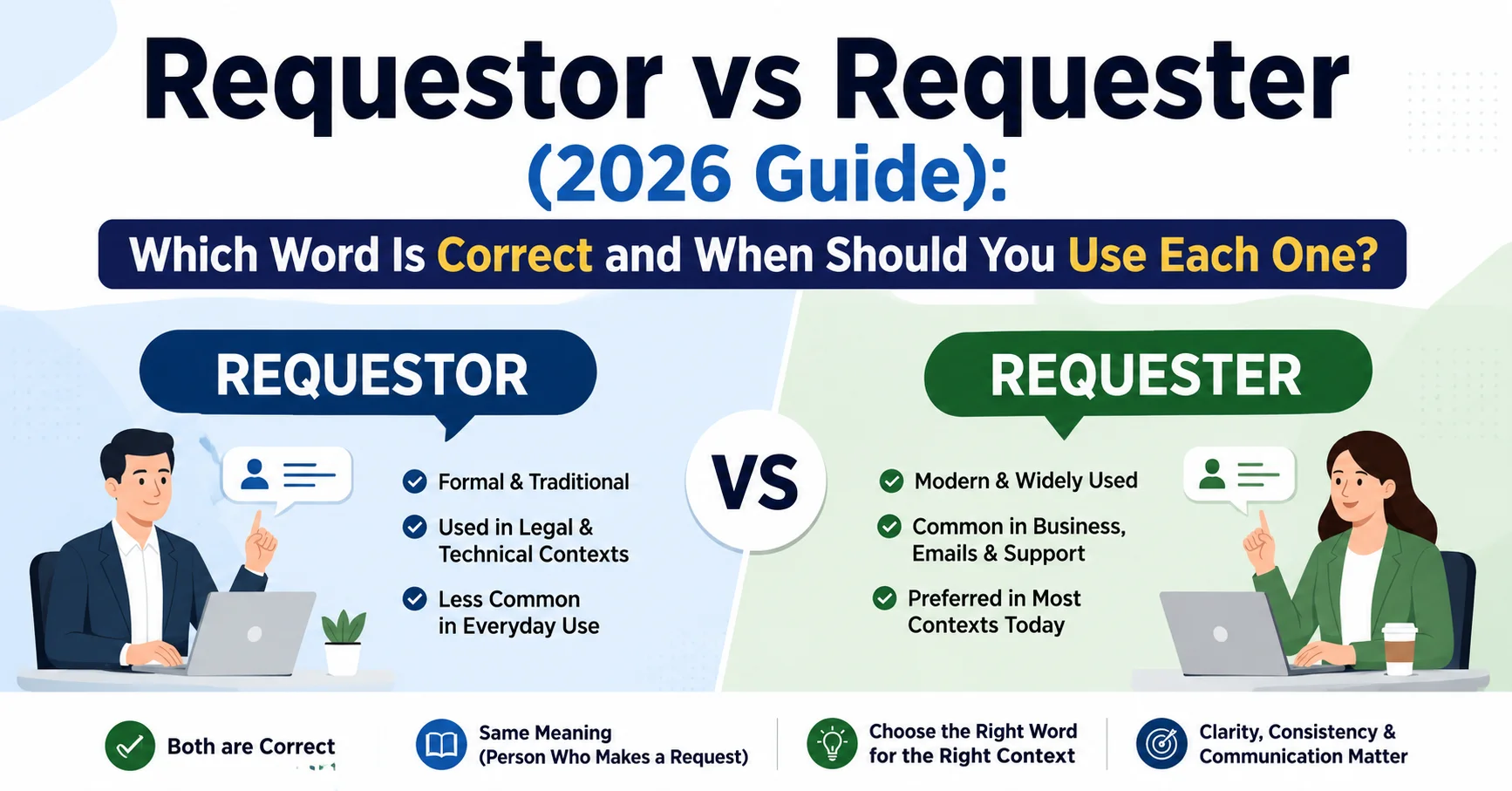
The short answer is simple. Both words are real English words. However, “requester” is far more common in modern English. Most grammar experts, style guides, and businesses prefer it today. Still, “requestor” continues to appear in technical, legal, and formal settings.
This guide explains everything in easy language. You will learn the meaning of each word, their differences, grammar rules, examples, business usage, and when you should choose one over the other. By the end, you will feel confident using the right term in emails, reports, websites, and professional writing.
What Does “Requestor” Mean?
The word “requestor” refers to a person who makes a request. In simple words, it means someone asking for something.
A requestor may ask for:
- Information
- Permission
- Documents
- Technical support
- Services
- Approval
The term often appears in formal systems or official paperwork. Some companies use it in internal software or legal forms.
Simple Examples
- The requestor submitted a support ticket.
- Please contact the requestor for more details.
- The requestor asked for account access.
Even though the word is correct, it sounds more technical or formal to many readers.
What Does “Requester” Mean?
The word “requester” also means a person who makes a request. Its meaning is almost identical to “requestor.”
Today, “requester” is considered the more natural and modern choice. It appears more often in:
- Everyday English
- Business writing
- Customer service
- Online forms
- Emails
- Academic writing
Simple Examples
- The requester needs a response today.
- Please verify the requester’s identity.
- The requester sent the payment receipt.
Most native English speakers feel that “requester” sounds smoother and easier to understand.
Requestor vs Requester: The Main Difference
The biggest difference between requestor vs requester is not meaning. It is mainly about style, preference, and usage frequency.
Here is a quick comparison:
| Feature | Requestor | Requester |
|---|---|---|
| Meaning | Person making a request | Person making a request |
| Grammar | Correct | Correct |
| Commonness | Less common | More common |
| Tone | Formal or technical | Natural and modern |
| Used in business | Sometimes | Very often |
| Preferred today | Rarely | Usually |
In most situations, “requester” is the safer choice because more readers recognize it immediately.
Why Do Both Words Exist?
English has many words with different endings that still share the same meaning. The endings “-or” and “-er” often create nouns that describe a person doing an action.
For example:
| Verb | -er Form | -or Form |
|---|---|---|
| Act | Actor | — |
| Edit | Editor | — |
| Invest | Investor | — |
| Request | Requester | Requestor |
Over time, English developed multiple spelling patterns. Some became more popular than others.
In the case of requestor vs requester, both forms entered usage, but “requester” eventually became more accepted in everyday communication.
Which Word Is More Common Today?
“Requester” is clearly more common in modern English.
You will see it more often in:
- Websites
- Apps
- Help desks
- Customer support systems
- HR forms
- Online articles
- Business communication
“Requestor” still appears in specialized environments, especially older software systems and legal documents.
Real-Life Observation
If you open most modern ticket systems today, you may notice labels like:
- Requester Name
- Requester Email
- Requester Information
Large companies usually prefer “requester” because it feels simpler and more readable.
Is “Requestor” Wrong?
No. “Requestor” is not wrong.
That is important to remember.
Many people think only “requester” is correct, but dictionaries recognize both words. The problem is not correctness. The issue is usage preference.
Some readers may view “requestor” as outdated, overly technical, or less natural. Still, it remains acceptable in formal contexts.
When “Requestor” May Still Be Used
You may still see “requestor” in:
- Legal documents
- Government forms
- Technical systems
- Software platforms
- Procurement departments
- Corporate databases
If a company already uses “requestor” consistently, it is usually best to follow that style internally.
Requestor vs Requester in Business Writing
Business writing values clarity and readability. Because of this, most companies now choose “requester.”
Here is why:
- It sounds friendlier
- It feels more modern
- More people recognize it quickly
- It improves readability
Better Business Example
✅ The requester approved the invoice.
This sounds smoother than:
⚠️ The requestor approved the invoice.
The second sentence is still correct, but many readers find it more robotic.
Requestor vs Requester in Technical Systems
Technical systems sometimes keep older wording for consistency. That is why “requestor” still appears in many platforms.
Examples include:
- IT service desks
- Database systems
- Procurement software
- Workflow automation tools
In these environments, developers may keep the original terminology for years.
Example
| System Field | Common Label |
|---|---|
| Support Ticket | Requestor |
| User Access Form | Requester |
| Procurement Portal | Requestor |
| HR Request Tool | Requester |
This mix explains why people continue seeing both terms online.
Which Word Should You Use in Emails?
For professional emails, “requester” is usually the best option.
It sounds natural and modern while remaining professional.
Email Example
✅ Please contact the requester if additional details are needed.
This sentence feels clear and polished.
Using “requestor” would not be incorrect, but it may sound overly formal unless your company already uses that style.
Requestor vs Requester in Legal Documents
Legal writing often keeps traditional wording for consistency. Some legal teams continue using “requestor” because it appears in older templates and contracts.
Legal Example
- The requestor agrees to provide accurate information.
Legal departments may avoid changing terms because consistency matters in contracts and official records.
However, many newer legal documents now use “requester” instead.
Pronunciation Difference Between Requestor and Requester
The pronunciation difference is very small.
| Word | Pronunciation |
|---|---|
| Requestor | ree-KWES-tor |
| Requester | ree-KWES-ter |
In fast conversation, many people barely notice the difference.
Still, “requester” tends to sound more natural to modern English speakers.
Common Grammar Mistakes People Make
Many writers accidentally create grammar issues while choosing between these words.
Here are some common mistakes.
Mistake 1: Thinking One Is Fake
❌ “Requestor is not a real word.”
This is false. Both are real words.
Mistake 2: Switching Styles Randomly
❌ The requester filed the form. The requestor received approval later.
Using both terms in the same document can confuse readers.
Better Version
✅ The requester filed the form. The requester received approval later.
Consistency matters.
Mistake 3: Using Them as Verbs
❌ He requestered the information.
These words are nouns, not verbs.
Requestor vs Requester in American and British English
Interestingly, both American and British English prefer “requester” today.
There is no major regional rule separating them.
However:
- American companies sometimes keep “requestor” in technical systems
- British business writing usually favors “requester”
Overall, “requester” dominates globally in modern communication.
How Major Industries Use These Terms
Different industries have different habits.
| Industry | Preferred Term |
|---|---|
| Customer Service | Requester |
| IT Support | Requestor or Requester |
| Legal | Requestor |
| Education | Requester |
| Healthcare | Requester |
| Government | Mixed |
| Procurement | Requestor |
This variation explains why the debate around requestor vs requester still exists.
Why “Requester” Sounds More Natural
English speakers often prefer words ending in “-er” for people performing actions.
Examples include:
- Teacher
- Builder
- Reader
- Writer
- Requester
Because of this pattern, “requester” feels more familiar.
The human brain recognizes it faster, making reading easier.
That small advantage matters in business communication and SEO writing.
SEO and Content Writing Preference
If you write blog posts, website content, or SEO articles, “requester” is usually the stronger choice.
Why?
Because users search for it more often and understand it immediately.
SEO Benefits of “Requester”
- Better readability
- More modern tone
- Easier user understanding
- Higher natural language flow
However, if your target keyword is requestor vs requester, you should naturally include both terms.
Examples of Correct Usage
Here are real-world examples to help you understand the difference better.
| Sentence | Better Choice |
|---|---|
| The ___ submitted the ticket. | Requester |
| The ___ must sign the contract. | Requestor or Requester |
| Contact the ___ for details. | Requester |
| Procurement notified the ___. | Requestor |
| The ___ asked for technical help. | Requester |
Both words work in many cases, but “requester” often sounds smoother.
Requestor vs Requester in Customer Support
Customer support teams almost always prefer “requester” now.
Why?
Support communication should feel human and friendly.
Example From Help Desk Communication
✅ The requester will receive an update within 24 hours.
This wording feels easier and warmer for customers.
Using “requestor” could make the message sound too technical.
Should Students Use Requestor or Requester?
Students should usually use “requester.”
Teachers and professors often expect simple, modern English. Since “requester” is more common, it is safer in essays, assignments, and presentations.
Academic Example
✅ The requester asked for access to research materials.
This sounds clean and professional.
Which Word Do Dictionaries Prefer?
Most dictionaries recognize both forms, but many list “requester” first because it is more common.
That tells us something important.
Language changes over time. Words people use more frequently become the preferred standard.
Today, “requester” is winning that popularity battle.
Easy Trick to Remember the Difference
Here is a simple memory trick.
Use “Requester” for Most Situations
If you are unsure, choose “requester.”
It works well in:
- Emails
- Blogs
- School writing
- Customer support
- Websites
- General communication
Use “Requestor” Only When Needed
Choose “requestor” mainly if:
- Your company already uses it
- A legal template includes it
- Your software system requires it
That simple rule works almost every time.
Formal vs Informal Tone Comparison
| Tone Type | Better Word |
|---|---|
| Casual communication | Requester |
| Professional email | Requester |
| Technical document | Requestor |
| Legal paperwork | Requestor |
| Blog writing | Requester |
| Customer support | Requester |
Tone plays a big role in choosing between these words.
Why This Small Difference Matters
At first, the debate over requestor vs requester may seem tiny. But word choice affects how readers feel.
The right wording can make communication:
- Clearer
- Friendlier
- More professional
- Easier to understand
Businesses today focus heavily on user experience. Even small language choices influence readability and trust.
That is one reason “requester” continues growing in popularity.
Real-Life Workplace Example
A few years ago, I worked with a support platform that used “requestor” in every ticket.
New employees constantly asked:
“Is that spelled correctly?”
Eventually, the company changed all labels to “requester.” After the update, confusion dropped immediately.
That experience showed how small wording choices affect usability.
How Writers Can Stay Consistent
Consistency matters more than perfection.
If you choose “requester,” use it throughout the entire document.
If your company officially uses “requestor,” stay consistent there too.
Consistency Example
✅ Correct:
- The requester submitted the request.
- The requester received approval later.
❌ Inconsistent:
- The requester submitted the request.
- The requestor received approval later.
Readers notice inconsistent terminology quickly.
Quick Comparison Table
| Topic | Requestor | Requester |
|---|---|---|
| Correct spelling | Yes | Yes |
| Common today | Less | More |
| Natural sounding | Moderate | High |
| Technical usage | Common | Common |
| Legal usage | Common | Moderate |
| Business email | Less common | Preferred |
| SEO writing | Less ideal | Better |
| Customer support | Rare | Very common |
Best Alternative Words You Can Use
Sometimes, neither word feels perfect. In those cases, you can use simpler alternatives.
| Alternative | Example |
|---|---|
| Applicant | The applicant submitted documents. |
| Customer | The customer requested support. |
| User | The user asked for access. |
| Client | The client requested changes. |
| Employee | The employee requested leave. |
Using specific nouns often improves clarity even more.
FAQs About Requestor vs Requester
Is requester more correct than requestor?
No. Both are correct words. However, “requester” is more commonly used in modern English.
Why do some software systems use requestor?
Older technical systems and corporate databases often keep traditional wording for consistency.
Should I use requestor in professional emails?
Usually, “requester” is the better option for emails because it sounds more natural.
Is requestor outdated?
Not completely. It still appears in legal and technical environments, but it is less common today.
Can I use both words in the same document?
It is better not to. Choose one style and stay consistent throughout the document.
Final Thoughts on Requestor vs Requester
The debate around requestor vs requester is really about modern usage versus traditional style. Both words are grammatically correct. Both describe a person making a request.
Still, language changes over time.
Today, “requester” is clearly the preferred choice in most situations. It sounds smoother, feels more modern, and improves readability for everyday readers.
Meanwhile, “requestor” continues surviving in technical systems, legal documents, and older business environments.
If you are unsure which word to choose, remember this simple rule:
- Use “requester” for general communication
- Use “requestor” only when a system, company, or legal format requires it
That approach will keep your writing clear, professional, and easy to understand in 2026 and beyond.
