

Introduction
Words help us share ideas, explain feelings, and connect with others. One common word people use every day is “discuss.” We discuss plans with friends, discuss homework in class, and discuss ideas at work. But sometimes, you may need the opposite meaning instead. That is where learning the antonyms of discuss becomes useful.
Many students, writers, bloggers, and English learners search for antonyms because they want better vocabulary. Using opposite words correctly can make your speaking and writing stronger. It also helps you avoid repeating the same words again and again.
I remember helping a younger cousin with school homework. She kept using the word “discuss” in every answer. Once she learned opposite words like “ignore,” “hide,” and “suppress,” her writing instantly sounded smarter and more natural. Small vocabulary changes can make a big difference.
In this guide, you will learn the best antonyms of discuss, their meanings, examples, common uses, and easy tips to remember them. You will also see tables, real-life examples, and simple explanations written in easy English.
What Does “Discuss” Mean?
Before learning the antonyms of discuss, it helps to understand the main word first.
The word “discuss” means to talk about something with another person or group. It usually involves sharing opinions, ideas, or information.
Simple Examples
- Teachers discuss lessons with students.
- Friends discuss weekend plans.
- Doctors discuss health reports.
- Teams discuss project goals.
When people discuss something, they openly talk about it. So, the opposite words often mean:
- staying silent
- hiding information
- avoiding a topic
- refusing to speak
That is why there are many possible antonyms of discuss, depending on the situation.
Why Learning Antonyms Matters
Learning opposite words improves communication skills. It also makes your vocabulary richer and more flexible.
Here are a few reasons why learning the antonyms of discuss is important:
| Benefit | Explanation |
|---|---|
| Better Writing | Makes essays and blogs sound smarter |
| Strong Vocabulary | Helps you express ideas clearly |
| Easier Communication | Lets you explain opposite meanings |
| Improved Speaking | Helps in debates and conversations |
| Exam Preparation | Useful for school and English tests |
Students often memorize definitions only. But understanding opposites helps you truly understand a word.
Main Antonyms of Discuss
There is no single opposite word for “discuss.” Different situations use different antonyms.
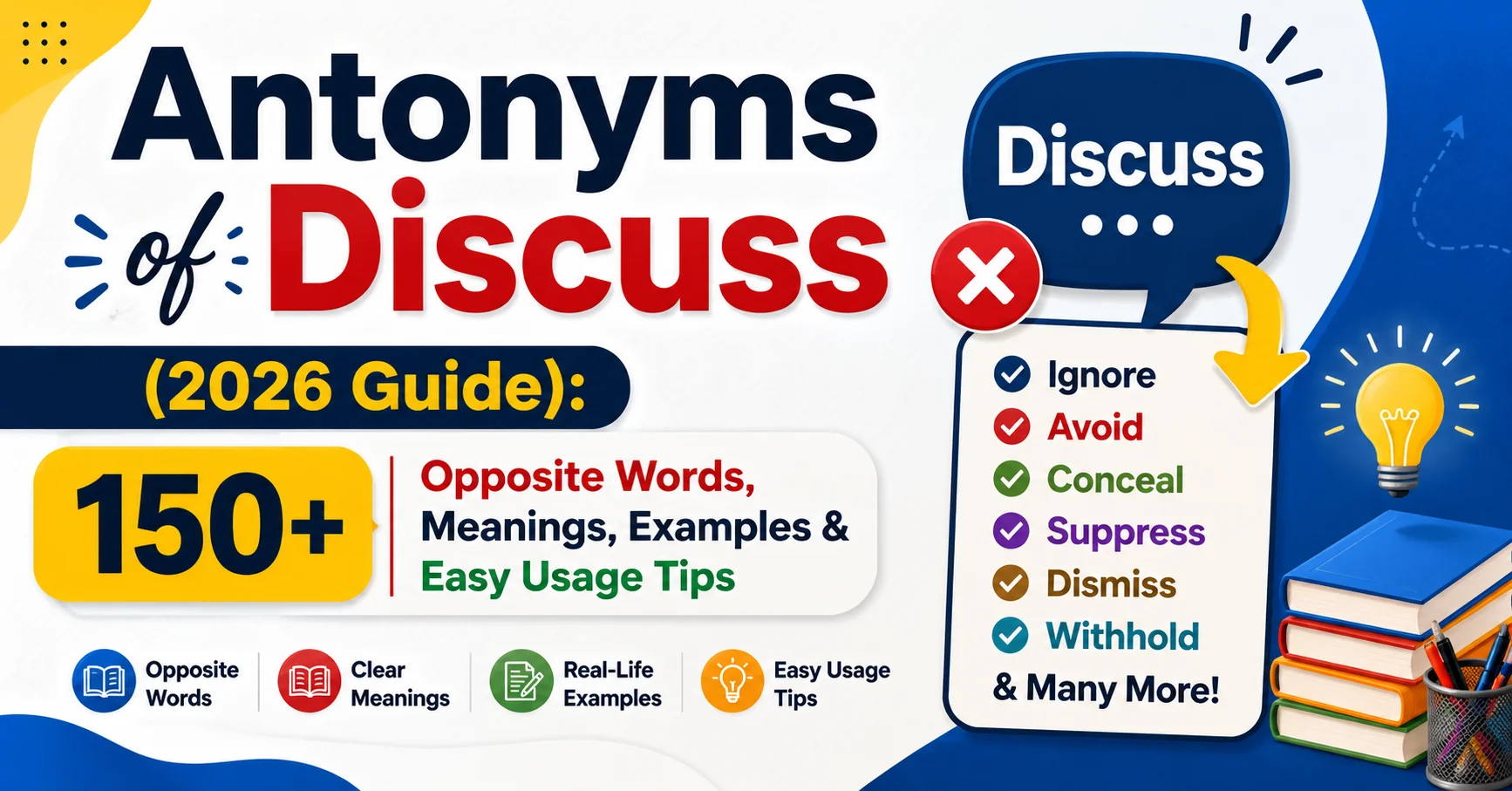
Here are the most common antonyms of discuss.
| Antonym | Meaning |
|---|---|
| Ignore | Pay no attention |
| Suppress | Hold back information |
| Conceal | Hide something |
| Avoid | Stay away from a topic |
| Withhold | Keep information secret |
| Silence | Stop discussion |
| Neglect | Fail to give attention |
| Dismiss | Reject without discussion |
| Overlook | Ignore intentionally |
| Hide | Keep unseen or secret |
Each word has a slightly different meaning. Let’s explore them one by one.
Ignore – A Common Opposite of Discuss
One popular choice among the antonyms of discuss is “ignore.”
When you ignore something, you choose not to talk about it or pay attention to it.
Examples
- The manager ignored the complaint.
- She ignored the rumors online.
- They ignored the warning signs.
This word works well when someone completely avoids conversation about a topic.
Real-Life Example
Imagine friends arguing in a group chat. One person stops replying and pretends nothing happened. That person is ignoring the discussion.
Avoid – Refusing to Talk About Something
Another strong opposite is “avoid.”
To avoid means to stay away from something completely.
Examples
- He avoided discussing politics.
- They avoided the difficult question.
- She avoids family arguments.
Many people avoid uncomfortable conversations. This makes “avoid” one of the most practical antonyms of discuss in daily life.
Common Situations
| Situation | Example |
|---|---|
| School | Avoid answering questions |
| Workplace | Avoid discussing mistakes |
| Relationships | Avoid serious talks |
| Social Media | Avoid online drama |
Conceal – Hiding Information
“Conceal” means to hide information, facts, or feelings.
Unlike discussing openly, concealing keeps things secret.
Examples
- The company concealed important details.
- He concealed his true feelings.
- They concealed the surprise party plan.
This word feels more formal and is often used in professional writing.
Quick Tip
If discussing means “sharing,” concealing means “hiding.”
That makes it one of the strongest antonyms of discuss.
Suppress – Stopping Communication
“Suppress” means stopping information, emotions, or ideas from being shared.
Examples
- The government suppressed the news.
- He suppressed his anger.
- They suppressed public discussion.
This word often appears in politics, news, and serious conversations.
Difference Between Suppress and Ignore
| Word | Meaning |
|---|---|
| Ignore | Pay no attention |
| Suppress | Actively stop information |
Both are useful antonyms of discuss, but suppress is stronger.
Silence – Ending a Conversation
“Silence” is another useful opposite.
To silence someone means stopping them from speaking or sharing opinions.
Examples
- The teacher silenced the noisy class.
- Fear silenced many people.
- The rules silenced criticism.
In online culture, people sometimes say someone was “silenced” when they were blocked or prevented from speaking.
Dismiss – Rejecting a Topic Quickly
“Dismiss” means rejecting an idea without giving it proper discussion.
Examples
- She dismissed the complaint immediately.
- They dismissed the suggestion.
- The coach dismissed the rumors.
This is one of the smartest antonyms of discuss for formal writing.
Real-Life Observation
People often dismiss ideas too quickly online without understanding them first. Social media debates show this every day.
Hide and Withhold – Keeping Things Secret
Both words relate to secrecy.
Hide
Hide means keeping something unseen.
Withhold
Withhold means refusing to share information intentionally.
Examples
| Word | Example |
|---|---|
| Hide | He hid the documents |
| Withhold | They withheld important facts |
These are important antonyms of discuss because discussing usually involves openness.
Antonyms of Discuss in Different Situations
Different settings require different opposite words.
| Situation | Best Opposite |
|---|---|
| Classroom | Ignore |
| Legal Writing | Conceal |
| Politics | Suppress |
| Casual Talk | Avoid |
| Workplace | Dismiss |
| Relationships | Withhold |
Understanding context helps you choose the correct word naturally.
Everyday Sentences Using Antonyms of Discuss
Learning examples is one of the easiest ways to remember vocabulary.
Examples
- He ignored the topic during dinner.
- She concealed the truth from friends.
- They avoided discussing money.
- The company withheld details.
- The teacher silenced the argument.
- He dismissed my opinion quickly.
Using these naturally improves English fluency.
Formal vs Casual Antonyms
Some opposite words sound formal. Others feel casual.
| Formal Words | Casual Words |
|---|---|
| Conceal | Ignore |
| Suppress | Avoid |
| Withhold | Skip |
| Dismiss | Brush off |
Choosing the right tone matters in writing.
For example, “suppress” sounds serious, while “skip” sounds friendly and informal.
Synonyms and Antonyms Together
Learning both synonyms and antonyms improves memory.
| Word | Synonyms | Antonyms |
|—|—|
| Discuss | Talk, Debate, Explain | Ignore, Avoid |
| Share | Reveal, Tell | Conceal, Hide |
| Communicate | Speak, Express | Silence, Suppress |
This method helps students remember vocabulary faster.
Common Mistakes People Make
Many English learners misuse opposite words.
Mistake 1: Using Any Opposite Word Anywhere
Not every antonym fits every sentence.
Wrong:
- He concealed the football game.
Better:
- He ignored the football game.
Mistake 2: Confusing “Avoid” and “Suppress”
Avoid means staying away. Suppress means actively stopping.
Mistake 3: Overusing One Word
Many people use only “ignore.” Learning multiple antonyms of discuss improves writing variety.
Antonyms of Discuss in School Writing
Students often need opposite words in essays and assignments.
Teachers usually expect vocabulary variety.
Useful Academic Alternatives
| Word | Best Use |
|---|---|
| Dismiss | Essays |
| Suppress | History |
| Conceal | Reports |
| Avoid | Personal writing |
Using advanced vocabulary can improve grades and clarity.
How Social Media Changed Word Usage
Social media changed how people communicate. Because of that, many antonyms of discuss became more common online.
Modern Examples
- “He ignored my message.”
- “They silenced critics.”
- “The company concealed updates.”
Platforms like TikTok, Instagram, and X made these expressions popular in digital culture.
People now talk about “canceling,” “muting,” and “blocking” as forms of avoiding discussion.
Easy Memory Tricks
Vocabulary becomes easier when connected to simple memory tricks.
Tricks
| Word | Memory Idea |
|---|---|
| Ignore | Pretend it does not exist |
| Avoid | Walk away from it |
| Conceal | Hide it behind a wall |
| Suppress | Push it down |
| Silence | Stop all talking |
These visual ideas help children and beginners remember meanings quickly.
Best Antonyms of Discuss for Writing
If you write blogs, essays, or articles, these words work best.
| Purpose | Recommended Word |
|---|---|
| Serious tone | Suppress |
| Friendly tone | Avoid |
| Academic writing | Conceal |
| Simple writing | Ignore |
| Debate topics | Dismiss |
Writers should avoid repeating the same word too often.
How Teachers Explain Antonyms
Teachers often explain antonyms through opposites.
Example
- Discuss = openly talk
- Opposite = keep silent
This simple method works especially well for younger learners.
A teacher once explained vocabulary using cartoons in class. Students remembered words faster because the examples felt real and funny. Practical learning always works better than memorizing lists alone.
Can One Word Be the Perfect Opposite?
Not always.
Language depends on context. That means different situations need different opposite words.
For example:
- Ignore works in casual speech.
- Suppress works in political topics.
- Conceal works in secret situations.
That is why there are many valid antonyms of discuss instead of only one.
Frequently Asked Questions
What is the best antonym of discuss?
The best antonym depends on context. Common choices include “ignore,” “avoid,” “conceal,” and “suppress.”
Is “ignore” an antonym of discuss?
Yes. Ignore means not paying attention or refusing to talk about something.
What is a formal opposite of discuss?
Formal opposites include “suppress,” “dismiss,” and “conceal.”
What is the easiest antonym for kids?
“Ignore” is usually the easiest word for children to understand.
Why are there many antonyms of discuss?
Because discussion can involve sharing, speaking, explaining, or debating. Different opposites match different situations.
Conclusion
Learning the antonyms of discuss can improve both speaking and writing skills. These opposite words help people communicate more clearly and naturally in daily life.
Words like “ignore,” “avoid,” “conceal,” “suppress,” and “dismiss” all carry slightly different meanings. Understanding those differences helps you choose the perfect word for every situation.
The best way to remember vocabulary is through real examples and daily practice. Try using one new antonym each day in conversation or writing. Over time, your English will feel smoother, smarter, and more confident.
Whether you are a student, blogger, teacher, or English learner, strong vocabulary always creates better communication.
