

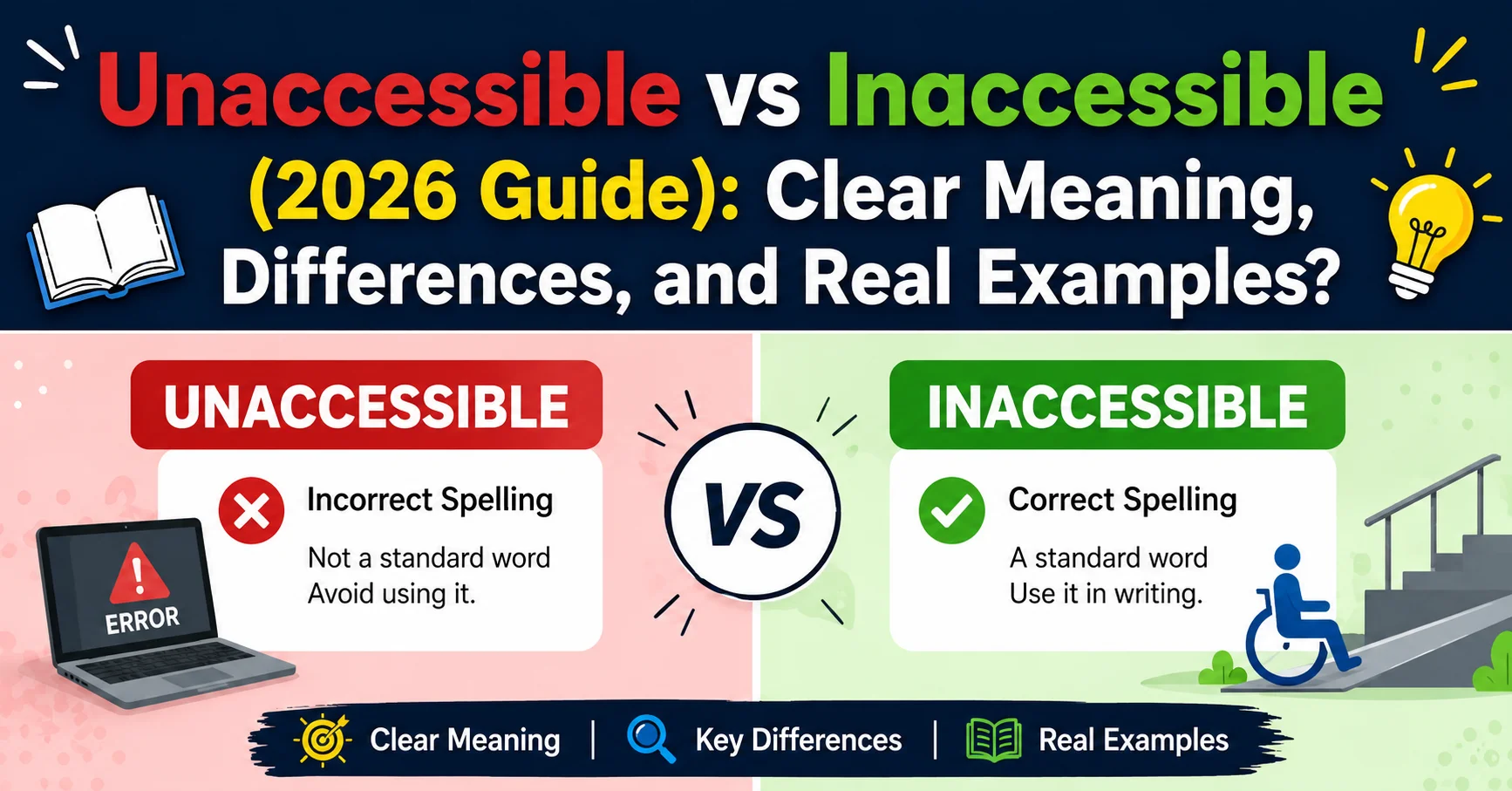
When learning English, small word differences can feel confusing. One common mix-up is Unaccessible vs Inaccessible. At first glance, both words look similar. They even seem to mean the same thing. But here’s the truth: only one is correct in standard English.
In this simple and helpful guide, you’ll learn the real difference between Unaccessible vs Inaccessible, when to use the correct word, and why the other one causes confusion. We’ll use easy examples, clear rules, and real-life situations so anyone can understand—even a beginner.
By the end, you’ll never feel unsure about this again.
What Does “Inaccessible” Mean?
Let’s start with the correct word.
Inaccessible means something that cannot be reached, entered, or used easily. It can also describe something hard to understand.
For example:
- The mountain village is inaccessible during winter.
- The website became inaccessible due to a server error.
- His ideas felt inaccessible to beginners.
In each case, something is hard to reach or understand.
The word comes from Latin roots:
- “in” = not
- “accessible” = able to be reached
So, it literally means “not able to be accessed.”
This word is widely accepted and used in formal writing, schools, and professional settings. If you want to be correct, inaccessible is the safe and proper choice.
What Does “Unaccessible” Mean?
Now let’s look at the confusing one.
Unaccessible is often used by mistake. Some people think it’s correct because many English words start with “un.” For example:
- unhappy
- unfair
- unclear
So naturally, people assume “unaccessible” should also work.
But here’s the key point:
👉 “Unaccessible” is not standard English.
Most dictionaries do not recognize it as correct. Some may list it as rare or outdated, but it is not recommended for use today.
That means if you use it in writing—especially academic or professional writing—it may be marked wrong.
Unaccessible vs Inaccessible: The Key Difference
Here is the simplest way to understand Unaccessible vs Inaccessible:
| Word | Is it correct? | Usage Level | Recommendation |
|---|---|---|---|
| Inaccessible | Yes | Standard English | Always use this |
| Unaccessible | No (rare) | Non-standard | Avoid using it |
So, even though both look similar, only one is correct in modern English.
Why Do People Confuse These Words?
The confusion around Unaccessible vs Inaccessible happens for a few simple reasons.
First, English has many prefixes. “Un-” is very common. People use it to make negative words. So they assume it works everywhere.
Second, “in-” changes form depending on the word. For example:
- invisible
- incorrect
- impossible
This makes things feel inconsistent.
Third, many learners rely on sound. Both words sound similar when spoken quickly. So the mistake goes unnoticed.
This is normal. Even native speakers sometimes make this error.
When Should You Use “Inaccessible”?
You should use inaccessible whenever you want to describe something that cannot be reached or understood.
Here are some common situations:
Physical Access
- The road is inaccessible after the flood.
- The building is inaccessible without a key card.
Digital Access
- The file is inaccessible due to permissions.
- The app became inaccessible during maintenance.
Understanding or Communication
- The topic feels inaccessible to new learners.
- His explanation was too complex and inaccessible.
As you can see, the word works in many everyday situations.
Why “Unaccessible” Should Be Avoided
Using “unaccessible” can cause problems. Let’s break it down.
| Issue | Explanation |
|---|---|
| Not widely accepted | Most grammar experts reject it |
| Can lower credibility | Makes writing look less professional |
| Confuses readers | People may question your accuracy |
If your goal is clear and strong communication, it’s best to avoid it completely.
Real-Life Examples of Correct Usage
Let’s look at real examples using inaccessible in daily life.
| Situation | Example Sentence |
|---|---|
| Travel | The island is inaccessible during storms. |
| Technology | The server is inaccessible right now. |
| Education | Some textbooks feel inaccessible to beginners. |
| Health | The clinic is inaccessible without transport. |
These examples show how useful and flexible the word is.
Common Mistakes to Avoid
When dealing with Unaccessible vs Inaccessible, here are some mistakes people often make:
Mistake 1: Using “Unaccessible” in Writing
Wrong: The website is unaccessible.
Correct: The website is inaccessible.
Mistake 2: Mixing Both Words
Wrong: This place is both unaccessible and inaccessible.
Correct: This place is inaccessible.
Mistake 3: Thinking Both Are Equal
They are not equal. Only one is correct.
Avoiding these mistakes will improve your English quickly.
Easy Trick to Remember the Difference
Here’s a simple trick:
👉 If you’re unsure, always choose inaccessible.
You don’t need to overthink it. Just remember:
- “Inaccessible” = correct
- “Unaccessible” = avoid
Think of it like a rule. This makes things easier and faster.
Similar Words You Should Know
To better understand Unaccessible vs Inaccessible, it helps to learn related words.
| Word | Meaning |
|---|---|
| Accessible | Easy to reach or use |
| Inaccessible | Not easy to reach or use |
| Available | Ready for use |
| Unavailable | Not ready for use |
Notice something interesting?
We say:
- unavailable (correct)
But we don’t say: - unaccessible (incorrect)
English can be tricky like that!
Is “Unaccessible” Ever Correct?
In rare cases, “unaccessible” may appear in very old texts or informal speech. But in modern English, it is not recommended.
Language changes over time. Some words disappear. Others become standard.
Right now, in 2026, grammar experts agree:
👉 Stick with “inaccessible.”
Personal Tip: How I Remember It
Here’s a simple way I personally remember this.
Whenever I see a word ending in “-accessible,” I pause and ask:
“Does this word usually take ‘in’ instead of ‘un’?”
Most of the time, the answer is yes.
So I go with inaccessible without thinking twice.
This habit has helped me avoid mistakes in writing and speaking.
Why This Matters in Writing
You might wonder, “Why does this small difference matter?”
It matters because:
- Clear language builds trust
- Correct grammar shows professionalism
- Good writing improves communication
If you’re writing blogs, emails, or school work, using the correct word makes a big difference.
Even small mistakes can affect how people see your work.
Quick Comparison Table
Here’s a final quick look at Unaccessible vs Inaccessible:
| Feature | Inaccessible | Unaccessible |
|---|---|---|
| Correct usage | Yes | No |
| Common in writing | Yes | No |
| Accepted by experts | Yes | No |
| Safe to use | Always | Never (avoid) |
Keep this table in mind for quick reference.
FAQs About Unaccessible vs Inaccessible
1. Is “unaccessible” a real word?
It may appear in rare cases, but it is not accepted in standard English today.
2. Which is correct: unaccessible or inaccessible?
“Inaccessible” is correct. Always use this in writing and speech.
3. Why do people say “unaccessible”?
Because “un-” is a common prefix, people assume it works with every word.
4. Can I use “unaccessible” in informal writing?
It’s still better to avoid it. It can confuse readers and look incorrect.
5. What is the opposite of inaccessible?
The opposite is “accessible,” meaning easy to reach or use.
Conclusion: Keep It Simple and Correct
Understanding Unaccessible vs Inaccessible is easier than it seems. Even though both words look similar, only one is correct in modern English.
👉 Always use inaccessible.
👉 Avoid unaccessible completely.
This small change can improve your writing, boost your confidence, and help you communicate clearly.
If you found this guide helpful, try using “inaccessible” in your next sentence. Practice makes perfect—and soon, it will feel natural.
Want more simple English guides like this? Keep learning, keep practicing, and you’ll master these tricky words in no time.
