


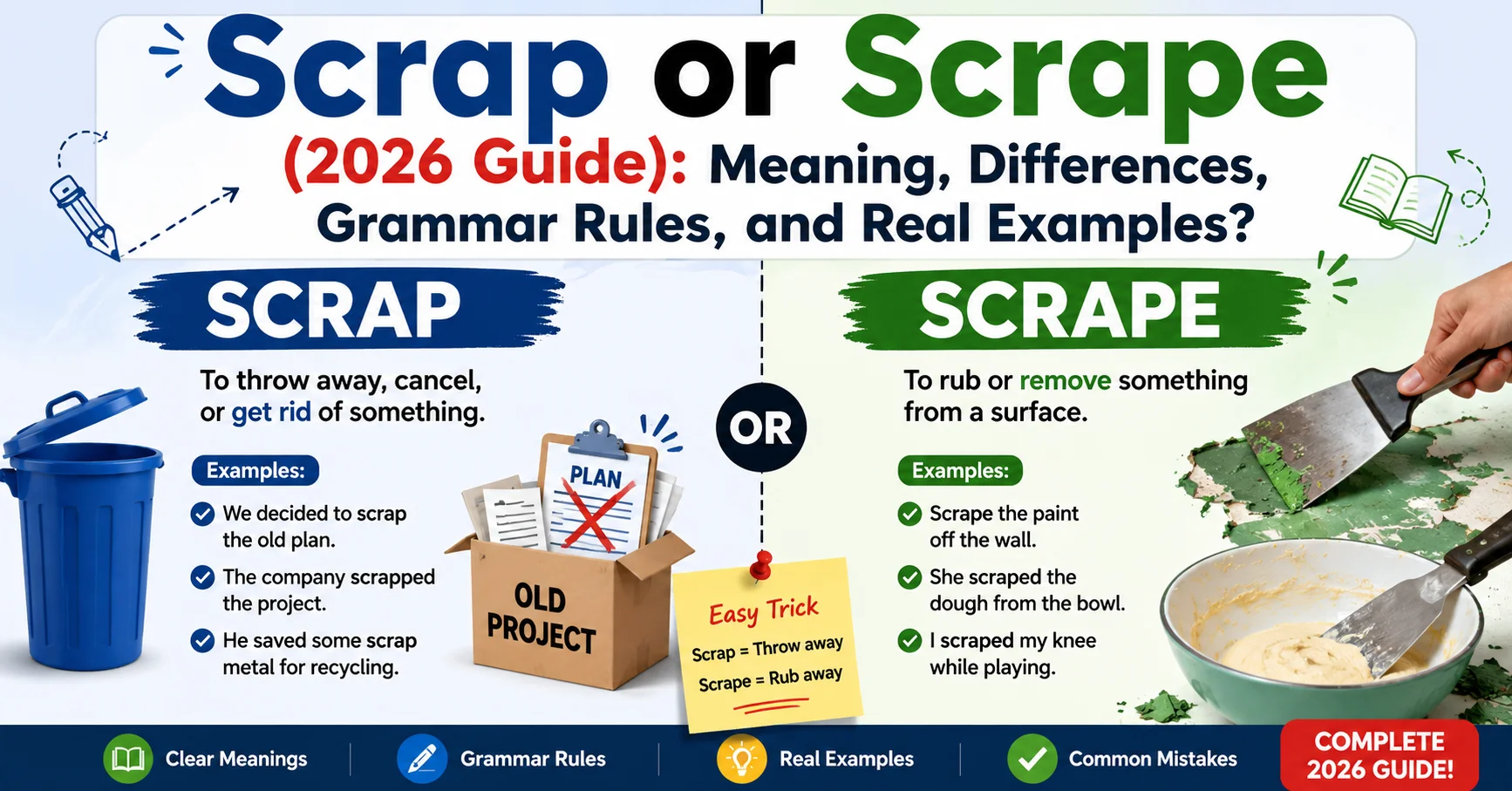
Many English words look almost the same but carry different meanings. One common example is “Scrap or Scrape.” These two words confuse many writers, students, and even native speakers because they sound similar and are sometimes used in related situations.
Still, their meanings are very different.
If you have ever wondered whether you should write “scrap the plan” or “scrape the plan,” this guide will help. You will learn the meanings, grammar rules, examples, memory tricks, and real-life uses of both words in simple English.
By the end of this guide, you will never confuse Scrap or Scrape again.
Why People Confuse Scrap or Scrape
The confusion usually happens because both words:
- Start with the same letters
- Sound similar when spoken quickly
- Can describe removing something
- Are often used in daily conversations
But the actions behind these words are not the same.
One means to throw away or cancel something. The other means to rub or remove something from a surface.
That small difference changes the whole sentence.
Quick Difference Between Scrap and Scrape
| Word | Main Meaning | Common Use |
|---|---|---|
| Scrap | To throw away, cancel, or discard | Scrap a project |
| Scrape | To rub or remove from a surface | Scrape paint off |
| Scrap | Can also mean leftover pieces | Scrap metal |
| Scrape | Can also mean barely succeed | Scrape through an exam |
This table gives a quick overview, but there is much more to learn.
What Does Scrap Mean?
The word scrap usually means to get rid of something because it is no longer useful.
People use it when talking about:
- Canceling plans
- Throwing away old items
- Removing useless things
- Small leftover pieces
Simple Examples
- We decided to scrap the old design.
- Dad sold scrap metal.
- The company scrapped the project.
- I used scrap paper for notes.
In many cases, “scrap” relates to something unwanted or no longer needed.
Scrap as a Noun
As a noun, scrap often means a small leftover piece.
Examples
| Sentence | Meaning |
|---|---|
| She kept fabric scraps. | Small leftover cloth pieces |
| Scrap metal was everywhere. | Leftover metal parts |
| He wrote on a scrap of paper. | A small paper piece |
You may hear this word in recycling, art projects, or construction work.
Scrap as a Verb
As a verb, scrap means to throw away, stop, or cancel something.
Examples
- The team scrapped the idea.
- We had to scrap the broken machine.
- The school scrapped the old rule.
This meaning is very common in business and planning.
What Does Scrape Mean?
The word scrape means to rub against a surface or remove something by rubbing.
It often involves friction or contact.
Simple Examples
- Scrape the mud off your shoes.
- I scraped my knee.
- She scraped paint from the wall.
- He scraped ice off the car window.
Unlike “scrap,” this word usually describes physical movement.
Scrape as a Verb
Most of the time, scrape is used as a verb.
Common Actions
| Action | Example |
|---|---|
| Removing something | Scrape food off a plate |
| Rubbing a surface | Scrape the floor |
| Slight injury | I scraped my arm |
| Barely succeeding | He scraped through the test |
The word can describe both physical and non-physical situations.
Scrape as a Noun
As a noun, “scrape” can mean:
- A mark made by rubbing
- A difficult situation
Examples
- The car has a scrape on the door.
- He got into a scrape at school.
This noun form is less common but still important.
Scrap or Scrape: The Core Difference
The easiest way to understand Scrap or Scrape is this:
| Word | Think About |
|---|---|
| Scrap | Throwing away |
| Scrape | Rubbing or removing |
If you are removing an idea, project, or object forever, use scrap.
If you are rubbing, scratching, or cleaning a surface, use scrape.
Real-Life Examples of Scrap or Scrape
Learning from real situations makes grammar easier.
Example 1: Business
- Correct: The company scrapped the marketing plan.
- Wrong: The company scraped the marketing plan.
Why? Because the plan was canceled, not rubbed.
Example 2: Cleaning
- Correct: Please scrape the burnt food off the pan.
- Wrong: Please scrap the burnt food off the pan.
Why? Because food is being removed by rubbing.
Example 3: Injury
- Correct: I scraped my elbow on the wall.
- Wrong: I scrapped my elbow on the wall.
A scrape is a light injury caused by friction.
Example 4: Recycling
- Correct: He sells scrap metal.
- Wrong: He sells scrape metal.
“Scrap metal” means leftover metal pieces.
Common Phrases With Scrap
English speakers use “scrap” in many expressions.
Popular Scrap Phrases
| Phrase | Meaning |
|---|---|
| Scrap the idea | Cancel the idea |
| Scrap paper | Leftover paper |
| Scrap metal | Leftover metal |
| Scrap the plan | Stop the plan |
| In the scrap heap | Thrown away or useless |
These phrases appear often in news articles and daily speech.
Common Phrases With Scrape
Now let’s look at common “scrape” expressions.
Popular Scrape Phrases
| Phrase | Meaning |
|---|---|
| Scrape off | Remove by rubbing |
| Scrape by | Barely survive or succeed |
| Scrape through | Pass with difficulty |
| Scrape together | Collect with effort |
| Scrape clean | Remove all residue |
These phrases are very common in spoken English.
Scrap or Scrape in Grammar
Grammar becomes easier when you see how words change.
Forms of Scrap
| Form | Example |
|---|---|
| Scrap | I scrap old notes |
| Scraps | She scraps unused files |
| Scrapped | They scrapped the event |
| Scrapping | We are scrapping the plan |
Forms of Scrape
| Form | Example |
|---|---|
| Scrape | Scrape the wall |
| Scrapes | He scrapes ice daily |
| Scraped | I scraped my hand |
| Scraping | She is scraping paint |
Knowing these forms helps you write correctly in all tenses.
Memory Trick for Scrap or Scrape
Here is a simple trick many learners use.
Remember This:
Scrap = Stop
Both words begin with “S.”
If something is canceled or thrown away, choose scrap.
Scrape = Surface
Both words contain the sound of rubbing.
If something touches or rubs a surface, choose scrape.
This quick trick works surprisingly well.
Scrap or Scrape in Everyday Conversation
These words appear often in normal life.
At Home
You may hear:
- Scrape the dishes clean.
- Use the scrap fabric.
At Work
People say:
- The company scrapped the proposal.
- We scraped together enough money.
At School
Students may say:
- I scraped through the exam.
- I used scrap paper for math practice.
Real-life exposure helps you remember meanings naturally.
Common Mistakes People Make
Many English learners mix these words because they focus only on pronunciation.
Here are some frequent mistakes.
| Incorrect Sentence | Correct Sentence |
|---|---|
| We scraped the project. | We scrapped the project. |
| Scrap the mud off. | Scrape the mud off. |
| I have scrape paper. | I have scrap paper. |
| He scrapped his knee. | He scraped his knee. |
Small spelling changes can completely change the meaning.
Scrap or Scrape in American and British English
Good news: both American and British English use these words the same way.
The meanings stay consistent across regions.
Still, pronunciation may sound slightly different depending on accent.
That means once you learn the meanings, you can use them confidently almost anywhere.
How Writers Use Scrap or Scrape
Professional writers use these words carefully because they create very different images.
“Scrap” Creates Ideas Like:
- Ending
- Rejecting
- Discarding
- Recycling
“Scrape” Creates Ideas Like:
- Friction
- Cleaning
- Injury
- Effort
Good writers choose the word that matches the action clearly.
Scrap or Scrape in Technology
Modern technology has added new meanings too.
Web Scraping
In technology, scraping means collecting data from websites automatically.
Example:
- The software scraped information from web pages.
This meaning comes from the idea of “pulling off” information.
Scrap in Manufacturing
Factories often use “scrap” for leftover material.
Example:
- The machine produces scrap metal.
This leftover material may be recycled later.
Easy Sentences to Practice
Practice helps you remember faster.
Try reading these aloud.
Scrap Sentences
- We scrapped the old truck.
- She kept scrap fabric.
- The company scrapped the project.
- He used a scrap of paper.
Scrape Sentences
- Scrape the ice off the window.
- I scraped my arm yesterday.
- She scraped the bowl clean.
- We scraped together enough cash.
Repeating examples builds confidence naturally.
Which Word Should You Use?
Ask yourself one simple question:
Is something being thrown away or canceled?
If yes, use scrap.
OR
Is something being rubbed, cleaned, or removed from a surface?
If yes, use scrape.
That one question solves most mistakes instantly.
Mini Comparison Chart
| Situation | Correct Word |
|---|---|
| Canceling a project | Scrap |
| Cleaning a pan | Scrape |
| Leftover material | Scrap |
| Rubbing paint off | Scrape |
| Barely passing a test | Scrape |
| Throwing away an idea | Scrap |
This chart is useful for quick review.
Why Learning Small Word Differences Matters
Tiny word differences improve your writing quality.
Using the wrong word can:
- Change your meaning
- Confuse readers
- Hurt professionalism
- Make sentences sound unnatural
When you master confusing pairs like Scrap or Scrape, your English becomes clearer and more polished.
That matters in school, work, blogging, and daily communication.
Expert Writing Tip
One thing experienced writers do well is visualize actions.
Before choosing between Scrap or Scrape, picture the scene.
If you see:
- A canceled idea
- A discarded object
- Leftover material
Choose scrap.
If you see:
- Rubbing
- Cleaning
- Surface contact
- Friction
Choose scrape.
Visualization makes grammar easier than memorization alone.
Scrap or Scrape: Quick Summary
Here is the simplest explanation possible:
| Word | Easy Meaning |
|---|---|
| Scrap | Throw away or cancel |
| Scrape | Rub or remove from a surface |
That is the core difference.
Once you remember this, most confusion disappears.
FAQs About Scrap or Scrape
Is it scrap or scrape paper?
The correct phrase is scrap paper because it means leftover paper pieces.
What does scrape mean in slang?
“Scrape by” or “scrape through” means barely succeeding or surviving a difficult situation.
Can scrap be used as a verb?
Yes. “Scrap” as a verb means to cancel, discard, or throw away something.
Example:
- They scrapped the meeting.
What is a scrape injury?
A scrape injury is a small skin wound caused by rubbing against a rough surface.
Example:
- The child scraped his knee.
What is scrap metal?
Scrap metal is leftover or unwanted metal that can often be recycled.
Conclusion
Understanding Scrap or Scrape is much easier once you focus on the action behind each word.
Use scrap when talking about:
- Throwing away
- Canceling
- Leftover pieces
Use scrape when talking about:
- Rubbing
- Cleaning
- Removing from surfaces
- Barely succeeding
Although these words sound alike, their meanings are very different. Learning the distinction helps your writing sound clearer, smarter, and more natural.
The next time you pause while writing “Scrap or Scrape,” you will know exactly which word fits the sentence.
