


Have you ever heard someone say, “It makes no difference,” and another person say, “It’s no different”? At first, these phrases seem almost the same. Both talk about similarity or lack of change. Yet many English learners wonder if one is more correct than the other.
The good news is simple: both phrases are correct. Still, they are used in different ways. That is why understanding No Difference vs No Different matters. Small grammar changes can completely change sentence structure and meaning.
I remember helping a friend prepare for a job interview. He said, “This company is no difference from my old one.” The interviewer understood him, but the sentence sounded unnatural. A small correction made his English sound smoother and more professional.
In this guide, you will learn the meaning, grammar rules, sentence patterns, and real-life examples of No Difference vs No Different. You will also see common mistakes, easy tips, and helpful tables to make learning easier.
Why People Confuse “No Difference” and “No Different”
English often uses words that look similar but work differently. That is exactly what happens with No Difference vs No Different.
The word “difference” is a noun. It names a thing or idea. Meanwhile, “different” is an adjective. It describes something.
Because the words come from the same root, many learners think they can be swapped freely. But grammar rules do not allow that in every sentence.
For example:
- Correct: “There is no difference between the phones.”
- Correct: “The phones are no different from each other.”
- Incorrect: “The phones are no difference.”
The confusion grows because both phrases express similarity. They both suggest that two things are alike. Still, their sentence structures are completely different.
Understanding this grammar point helps you sound more natural in speaking and writing. It also improves school essays, emails, and professional communication.
What Does “No Difference” Mean?
The phrase “no difference” means there is zero change or distinction between two things. It focuses on the absence of variation.
Since “difference” is a noun, this phrase usually appears after verbs like:
- is
- makes
- see
- notice
- find
Examples
- “There is no difference between the two shirts.”
- “I can see no difference in quality.”
- “Changing the color makes no difference.”
In everyday English, this phrase is very common. People use it when comparing products, opinions, prices, or situations.
Imagine buying two brands of cereal. One costs more, but both taste the same. You might say:
“Honestly, there’s no difference between them.”
That sentence sounds natural because “difference” works as the object of the sentence.
What Does “No Different” Mean?
The phrase “no different” means something is similar to another thing. It describes sameness rather than naming it.
Because “different” is an adjective, it usually follows linking verbs such as:
- is
- are
- seems
- looks
- feels
Examples
- “This laptop is no different from mine.”
- “Her reaction was no different.”
- “Today feels no different than yesterday.”
In many situations, “no different” sounds more conversational and personal. It often describes experiences, feelings, or comparisons.
For example:
“Life in a small town is no different from city life in some ways.”
That sentence compares two experiences directly.
Main Grammar Difference Between the Two
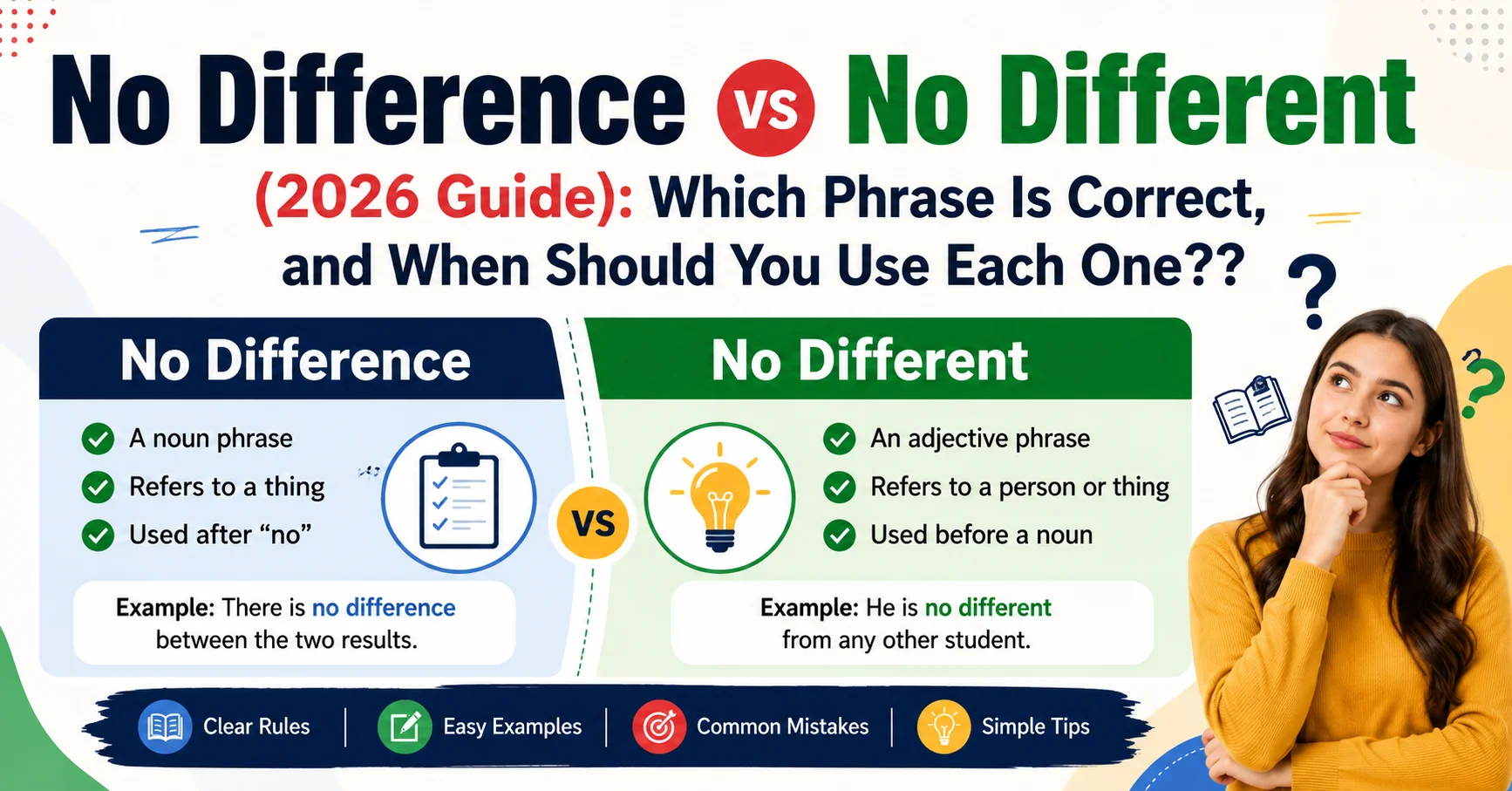
The biggest difference in No Difference vs No Different is grammar structure.
Here is a simple breakdown:
| Phrase | Word Type | Main Function |
|---|---|---|
| No Difference | Noun Phrase | Names lack of distinction |
| No Different | Adjective Phrase | Describes similarity |
This grammar rule changes sentence structure completely.
Examples
| Correct Sentence | Why It Works |
|---|---|
| “There is no difference.” | “Difference” is a noun |
| “The result is no different.” | “Different” describes the result |
| “I noticed no difference.” | Noun object |
| “Her opinion was no different.” | Adjective complement |
A quick trick helps here:
- If you need a thing, use “difference.”
- If you need a description, use “different.”
This simple rule solves most mistakes.
Sentence Patterns You Should Know
Learning common sentence patterns makes English easier. Below are the most natural structures for No Difference vs No Different.
Common Patterns With “No Difference”
| Pattern | Example |
|---|---|
| There is no difference between A and B | “There is no difference between the brands.” |
| Make no difference | “The extra sugar makes no difference.” |
| Notice no difference | “I noticed no difference after the update.” |
Common Patterns With “No Different”
| Pattern | Example |
|---|---|
| A is no different from B | “My experience is no different from yours.” |
| Feel no different | “I feel no different today.” |
| Seem no different | “The copies seem no different.” |
These patterns appear often in spoken and written English. Memorizing them improves fluency quickly.
Real-Life Examples of “No Difference”
Real examples help grammar feel natural. Let’s look at how native speakers use “no difference.”
In Shopping
“I tested both headphones, and there’s no difference in sound.”
In School
“The teacher said there was no difference between the answers.”
In Sports
“Changing coaches made no difference to the team.”
In Technology
“I updated my phone, but I noticed no difference.”
In Health
“The medicine made no difference after two weeks.”
Notice how the phrase usually talks about results, effects, or comparisons.
Real-Life Examples of “No Different”
Now let’s see “no different” in everyday communication.
In Family Conversations
“Teenagers today are no different from teenagers years ago.”
In Workplaces
“Remote work is no different from office work for some jobs.”
In Travel
“The weather here feels no different than home.”
In Relationships
“His attitude was no different after the argument.”
In Education
“Online classes are no different from traditional classes in some ways.”
These examples show how the phrase describes similarity directly.
Common Mistakes English Learners Make
Many learners mix these phrases incorrectly. That happens because the meanings overlap.
Here are the most common mistakes.
| Incorrect | Correct |
|---|---|
| “This phone is no difference.” | “This phone is no different.” |
| “There is no different.” | “There is no difference.” |
| “My car makes no different.” | “My car makes no difference.” |
| “The movie was no difference from the book.” | “The movie was no different from the book.” |
One easy way to avoid errors is to check the verb.
- After “is/are,” use “no different.”
- After “there is” or “make,” use “no difference.”
That small grammar check fixes many problems instantly.
Which Phrase Sounds More Natural?
Both phrases are common, but context changes which one sounds smoother.
“No Difference” Sounds Better When:
- discussing results
- talking about impact
- comparing measurable things
- describing effects
Examples:
- “The new batteries made no difference.”
- “There’s no difference in price.”
“No Different” Sounds Better When:
- comparing experiences
- describing people or situations
- making conversational comparisons
Examples:
- “Life here is no different.”
- “Kids today are no different from before.”
Native speakers naturally choose based on sentence flow.
British vs American English Usage
In both British and American English, these phrases are widely accepted. However, slight style differences appear sometimes.
American English often prefers:
- “no different from”
British English sometimes accepts:
- “no different to”
Examples
| American English | British English |
|---|---|
| “This is no different from mine.” | “This is no different to mine.” |
Still, “from” works everywhere and is usually safer for learners.
If you want international English, choose:
“No different from.”
It sounds natural in almost every setting.
Formal vs Informal Usage
Another important part of No Difference vs No Different is tone.
Formal Writing
Formal writing often uses “no difference” because it sounds precise and objective.
Example:
“Researchers found no difference between the two treatments.”
Informal Conversation
Casual speech often prefers “no different.”
Example:
“Honestly, this place feels no different.”
Understanding tone helps improve communication in school, work, and daily life.
Easy Memory Trick for Learners
Grammar becomes easier with memory tricks.
Here is a simple one:
Use “Difference” for Things
If you can replace the word with “change” or “distinction,” use “difference.”
Example:
- “There is no difference.”
- “There is no change.”
Use “Different” for Descriptions
If the word describes something, use “different.”
Example:
- “The car is no different.”
- “The car is not unusual.”
This trick works in most situations.
How Native Speakers Use These Phrases
Native speakers rarely think about grammar rules directly. They learn patterns through hearing and practice.
For example, you will often hear:
- “Makes no difference.”
- “No different from.”
- “See no difference.”
- “Feels no different.”
These patterns become automatic over time.
One helpful way to learn is by listening to movies, podcasts, or interviews. Pay attention to how people compare things naturally.
I once noticed a sports commentator saying:
“This season is no different from last season.”
That simple sentence sounded smooth because it followed natural English structure.
Exposure helps grammar stick faster than memorization alone.
Similar Expressions You Can Use
English offers many alternatives to No Difference vs No Different.
Here are some useful synonyms.
| Phrase | Meaning |
|---|---|
| The same | Completely alike |
| Identical | Exactly equal |
| Similar | Nearly alike |
| Equal | Matching in value |
| Unchanged | Not altered |
Examples
- “The two bags are identical.”
- “Her opinion stayed unchanged.”
- “The products are similar.”
Using varied vocabulary improves writing quality and SEO strength.
Why This Grammar Point Matters
Some learners think tiny grammar differences do not matter. But correct structure improves clarity and confidence.
Using the wrong phrase can sound awkward in:
- interviews
- essays
- presentations
- emails
- professional communication
Good grammar also helps search engines trust your content online. Clear writing improves readability and reader experience.
When readers understand your meaning quickly, they stay longer on the page. That helps both SEO and communication success.
Small grammar improvements create big results over time.
Practice Sentences for Better Understanding
Try filling in the blanks yourself.
| Sentence | Correct Answer |
|---|---|
| There is no ______ between the results. | difference |
| My experience is no ______ from yours. | different |
| The extra effort made no ______. | difference |
| Her attitude seems no ______ today. | different |
Practice makes grammar feel natural.
You can even create your own examples daily. Compare food, movies, clothes, or weather using these phrases.
That kind of real-life practice builds confidence quickly.
FAQs About No Difference vs No Different
Is “No Difference” grammatically correct?
Yes, it is completely correct. “Difference” is a noun, so it works when naming a lack of distinction.
Example:
“There is no difference between the options.”
Is “No Different” grammatically correct?
Yes. “Different” is an adjective that describes similarity.
Example:
“This method is no different from the old one.”
Which is more common in conversation?
Both are common. However, “no different” often sounds more conversational and personal.
Can I say “No Different Than”?
Yes, especially in American English. Still, “no different from” is considered more formal and widely accepted.
Why do learners confuse these phrases?
The words come from the same root and share similar meanings. But grammar structure changes how each phrase works in a sentence.
Conclusion
Understanding No Difference vs No Different is easier than many learners think. Both phrases are correct, but they follow different grammar rules.
Use “no difference” when talking about the absence of change or distinction. Use “no different” when describing similarity between things.
The easiest way to remember is simple:
- “Difference” names something.
- “Different” describes something.
With practice, these phrases will start feeling natural. Read examples, listen to native speakers, and make your own sentences daily.
